UD-WAR-0002
RAMREE ISLAND, 1945
- Location
- Myanmar
- Date
- 1945
- Case type
- Deep Sea & Underwater
- File status
- Open
TWO-MINUTE SUMMARY
Wartime accounts, crocodile claims and the contested history of Ramree Island.
KEY FACTS
- country
- Burma (now Myanmar), Rakhine State — Ramree Island
- type
- Wartime Mystery / Human–Animal Conflict / Disputed Historical Event
- year
- 19 February 1945 (primary incident night)
WHAT THE RECORD ACTUALLY SAYS
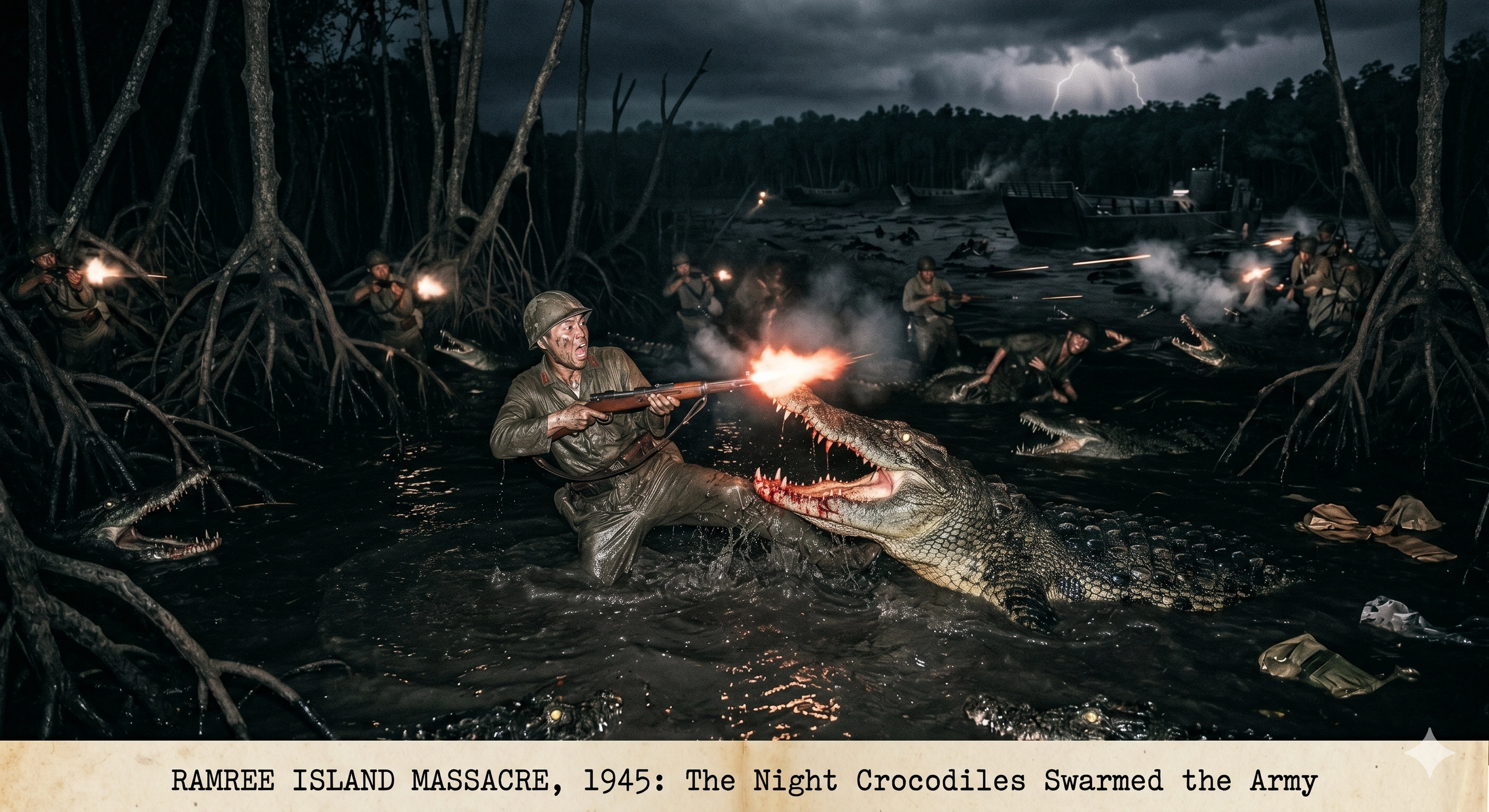
Ramree Island is a flat, muddy landmass of approximately 1,350 square kilometers off the coast of Rakhine State in western Myanmar. During World War II, the island was occupied by Japanese forces and targeted by the British XV Corps in January 1945 as part of Operation Matador, an amphibious assault to secure airfields for the mainland campaign. After weeks of fierce fighting, British and Indian forces outflanked a Japanese stronghold, splitting the garrison and isolating approximately 900–1,000 soldiers. Rather than surrender, the Japanese chose to cross roughly 16 kilometers of dense mangrove swamp to rejoin a larger force on the far side of the island. The mangrove swamps of Ramree were—and remain— natural habitat for saltwater crocodiles, the world’s largest and most aggressive crocodilian species. What happened over the following nights has become one of the most debated incidents in both military history and zoological literature. The canonical account claims that hundreds of Japanese soldiers were killed by crocodiles in the swamp, while only approximately 20 survived to be captured by the British. Modern revisionist research suggests the true number of crocodile fatalities may have been as low as 10–15, with the majority of deaths attributable to combat, drowning, disease, and exposure.
TIMELINE
Early 1942
Japanese forces invade and occupy Ramree Island during the conquest of Burma.
21 January 1945
British XV Corps launches Operation Matador; the 71st Indian Infantry
26 January 1945
Operation Sankey: Royal Marines land on neighboring Cheduba Island,
1 February 1945
British forces reach the town of Sane; Japanese positions are increasingly
8–22 February 1945
Operation Block: Royal Navy destroyers blockade sea exits; RAF strafes
c. 19 February 1945
Approximately 900–1,000 Japanese soldiers enter the mangrove swamp
24 February 1945
Reuters correspondents report Japanese soldiers “being forced by hunger
Late February 1945
Only approximately 20 Japanese soldiers are captured alive by British
1962
Bruce S. Wright publishes his account in “Wildlife Sketches Near and Far,” providing the
1964
Conservationist Roger Caras amplifies Wright’s account in “Dangerous to Man,” calling it
1998
Herpetologist Steven Platt visits Ramree Island and interviews wartime survivors, who
2016
Historian Sam Willis uncovers British military documents suggesting most Japanese
SELECTED EVIDENCE
### Documentary Evidence: Reuters dispatch of 24 February 1945 references crocodile killings. Bruce Wright’s 1962 account provides the canonical narrative. British military operational reports (Operation Block) document the Japanese retreat into the swamp but do not specifically attribute casualties to crocodiles. ### Testimonial Evidence: Wright’s account is secondhand (assembled from motor launch crew reports). No Japanese survivor testimony corroborates mass crocodile predation. Local Burmese villagers (Platt, 1998) rejected the narrative. Japanese War Office (1974) could not confirm. ### Scientific Evidence: Platt (1998) argued the mangrove ecosystem could not support the thousands of crocodiles implied by the massacre narrative. Historian Frank McLynn raised the same ecological objection. Saltwater crocodiles were subsequently eradicated from Ramree Island by the late 20th century. Guinness Record: Listed as “Most Number of Fatalities in a Crocodile Attack” in some editions, though the record’s accuracy has been questioned. Guinness partnered with National Geographic Channel to reinvestigate in 2016.
WHAT REMAINS UNCERTAIN
From a cultural perspective, the Ramree Island massacre sits at the intersection of wartime myth-making and humanity’s primal fear of predation. The image of soldiers—armed, trained, and organized—being helpless before natural predators inverts the usual narrative of human dominance over nature and creates a story of almost mythological power. Psychologically, the narrative taps into thalassophobia (fear of deep water), nyctophobia (fear of darkness), and a deep evolutionary dread of reptilian predators. The story persists not because it is well-documented, but because it is terrifying in a way that resonates at the most fundamental level of human anxiety. Historically, the Ramree incident serves as a case study in how a single unreliable account— elevated by institutional endorsement (Guinness) and successive amplification (Caras)—can become an accepted “fact” that resists correction for decades. The 1998 Platt investigation and the 2016 Willis/National Geographic reinvestigation represent important correctives, but the myth remains far better known than the debunking. Scientifically, the case raises important questions about saltwater crocodile behavior. While individual predation on humans is well-documented (approximately 1,000 fatalities annually worldwide), no verified instance of coordinated mass predation of the scale claimed at Ramree has ever been confirmed.
SELECTED SOURCES
Selected source notes are being prepared. The public record will be expanded as material is reviewed.
Continue research