TWO-MINUTE SUMMARY
The sinking, survivor accounts and shark-attack reports following the USS Indianapolis disaster.
KEY FACTS
- country
- Philippine Sea — approximately 12°02′N, 134°48′E; midway between Guam and Leyte Gulf, Philippines
- type
- Wartime Disaster / Deadliest Shark Attack in History / Naval Communication Failure
- year
- 30 July 1945 (torpedoed at 00:15); rescued 2 August 1945
WHAT THE RECORD ACTUALLY SAYS
The USS Indianapolis occupies a singular place in both military and natural history. It is simultaneously the story of a warship that changed the course of World War II by delivering the components of the first nuclear weapon used in combat, and the story of the worst shark attack ever inflicted on human beings. The Indianapolis was a Portland-class heavy cruiser that served as the flagship of Admiral Raymond Spruance’s Fifth Fleet from 1943 to 1945, participating in major engagements across the Central Pacific including the Battles of the Philippine Sea and Iwo Jima. In March 1945, the ship was severely damaged by a kamikaze strike off Okinawa and sent to California for repairs. It was during this repair period that the Navy selected Indianapolis for one of the most consequential missions of the war: the secret delivery of enriched uranium and other components for the atomic bomb to the island of Tinian. The ship completed the delivery in record time, traveling from San Francisco to Tinian in just ten days. What no one aboard knew was that the cargo they had carried would, eleven days later, level the city of Hiroshima and effectively end the war in the Pacific. But for the crew of the Indianapolis, the war would end in a different way entirely.
TIMELINE
16 July 1945
Indianapolis departs San Francisco carrying secret atomic bomb components under maximum security.
26 July 1945
Arrives at Tinian Island; cargo delivered to scientists assembling “Little Boy.”
28 July 1945
Departs Guam for Leyte Gulf, Philippines, unescorted. Captain McVay requests but is denied a destroyer escort. The Navy fails to warn him of known Japanese submarine activity in the area.
30 July 1945 — 00:15
Two torpedoes from submarine I-58, commanded by Mochitsura Hashimoto, strike the Indianapolis. The first blows off the bow; the second hits amidships near the powder magazine, splitting the ship to the keel. All power is lost instantly.
00:27
Indianapolis sinks. Approximately 300 men go down with the ship. ~890 survivors enter the water, many injured, burned, or covered in fuel oil. Distress signals are sent but not received or acted upon.
31 July 1945
Indianapolis fails to arrive at Leyte Gulf as scheduled. No search is initiated. Three separate shore stations received distress signals but failed to act: one commander was drunk, another had ordered his men not to disturb him, and a third believed it was a Japanese trap.
30 July – 2 August
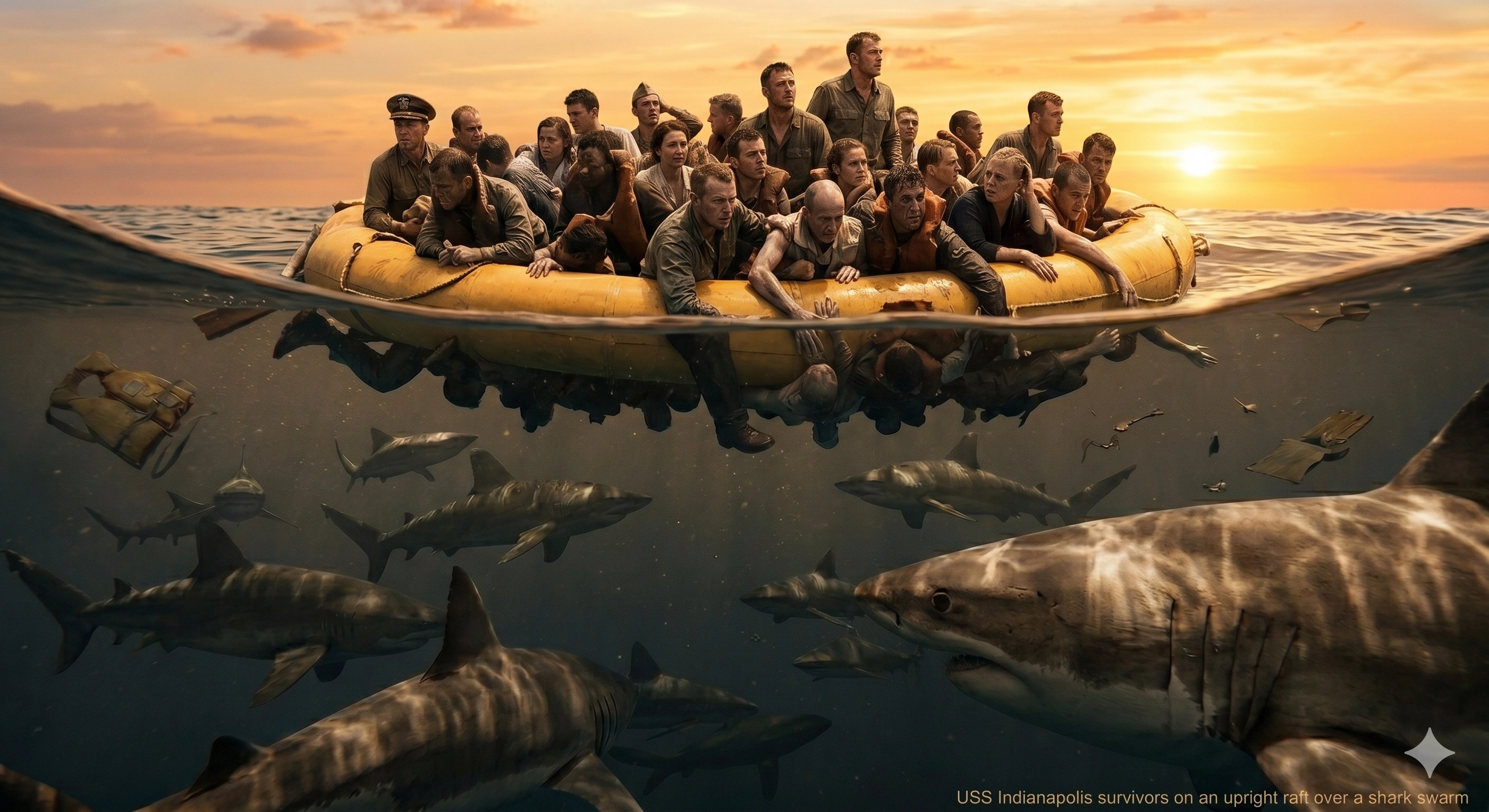
For four days and five nights, survivors float in groups in the open Pacific. They face: dehydration, saltwater poisoning (hypernatremia), hypothermia at night, severe sunburn by day, hallucinations and psychosis, shark attacks (primarily oceanic whitetips), and violence between delusional survivors. The dead are cut loose and pushed away to avoid attracting more sharks.
2 August 1945 — 11:00
Lieutenant Wilbur Gwinn, flying a routine patrol in a PV-1 Ventura, spots a large oil slick. Investigating, he discovers hundreds of men floating in the water. He radios the sighting.
2 August — afternoon
A PBY Catalina flying boat, piloted by Lieutenant Adrian Marks, lands on the open sea despite 12-foot swells to begin pulling survivors from the water. USS Cecil Doyle (DD-368) arrives and begins coordinated rescue.
2–3 August 1945
Seven ships participate in the rescue operation. 316 survivors are recovered. The rest—879 men—are dead.
6 August 1945
The atomic bomb “Little Boy,” assembled using the components delivered by Indianapolis, is dropped on Hiroshima.
November 1945
Captain McVay is court-martialed on charges of “hazarding his ship by failing to zigzag” and “failing to order abandon ship.” He is convicted of the former despite testimony from Commander Hashimoto himself that zigzagging would not have prevented the attack.
1968
Captain McVay dies by suicide at age 70, reportedly found holding a toy sailor given to him by his father as a boy.
2000–2001
U.S. Congress passes a resolution exonerating McVay. The Navy places a memorandum in his file clearing him of all wrongdoing.
August 2017
A research expedition funded by Paul Allen locates the wreckage of Indianapolis at a depth of 5,500 meters (18,000 feet) on the floor of the Philippine Sea.
SELECTED EVIDENCE
**Physical Evidence** Wreckage located at 5,500 meters depth in August 2017 by the Paul Allen expedition using the research vessel R/V Petrel. The wreck confirmed the violence of the torpedo strikes and the rapid nature of the sinking. **Documentary Evidence** Extensive U.S. Navy records, court-martial transcripts, after-action reports, and communication logs. Reuters and Associated Press dispatches from August 1945. Declassified intelligence showing the Navy knew of Japanese submarine activity in Indianapolis’s path. **Testimonial Evidence** Hundreds of survivor accounts collected over 80 years. Key testimonies include Harlan Twible, Loel Dean Cox, Edgar Harrell, Harold Bray, and many others. Commander Hashimoto’s own testimony at McVay’s court-martial. **Scientific Evidence** Discovery Channel’s 2007 documentary “Ocean of Fear” employed shark attack researcher George Burgess to analyze the predation patterns. Oceanic whitetip sharks confirmed as the primary species involved, consistent with their known behavior of investigating shipwrecks and floating debris in open ocean. **Cultural Evidence** The 1975 film Jaws featured a famous monologue by the character Quint (Robert Shaw) describing the Indianapolis sinking, which brought the incident to global public awareness for the first time.
WHAT REMAINS UNCERTAIN
The USS Indianapolis disaster operates on multiple levels of significance simultaneously. As a military event, it represents the single greatest loss of life at sea from a single ship in U.S. Navy history, and one of the most catastrophic communication failures in modern warfare. As a natural history event, it is the deadliest documented shark attack on humans, providing critical data on oceanic whitetip predation behavior under extreme conditions. Culturally, the Indianapolis has become the defining symbol of shark terror in the Western imagination, largely through the Jaws monologue—a four-minute scene written by Robert Shaw himself that is widely regarded as one of the greatest monologues in cinema history. The irony is that the monologue’s power derives from the very real horror of the event, yet it also distorted public understanding by centering the sharks as the primary threat, when in truth the Navy’s negligence was the greater killer. Psychologically, the Indianapolis survivors suffered not one trauma but a cascade of compounding traumas: the torpedo strike, the sinking, the abandonment, the thirst, the hallucinations, the shark attacks, the deaths of companions, and then the institutional betrayal of McVay’s court-martial. Many survivors did not speak of the event for decades. The Navy explicitly instructed them to go home and forget. The exoneration of Captain McVay in 2000–2001, driven largely by the efforts of his surviving crew members and a twelve-year-old student named Hunter Scott who had begun researching the case as a school project, stands as one of the more remarkable acts of institutional correction in American military history. Ethically, the case poses a question that remains relevant: when institutions make catastrophic errors, who bears the blame—the individuals who happened to be in command, or the systems that failed around them?
SELECTED SOURCES
Selected source notes are being prepared. The public record will be expanded as material is reviewed.
Continue research