TWO-MINUTE SUMMARY
Bronze Age iconography, the Shu kingdom and an archaeological culture rediscovered.
WHAT THE RECORD ACTUALLY SAYS
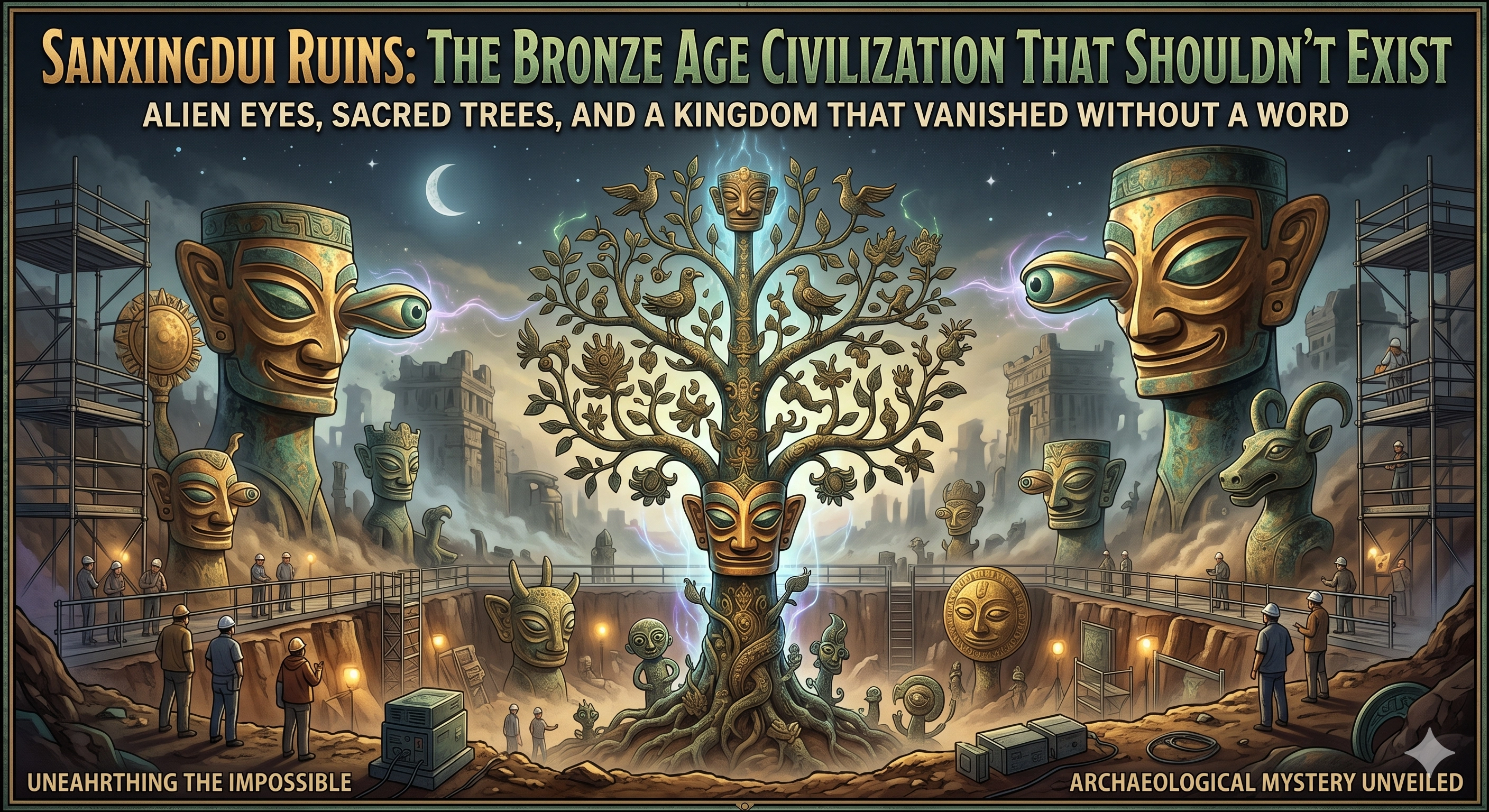
<p>Sanxingdui is arguably the most important archaeological discovery of the late 20th century—and certainly the most mysterious. The bronzes look like nothing else in the known archaeological record. They are not Chinese in the conventional sense—they bear no resemblance to the ritual vessels of the contemporary Shang Dynasty. They are not Mesopotamian, not Egyptian, not Mesoamerican. They are their own thing: a visual language of supernatural faces, sacred trees, and hybrid creatures that appears fully formed, without identifiable artistic predecessors, in a walled city in the mountains of Sichuan.</p> <p>The British Museum's Task Rosen called the Sanxingdui bronzes "more outstanding than the Terracotta Army." The Bowers Museum called them "the ninth wonder of the world." And the objects themselves—those enormous masks with their cylindrical protruding eyes, staring outward with an expression that is simultaneously human and profoundly alien—continue to generate debate about whether they depict gods, ancestors, priests in ritual costume, or something else entirely.</p> <p>Sanxingdui is not a lost civilization in the sense that it vanished without a trace. Traces are exactly what it left—thousands of them, exquisite and bewildering. What it did not leave is an explanation.</p>
TIMELINE
c. 1600 BC
A walled city is established on the banks of the Yazi River. Walls are 40 m at the base, up to 10 m high. The city covers ~3.6 km².
c. 1300–1100 BC
The city reaches its peak. Bronze-casting workshops produce the extraordinary masks, figures, trees, and ritual objects.
c. 1200–1100 BC
The sacrificial pits are created. Hundreds of precious objects are deliberately smashed, burned, and buried.
c. 1000 BC
The city is abandoned. No evidence of military destruction. Population may have moved to Jinsha (~40 km away).
1927/1929
Local farmer Yan Daocheng discovers jade and stone artifacts while digging a drainage ditch.
1934
American archaeologist David Crockett Graham conducts the first formal excavation.
1986
Two sacrificial pits (Pits 1 & 2) accidentally uncovered. ~1,000 artifacts including bronze masks, standing figure, gold masks. Discovery shocks the archaeological world.
2001
Jinsha site discovered 40 km away near Chengdu: related artifacts suggesting cultural continuity.
2020–2022
Six additional pits (Pits 3–8) excavated. Over 13,000 artifacts recovered including 280g gold mask, silk traces, painted bronzes.
September 2025
2025 Sanxingdui Forum reveals painted-bronze findings, extending China's painted-bronze timeline by ~1,000 years.
SELECTED EVIDENCE
<p><strong>Physical:</strong> 13,000+ artifacts from 8 sacrificial pits (1986 and 2020–2022). Bronze masks, figures, trees; gold masks and foil; jade tablets and scepters; ivory tusks; cowrie shells; silk traces; painted bronzes. Walled city (~3.6 km²).</p> <p><strong>Archaeological:</strong> Radiocarbon dating: 12th–11th centuries BC. City walls comparable to Shang-era Zhengzhou. Jinsha site shows cultural continuity.</p> <p><strong>Textual:</strong> Chronicles of Huayang (4th century AD): describes Kingdom of Shu, king Cancong with "protruding eyes."</p> <p><strong>Scientific (2025):</strong> Painted bronze analysis: black and red pigments. Bronze casting: copper-tin-lead alloys. Silk residue identification.</p> <p><strong>Absence of Evidence:</strong> No written language identified. No human remains found. Reason for abandonment not definitively established.</p>
WHAT REMAINS UNCERTAIN
<p>Sanxingdui's significance operates on two levels. On the first, it is a spectacular archaeological discovery: a Bronze Age city that produced distinctive artifacts and was eventually abandoned. On the second, it is a challenge to fundamental assumptions about how civilizations develop.</p> <p>The artifacts have no identifiable artistic predecessors. The protruding-eye motif appears fully formed. There is no "primitive" Sanxingdui art. This absence of precursors generates the "out-of-place artifact" label and more exotic theories.</p> <p>The most likely explanation is that the developmental phases exist but have not yet been found. The site is enormous (12 km²) and only partially excavated.</p> <p>The deliberate destruction of the artifacts is the case's deepest puzzle. No other Bronze Age culture is known to have systematically destroyed such a vast quantity of its own sacred objects. Whatever the masks, the tree, and the standing figure meant, that meaning was terminated—deliberately, thoroughly, and with fire. Sanxingdui asks a question that archaeology struggles to answer: what does it mean when a civilization destroys its own gods?</p>
SELECTED SOURCES
Selected source notes are being prepared. The public record will be expanded as material is reviewed.
Continue research