UD-ANCIENT-0005
GREAT PYRAMID INTERNAL VOIDS
- Location
- Egypt
- Case type
- Ancient Mysteries
- File status
- Open
TWO-MINUTE SUMMARY
Muon imaging, internal voids and questions about the Great Pyramid’s unexplored spaces.
WHAT THE RECORD ACTUALLY SAYS
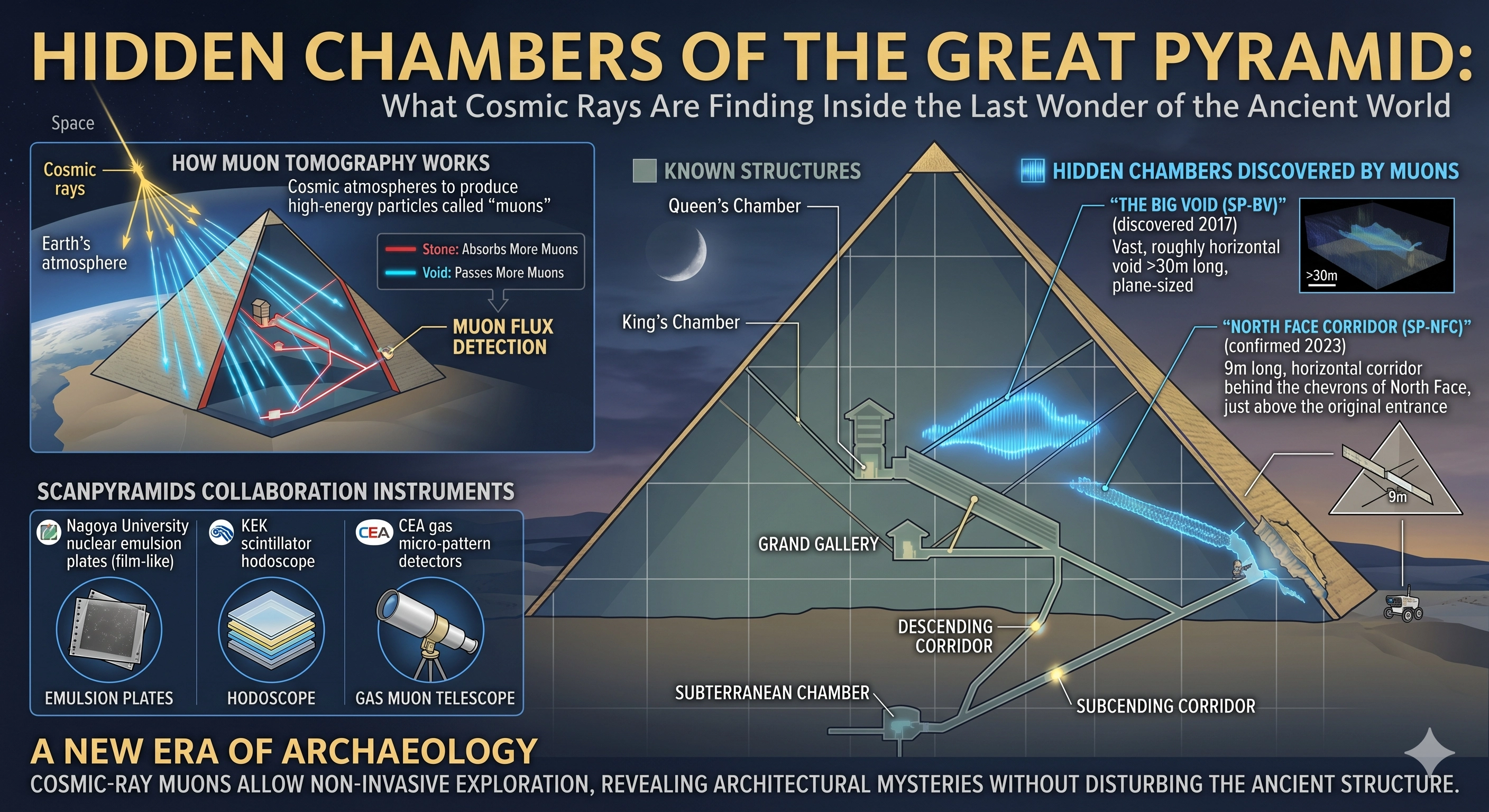
<p>The Great Pyramid of Giza is simultaneously the most studied and the least understood large structure on Earth. Its exterior has been measured, mapped, and photographed from every conceivable angle. Its known interior spaces have been explored for centuries. And yet, as the discoveries of 2017 and 2023 demonstrate, the pyramid still contains major architectural features that were unknown to the modern world until subatomic particles from outer space revealed them.</p> <p>Muon tomography—originally conceived by Nobel laureate Luis Alvarez in the 1960s—exploits the fact that muons, produced when cosmic rays strike Earth's atmosphere, penetrate solid matter but are partially absorbed by dense material. By counting the muons that pass through the pyramid from various angles, researchers can create density maps that reveal voids.</p> <p>The technique works. The Big Void is real—confirmed by three independent detector systems. The North Face Corridor is real—confirmed by endoscopy in 2023. The question now is what else the pyramid contains.</p>
TIMELINE
c. 2560 BCE
Great Pyramid completed for Pharaoh Khufu. Contains three known chambers, Grand Gallery, passages, five relieving chambers, two pairs of air shafts.
c. 820 CE
Caliph al-Ma'mun forces entry into the pyramid (Robbers' Tunnel), bypassing granite plug blocks.
1837
Howard Vyse discovers the five relieving chambers above the King's Chamber.
1968–1970
Luis Walter Alvarez uses muon tomography to scan the Pyramid of Khafre. No new chambers found. Pioneering application.
1993
Robot Upuaut-2 explores Queen's Chamber air shaft, discovering a blocking stone with copper fittings.
October 2015
ScanPyramids project launched by Cairo University and HIP Institute.
November 2017
ScanPyramids announces the 'Big Void' in Nature: ≥30 m long above Grand Gallery, confirmed by three independent muon detector systems.
March 2023
ScanPyramids confirms the North Face Corridor: 9 m passage behind original entrance. Verified by endoscopy.
2025
ERT independently confirms North Face Corridor. ScIDEP project begins building muon telescopes for Pyramid of Khafre. SAR claims of subterranean complex (unverified).
Planned
EGP mission: muon telescope system with 100× sensitivity for true tomographic 3D imaging.
SELECTED EVIDENCE
<p><strong>Physical (Known):</strong> Three chambers, Grand Gallery, passages, five relieving chambers, Well Shaft, Grotto, two pairs of air shafts, granite sarcophagus, quarry marks including Khufu's name.</p> <p><strong>Muon Tomography (Confirmed):</strong> Big Void: ≥30 m long, above Grand Gallery, confirmed by three independent detector systems (Nature, 2017). North Face Corridor: ~9 m, confirmed by muography and endoscopy (2023), independently verified by ERT (2025).</p> <p><strong>Theoretical:</strong> Houdin's Noble Circuit hypothesis predicts connecting passage system. Multiple hypotheses on air shaft function.</p> <p><strong>Unverified Claims:</strong> SAR Doppler tomography (2025): claims extensive subterranean complex beneath Giza Plateau. Not verified by Egyptian authorities or independent researchers.</p>
WHAT REMAINS UNCERTAIN
<p>The Great Pyramid hidden-chambers case is distinguished by the quality and rigor of its evidence. The Big Void was detected by three independent teams using three different technologies—a level of confirmation that meets the standards of particle physics.</p> <p>The debate between Hawass and ScanPyramids is about interpretation, not data. Both sides agree on the muon measurements. The EGP mission should resolve this definitively.</p> <p>What is not in dispute is that the Great Pyramid contains more than what has been mapped. The 2017 and 2023 discoveries prove this. The answer—whether a single void, a network of passages, or the architectural skeleton of the most ambitious building project in history—will add another chapter to a 4,500-year story.</p>
SELECTED SOURCES
Selected source notes are being prepared. The public record will be expanded as material is reviewed.
Continue research