No Image
View Case File
CORROBORATED
Last updated: 19 Apr 2026
On 30 July 1945, the heavy cruiser USS Indianapolis (CA-35) was torpedoed by the Japanese submarine I-58 in the Philippine Sea, sinking in just 12 minutes. Of the 1,195 crew members aboard, approximately 300 went down with the ship. The remaining 890 men were cast into the open Pacific with minimal supplies—no distress signal was received, and no one came looking for them. Over the next four days and five nights, the survivors endured exposure, dehydration, saltwater poisoning, hallucinations, and what is now considered the deadliest mass shark attack in recorded history. By the time rescue arrived on 2 August, only 316 men remained alive. The disaster was compounded by a series of catastrophic communication failures within the U.S. Navy, and the subsequent court-martial of Captain Charles B. McVay III became one of the most controversial military proceedings of the 20th century.
Indianapolis departs San Francisco carrying secret atomic bomb components under maximum security.
Arrives at Tinian Island; cargo delivered to scientists assembling “Little Boy.”
Departs Guam for Leyte Gulf, Philippines, unescorted. Captain McVay requests but is denied a destroyer escort. The Navy fails to warn him of known Japanese submarine activity in the area.
Two torpedoes from submarine I-58, commanded by Mochitsura Hashimoto, strike the Indianapolis. The first blows off the bow; the second hits amidships near the powder magazine, splitting the ship to the keel. All power is lost instantly.
Indianapolis sinks. Approximately 300 men go down with the ship. ~890 survivors enter the water, many injured, burned, or covered in fuel oil. Distress signals are sent but not received or acted upon.
Indianapolis fails to arrive at Leyte Gulf as scheduled. No search is initiated. Three separate shore stations received distress signals but failed to act: one commander was drunk, another had ordered his men not to disturb him, and a third believed it was a Japanese trap.
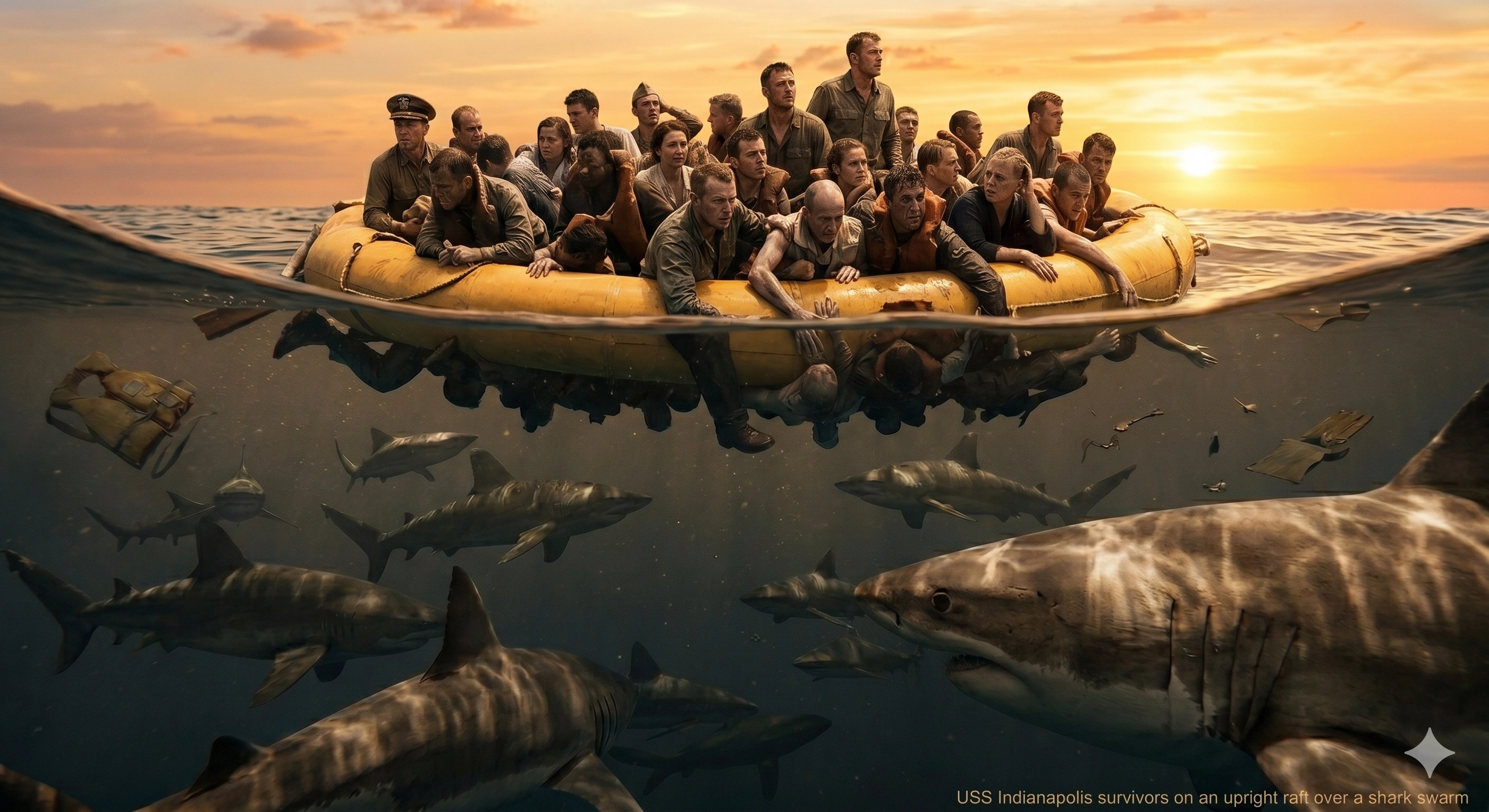
For four days and five nights, survivors float in groups in the open Pacific. They face: dehydration, saltwater poisoning (hypernatremia), hypothermia at night, severe sunburn by day, hallucinations and psychosis, shark attacks (primarily oceanic whitetips), and violence between delusional survivors. The dead are cut loose and pushed away to avoid attracting more sharks.
Lieutenant Wilbur Gwinn, flying a routine patrol in a PV-1 Ventura, spots a large oil slick. Investigating, he discovers hundreds of men floating in the water. He radios the sighting.
A PBY Catalina flying boat, piloted by Lieutenant Adrian Marks, lands on the open sea despite 12-foot swells to begin pulling survivors from the water. USS Cecil Doyle (DD-368) arrives and begins coordinated rescue.
Seven ships participate in the rescue operation. 316 survivors are recovered. The rest—879 men—are dead.
The atomic bomb “Little Boy,” assembled using the components delivered by Indianapolis, is dropped on Hiroshima.
Captain McVay is court-martialed on charges of “hazarding his ship by failing to zigzag” and “failing to order abandon ship.” He is convicted of the former despite testimony from Commander Hashimoto himself that zigzagging would not have prevented the attack.
Captain McVay dies by suicide at age 70, reportedly found holding a toy sailor given to him by his father as a boy.
U.S. Congress passes a resolution exonerating McVay. The Navy places a memorandum in his file clearing him of all wrongdoing.
A research expedition funded by Paul Allen locates the wreckage of Indianapolis at a depth of 5,500 meters (18,000 feet) on the floor of the Philippine Sea.