0%|~2 min read
GUSTAVE: The Man-Eating Nile Crocodile of Burundi (1987) — CORROBORATED credibility River & Lake Mysteries case file
CLASS CORROBORATED
1 of 3

GUSTAVE: The Man-Eating Nile Crocodile of Burundi

Category|River & Lake Mysteries
Year|1987
Credibility Grade|CLASS CORROBORATED

Last updated: 19 Apr 2026


Quick Summary

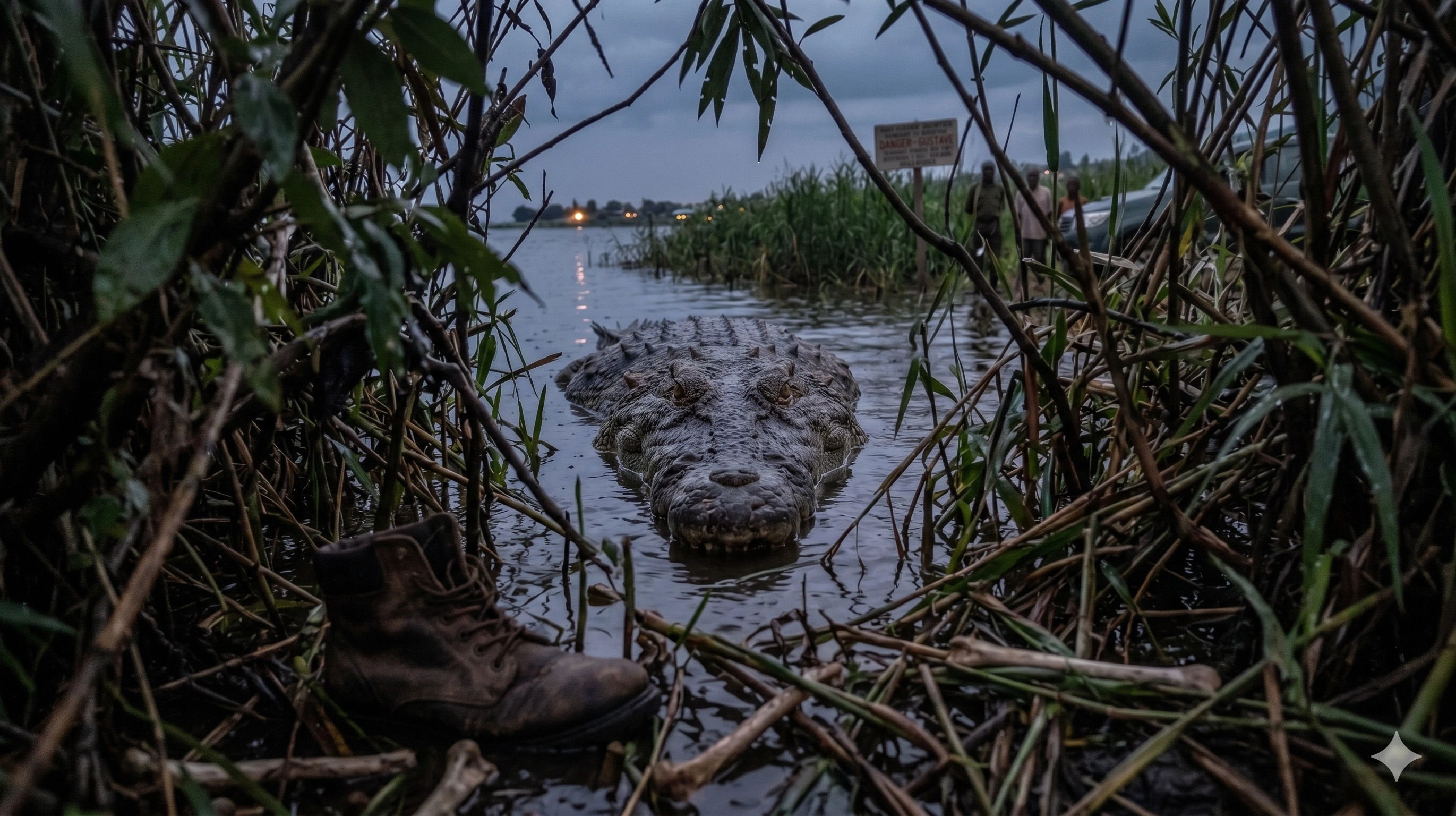
Gustave is a massive male Nile crocodile (Crocodylus niloticus) inhabiting the Ruzizi River delta and the northern shores of Lake Tanganyika in Burundi, East Africa. He is reputed to be one of the largest Nile crocodiles ever observed—estimated at 5.5 to 6+ meters in length and approximately 900 kilograms—and has been attributed with killing between 60 and 300 humans over a period spanning at least three decades, from the late 1980s to the 2010s. His exact kill count is impossible to verify, partly because his territory overlaps with a region devastated by the Burundian Civil War (1993–2005), during which corpses routinely entered waterways and may have been wrongly attributed to crocodile predation. Despite multiple capture attempts—including a heavily documented 2004 expedition—Gustave has never been caught, measured, weighed, or killed. His current status is unknown. He was last reliably sighted in 2015. Unverified claims of his death surfaced in 2019, but no evidence has been produced.


Key Facts

CountryBurundi, East Africa — Ruzizi River delta and northern Lake Tanganyika
Year1987
TypeHuman–Animal Conflict / Serial Predation

Overview

In the hierarchy of man-eating predators, Gustave occupies a category almost entirely his own. He is not a historical figure, like the Tsavo man-eaters of 1898 or the Champawat tigress. He is not a species-level threat, like the oceanic whitetip sharks of the USS Indianapolis disaster. Gustave is something rarer and more unsettling: a single, identifiable, living individual animal that has been killing humans for decades—and that no one has been able to stop. The Nile crocodile is the second-largest living reptile after the saltwater crocodile, with adult males averaging 4 to 4.5 meters and 400–500 kilograms. Gustave dwarfs these averages. He is estimated at nearly six meters in length and close to a metric ton in weight—a size so far beyond the norm that researchers initially believed he must be over 100 years old. However, examination of photographs revealed a complete set of teeth, suggesting an age more likely in the range of 60–70 years. His anomalous size may be the result of exceptional genetics, an unusually rich food supply, or both. Gustave’s territory stretches along the Ruzizi River—which forms the border between Burundi, Rwanda, and the Democratic Republic of the Congo—and into the northern reaches of Lake Tanganyika, the second-deepest lake in the world. This is a region of extraordinary natural beauty and extraordinary human suffering. The Burundian Civil War killed an estimated 300,000 people between 1993 and 2005, and the Ruzizi served as both a dumping ground for bodies and a corridor of displacement for refugees. It is within this context—a landscape where human death was routine and where the waterways themselves became instruments of war—that Gustave became legend. Scientists who have studied Gustave believe that his immense size actually impedes his ability to hunt the agile prey that smaller Nile crocodiles rely on, such as fish, antelope, and zebra. Instead, he is forced to target larger, slower animals: hippopotamuses, water buffalo, and humans. The result is a predator whose size has, paradoxically, made him more dangerous to people rather than less.
Listen to Case File
~13 min

Timeline

c. 1955

Estimated hatching year, based on size-to-age calculations adjusted for his full dentition.

1987

First documented attacks attributed to an unusually large crocodile in the villages of Magara, Kanyosha, and Minago along the northeastern shores of Lake Tanganyika. National Geographic later confirmed records dating to this year.

1993–2005

Burundian Civil War. Estimated 300,000 dead. Corpses routinely enter the Ruzizi River and Lake Tanganyika. Many disappearances near water may be wrongly attributed to Gustave. Conversely, the chaos may mask genuine crocodile predation.

Late 1990s

French expatriate and self-taught herpetologist Patrice Faye, living in Burundi, hears from fishermen that a colleague was eaten by an enormous crocodile. He begins investigating and discovers a pattern of attacks along the lake dating back a decade.

c. 2001

Faye formally names the crocodile “Gustave” and begins publicizing his existence to international media.

2002

Faye tells the BBC that Gustave is “three times as big as the other crocodiles in Burundi” and cannot hunt normal prey due to his size. Media reports begin citing a kill count of 200–300 humans.

2002–2004

Faye conducts two years of field research, tracking Gustave’s movements and documenting attack patterns. He secures funding for a capture expedition.

2004

PBS documentary “Capturing the Killer Croc” is filmed. A 907 kg, 9-meter trap cage with infrared cameras is deployed. Multiple baits fail. Giant snares catch only smaller crocodiles. A live goat is placed in the cage in the final week; the camera fails during a thunderstorm, and the next morning the goat is gone and the cage is partially submerged. Gustave is not captured. The team is forced to leave as civil conflict intensifies.

2007

The Hollywood film “Primeval” is released, loosely based on the Gustave story.

2009

Gustave is spotted again in the Ruzizi River near Lake Tanganyika after several years of absence.

2010

Gustave is voted the 3rd most famous personality in Burundi in a national poll.

2011

Faye reveals to author Richard Grant that he has documentation for approximately 60 deaths attributed to Gustave—far fewer than the 300 commonly cited in media.

2015

Last confirmed sighting: a local resident reports seeing Gustave dragging an adult buffalo carcass into the river.

2019

A writer for Travel Africa Magazine reports being told that Gustave was killed. No details of how, when, where, or by whom are provided. No photographs or physical evidence surface. The claim remains unverified.

2026

Gustave’s status is officially unknown. If alive, he would be approximately 70–71 years old—well within the lifespan of a large Nile crocodile, which can exceed 100 years.

Witness Accounts

Patrice Faye’s first encounter with Gustave’s legend came in 1998, when a group of fishermen he regularly worked with told him that a colleague had been taken by an enormous crocodile. The fishermen described the animal as immediately recognizable—far larger than any other crocodile in the area, with visible scars on its body. They said it appeared periodically, killed, and then vanished for months or years before returning. Local villagers along Lake Tanganyika described a pattern: attacks would cluster in certain villages during specific seasons—particularly during Gustave’s apparent mating-season migrations along the Ruzizi River. Faye reported that Gustave would travel from his base near a small river island to the areas of Rumonge and Minago, killing fishermen and bathers along the way. Faye claimed he could eat 10, 15, or 20 people along the bank during a single migration. Perhaps the most disturbing element of the witness accounts is the consistent claim that Gustave often left his victims’ bodies uneaten or only partially consumed. This led to local belief that Gustave killed not for food but for pleasure—a perception that transformed him from a dangerous animal into something closer to a malevolent entity in local mythology. Scientists have since explained that this behavior is consistent with normal crocodile feeding patterns: Nile crocodiles have very low metabolic requirements and rarely consume an entire prey item. Multiple witnesses have described Gustave’s behavior as unusually bold. Unlike most Nile crocodiles, which avoid humans after failed encounters, Gustave has been reported to return to the same locations repeatedly and to approach boats and shorelines with apparent indifference to human presence. This behavioral pattern is consistent with a predator that has learned, through decades of experience, that humans are reliably available and relatively easy prey.

▶ CINEMATIC SECTIONNarrative Reconstruction

I. The River, Before the Name The Ruzizi River is born in the mountains of the Albertine Rift, pouring south from Lake Kivu through a valley of volcanic soil and equatorial green. It runs 117 kilometers before it empties into the northern end of Lake Tanganyika—the second deepest lake on Earth, a body of water so vast and so old that it holds its own evolutionary history, species found nowhere else, life forms that have been diverging in isolation for millions of years. Where the river meets the lake, it spreads into a delta of papyrus marshes, sandbars, and mangrove-like thickets. The water is warm and turbid. Hippos surface and submerge. Fish eagles wheel overhead. And in the shallows, partially submerged, motionless as driftwood, lie the Nile crocodiles. There have always been crocodiles here. The Nile crocodile, Crocodylus niloticus, has inhabited the waterways of Africa for millions of years—a lineage that predates humanity by an almost incomprehensible margin. They are not mindless predators. They are patient, intelligent, and supremely adapted. A Nile crocodile can hold its breath for over an hour. It can remain motionless for days. It can explode from the water with enough force to drag a 700-kilogram buffalo beneath the surface in a single motion. In the villages that line the shores of Lake Tanganyika—Magara, Kanyosha, Minago, Gatumba, Rumonge—the people have always known to be careful near the water. Fishermen know the signs: the twin bumps of nostrils and eyes that break the surface, the V-shaped wake that appears from nowhere. Children are taught to stay away from the banks at dusk and dawn. But sometime in the mid-20th century—the best estimates say around 1955—an egg hatched in the delta that would produce something different. Not a different species. Not a mutant. Just a crocodile at the extreme outer edge of what nature allows—an animal that, through some combination of genetics and circumstance, would grow far beyond the limits of its kind. For its first decades, this animal was invisible. A young Nile crocodile is indistinguishable from any other. It eats insects, then fish, then small mammals. It avoids the larger males that dominate the best basking spots and feeding territories. It grows. Slowly, year by year, it grows. By the time it was old enough to be noticed, it was already too large to be mistaken for anything ordinary. II. The Killing Begins The first reports came in 1987. Fishermen in the villages along the northeastern shore of Lake Tanganyika began telling stories of a crocodile unlike any they had seen. It was enormous—vastly larger than the other crocodiles in the lake. It had scars on its body, marks that suggested it had survived encounters that would have killed lesser animals. And it was killing people. The attacks followed a pattern that would become grimly familiar over the next three decades. A fisherman wading into the shallows to set a net. A woman washing clothes at the river’s edge. A child playing too close to the water. In each case, the attack was sudden and overwhelming—an explosion of water, a flash of jaws wide enough to engulf a human torso, and then the victim was gone. Pulled beneath the surface. The death roll—the crocodile’s method of drowning and dismembering its prey—would happen out of sight, in water dark enough to hide everything. What made these attacks different from ordinary crocodile predation was their frequency and their geography. The same enormous crocodile was being sighted in multiple villages, sometimes separated by considerable distances. It appeared, killed, and then vanished—only to reappear weeks or months later in another location along the lake or the river. And there was something else. The bodies, when they were found, were often largely intact. The crocodile had killed them—the bite marks, the drowning, the unmistakable signs of the death roll—but had not consumed them. This was not a starving animal taking what it could get. This was something else. The villages had no name for it yet. They simply called it the giant, or the devil, or the one that comes back. III. The War and the Water In 1993, Burundi descended into civil war. The conflict between the Hutu and Tutsi ethnic groups would last twelve years and kill an estimated 300,000 people in a country of barely six million. The Ruzizi River, which forms the western border of Burundi, became a corridor of death—bodies dumped into the current, refugees drowning in attempted crossings, massacres conducted on the riverbanks. During this period, the distinction between deaths caused by war and deaths caused by a crocodile became almost impossible to maintain. Bodies found in the water could have been victims of ethnic violence, drowning, or predation. The chaos was total. In this environment, the legend of the giant crocodile grew—not because there were more witnesses, but because there were more dead, and because attributing deaths to a monster was, in some terrible way, easier to comprehend than attributing them to one’s neighbors. Skeptics have argued that the Burundian Civil War is responsible for a significant inflation of Gustave’s kill count. If war dead entered the river and were subsequently scavenged by crocodiles, the physical evidence would be indistinguishable from active predation. This is a valid critique. It is also true, however, that the witnesses who reported seeing the enormous crocodile attack living people—not scavenge corpses—were numerous, consistent, and came from multiple villages over a period that both predated and postdated the war. The war may have inflated Gustave’s body count. But the war did not create Gustave. IV. Patrice Faye and the Naming Patrice Faye was a Frenchman who had lived in Burundi for decades, working as a self-taught naturalist, collecting specimens for a museum in the capital, Bujumbura, and hiring local fishermen to assist with fieldwork. In 1998, a group of fishermen he worked with regularly told him a story that would change the trajectory of his life. A colleague had been eaten by an enormous crocodile. The fishermen knew the animal—it was impossible to miss. It came around periodically, disappeared for months or years, and then returned to kill again. Faye was intrigued. He began investigating and discovered something extraordinary: the pattern of attacks was not random. It dated back at least to 1987 and traced a clear geographic path along the lake and up the river.

Evidence

Physical Evidence: Three bullet wound scars, deep right shoulder wound, head scarring—all observed and photographed but never examined at close range. No captured specimen. No DNA sample. No measured dimensions. Documentary Evidence: PBS documentary “Capturing the Killer Croc” (2004); National Geographic Adventure article (2005); BBC interviews with Faye (2002); Richard Grant’s book “Crazy River” (2013) documenting Faye’s revised estimate of ~60 verified kills. Testimonial Evidence: Extensive village testimony spanning 1987–2015 from multiple communities. Faye’s firsthand observations over 20+ years. Reports from the Congolese army capture attempt. Photographic/Video Evidence: Footage from the 2004 documentary confirming Gustave’s existence and extraordinary size. Infrared camera footage (limited by equipment failures). No high-resolution measurement photography. Absence of Evidence: No captured specimen. No post-mortem examination. No DNA. No confirmed death. No verified photograph after 2015.

Share This Archive

Community Verdict

Community Verdict