I. The Boys and the Tree (1795)
The summer of 1795. Nova Scotia is a young British colony, barely four decades past the expulsion of the Acadians. The coast is a jagged maze of bays, inlets, and islands—hundreds of them, most uninhabited, many unnamed. The waters of Mahone Bay are calm and dark, and the islands that dot its surface are low and wooded, thick with red oak and spruce and birch.
Oak Island is one of these—140 acres of forest and scrub, separated from the mainland by a narrow channel of cold Atlantic water. It is not entirely uninhabited; a few families farm its cleared lots. But much of the island is wild, particularly the eastern end, where the trees grow thick and the ground is soft with centuries of fallen leaves.
Daniel McGinnis is sixteen years old. He is exploring the eastern end of the island—or hunting, or wandering, or doing whatever sixteen-year-old boys do on summer days in a world without electricity or entertainment—when he notices something odd. A large oak tree stands in a small clearing, and one of its branches has been sawed or broken at a point directly over a circular depression in the ground. The depression is perhaps twelve feet across, clearly visible as a sunken area in the forest floor. And on the severed branch, marks suggest that something—a block and tackle, a pulley system—had once been attached.
McGinnis knows what this means. Or thinks he does. Every boy on the coast of Nova Scotia in 1795 knows the stories of Captain William Kidd, the privateer-turned-pirate who was hanged in London in 1701 and who, legend insists, buried enormous treasure somewhere along the Atlantic coast before his capture. The depression looks like a filled-in hole. The branch looks like the arm of a makeshift crane. The conclusion is irresistible: someone buried something here and went to considerable trouble to do it.
McGinnis returns with two friends: John Smith, and Anthony Vaughan. They bring shovels. They begin to dig.
At two feet, they hit a layer of flagstones—flat, heavy stones that are not native to Oak Island and have clearly been placed deliberately. Below the flagstones, the earth is softer than the surrounding ground, consistent with soil that has been dug up and backfilled. They keep digging.
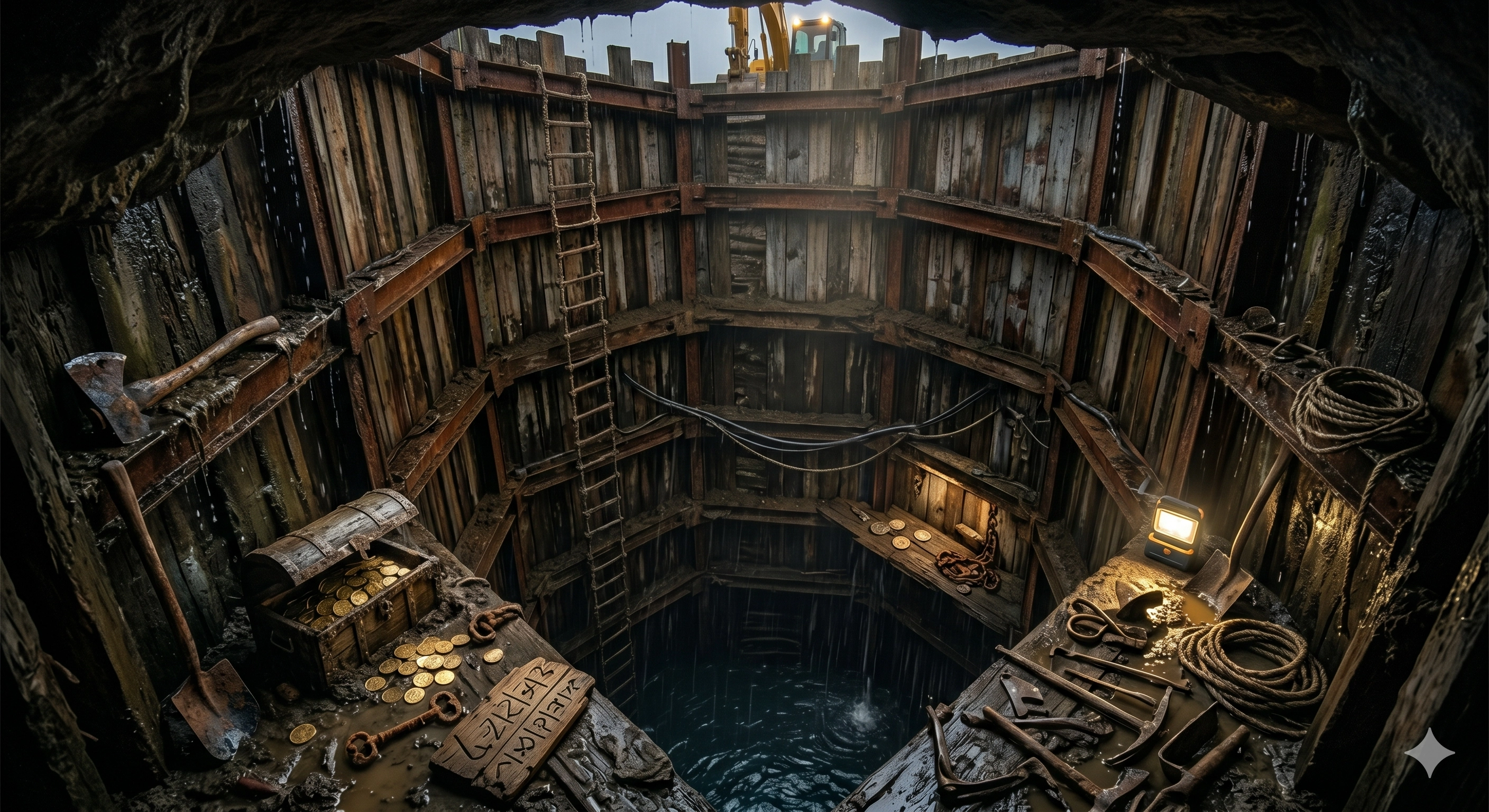
At ten feet, they strike a platform of oak logs, fitted horizontally into the walls of the shaft, spanning the entire diameter. The logs are old but solid. They lever them out and continue.
At twenty feet, another platform. Same construction. Same oak.
At thirty feet, another.
By now the boys are exhausted. They are three teenagers with hand tools, digging a shaft ten to twelve feet in diameter, thirty feet deep. They have removed tons of earth and three engineered platforms. Whatever lies below is clearly buried with a purpose and a precision that exceeds anything they can handle alone. They stop digging. They mark the spot. And they wait.
They will wait eight years for help to arrive. But the discovery is made. The pit is open. And the island will never be the same.
II. The First Expeditions and the Flooding (1803–1861)
In 1803, a group of businessmen from the town of Onslow, Nova Scotia, organize the first formal excavation company. They arrive on Oak Island with laborers, equipment, and the expectation that whatever was buried at thirty feet would be reached within days.
They are wrong.
The Onslow Company digs through platform after platform—every ten feet, another layer of oak logs, each sealed with putty, charcoal, or coconut fiber. The coconut fiber is particularly puzzling. Coconuts do not grow within thousands of miles of Nova Scotia. Whoever built the pit imported this material from the tropics, suggesting an origin connected to maritime trade routes spanning the Caribbean or beyond.
At approximately ninety feet, the diggers make two extraordinary discoveries. The first is a large flat stone, roughly two to three feet long, embedded in the wall of the shaft. It is made of a dark, dense material unlike any rock on the island, and its surface is covered with strange carved symbols that resemble no known alphabet. One later translation claims the inscription reads: “Forty feet below, two million pounds are buried.” The stone is removed and will eventually disappear from the historical record, its current whereabouts—if it survives at all—unknown.
The second discovery is water. At ninety-three feet, the earth becomes saturated. Water seeps in from the sides. At ninety-eight feet, a crowbar driven into the bottom strikes something hard and flat—bounded by the walls of the pit, spanning its full diameter. Some say it is wood. Others call it a chest.
The men stop for the night, convinced that they are within feet of the treasure. They discuss shares. They make plans.
By morning, the pit is flooded. Water has risen to within thirty-three feet of the surface—a column of seawater sixty feet deep, filling the shaft with a force that no hand pump of the era can overcome. Every attempt to bail the water fails. It refills as fast as they can pump.
The Onslow Company tries to circumvent the problem by digging a second shaft nearby and tunneling laterally to approach the treasure from below the water level. At 110 feet, water breaks through the tunnel wall and floods this shaft as well. The company is ruined. The men go home.
III. Death on the Island (1861–1965)
The pattern repeats itself through the 19th and early 20th centuries. Company after company forms, raises capital, excavates, floods, and fails. The Oak Island Association in 1861. The Oak Island Treasure Company in 1893. The Old Gold Salvage group in 1909, which counts among its young investors a Harvard undergraduate named Franklin Delano Roosevelt—a man who will become the 32nd President of the United States and who will maintain a fascination with Oak Island for the rest of his life.
Gilbert Hedden arrives in 1936, convinced that a map attributed to Captain Kidd corresponds to the layout of Oak Island. He excavates extensively but finds nothing definitive. In 1939, the actor Errol Flynn expresses interest in joining the search. John Wayne is said to have visited. The island draws dreamers and schemers alike.
And then it begins to kill them.
In the early hours of August 17, 1965, Robert Restall—a former motorcycle daredevil who had moved his entire family to Oak Island to pursue the treasure full-time—is working in a shallow shaft near Smith’s Cove. Without warning, he collapses. His eighteen-year-old son, Robert Jr., sees his father fall and descends into the shaft to help. He too collapses instantly. Karl Graeser, a fellow treasure hunter, follows. He falls. Cyril Hiltz, a sixteen-year-old helper, is next. He falls. All four die. The cause is toxic gas—hydrogen sulfide or carbon monoxide, generated by decomposing organic material in the waterlogged tunnels. The gas is invisible and odorless in its early stages, and lethal in seconds at high concentrations. The men had no warning.
A fifth man, Edward White, attempts to descend and is pulled back at the last moment by others on the surface. He survives. The island has claimed four lives in a matter of minutes.
With these deaths, the total reaches six. The curse says seven must die before the treasure is found. No one who works on Oak Island forgets this number.
IV. The Lagina Brothers and the Modern Era (2005–Present)
In 1965, an eleven-year-old boy in Kingsford, Michigan, reads a Reader’s Digest article about the Oak Island mystery. His name is Rick Lagina, and the article will shape the course of his life. He tells his younger brother, Marty, about the island. The seed is planted.
Forty years later, in 2005, the Lagina brothers—Rick, now a retired postal worker, and Marty, a successful energy entrepreneur—acquire a controlling interest in Oak Island Tours Inc. They have the resources, the technology, and the patience that previous explorers lacked. They also have something new: a television deal.
In 2014, History Channel premieres “The Curse of Oak Island,” a reality series documenting the Laginas’ search. The show becomes one of the network’s highest-rated programs and introduces the Oak Island mystery to a global audience of millions. By 2025, the show is in its thirteenth season.
The Laginas’ approach combines traditional excavation with modern technology: ground-penetrating radar, seismic surveys, LIDAR, core drilling, underwater cameras, heavy excavation equipment, and carbon dating. Their discoveries have been tantalizing if not conclusive: a lead cross with design elements potentially linked to the Knights Templar; a gemstone-set brooch of apparent antiquity; fragments of pottery dating to the 14th century; wood samples carbon-dated to as early as the 1400s; refined gold particles in soil samples from the Money Pit area; bone fragments of uncertain origin; and various metal and wood artifacts consistent with pre-18th-century construction.
None of these discoveries constitute “the treasure.” But they do suggest that human activity on Oak Island predates the 1795 discovery by centuries—raising the question of who was there, what they were doing, and what, if anything, they left behind.
The search continues. The pit has not surrendered its secret. The water keeps coming. And the seventh man has not yet died.
V. The Island at Night
There is a quality to Oak Island that photographs and television cannot capture. It is the quality of a place where the ground itself is suspect—where every step is taken over soil that has been dug, refilled, collapsed, flooded, drained, and dug again, over and over, for more than two centuries. The island is a palimpsest of excavation. The original shaft’s location is lost. The landscape is dotted with the scars of a hundred boreholes, tunnels, and abandoned shafts.
At night, the island is silent except for the wind in the oaks and the sound of the Atlantic against the rocks at Smith’s Cove. The water table rises and falls with the tides, and if you listen carefully—or if you imagine carefully enough—you can hear the faint sound of water moving underground, following channels that may have been dug by human hands or may have been carved by geology over millennia.
The pit is down there, somewhere. Filled with water. Filled with 230 years of shattered hope and broken machinery and the bones of six dead men. And possibly—just possibly—filled with something that someone, at some point in history, considered valuable enough to bury 200 feet underground and protect with a hydraulic trap powered by the Atlantic Ocean.
Or possibly filled with nothing at all.
That is the genius and the cruelty of Oak Island. It offers just enough evidence to sustain belief, and never enough to confirm it. It is a mystery that feeds on itself—each failed expedition providing the very frustration that motivates the next. The treasure is always just one dig away. Always forty feet below. Always just out of reach.