No Image
View Case File
PLAUSIBLE
THE CATACOMBS OF PARIS: The Empire of Death Beneath the City of Light
1786|Historical Ossuary
Last updated: 18 Apr 2026
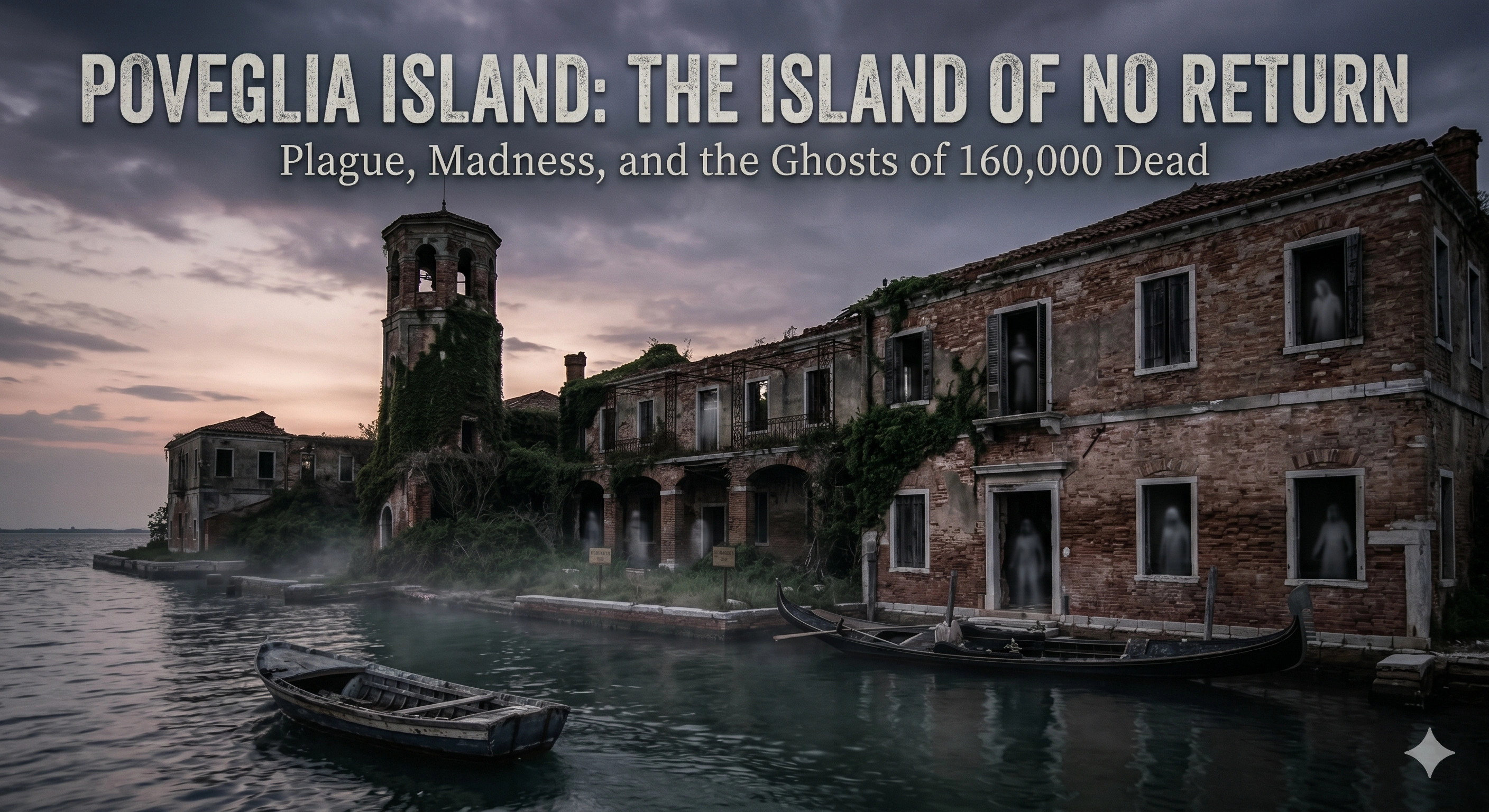
In the Venetian Lagoon, between Venice and the Lido, lies a small island that the fishermen of the lagoon will not approach. Poveglia—three small islands connected by a bridge and a strip of man-made land—has served, in its sixteen centuries of recorded history, as a community, a fortress, a quarantine station, a plague dumping ground, a Napoleonic weapons depot, and a psychiatric asylum. An estimated 100,000 to 160,000 people died there, most of them plague victims whose bodies were burned in mass pyres or dumped into pits so vast that the island’s soil is said to be 50 percent human ash. The island’s most famous legend concerns a doctor at the psychiatric asylum who, according to local tradition, tortured and lobotomized patients with crude instruments before going mad—driven insane, they say, by the ghosts of the plague dead who whispered to him from the walls—and leaping from the 12th-century bell tower to his death. The bell was removed from the tower decades ago. Locals and visitors report hearing it toll anyway. The geriatric hospital (the asylum’s final incarnation) closed in 1968. Since then, Poveglia has been abandoned, officially off-limits, and increasingly overgrown. Construction crews sent to restore the buildings have reportedly fled. The Italian government attempted to auction a 99-year lease in 2014; the winning bidder’s project was rejected. In August 2025, a citizens’ association called “Poveglia per Tutti” received a 6-year concession for the northern part of the island to create a public park. For the first time in over half a century, part of the island of the dead may return to the living. But the buildings still stand. The bell tower still rises. And the soil beneath them still contains the remains of a hundred thousand people who were sent to this island because the city across the water did not want them anymore.
Poveglia first appears in historical records.
Island populated by settlers fleeing barbarian invasions on the mainland. Community grows, governs itself under a dedicated Podestà, trades with neighboring Pellestrina but avoids the mainland (and its taxes).
War of Chioggia between Genoa and Venice. Poveglia’s population is evacuated to Giudecca. The island is abandoned. It will remain largely uninhabited for four centuries.
The Black Death devastates Venice. Poveglia is used as a quarantine/dumping ground for plague victims. Bodies are burned in mass pyres or buried in plague pits. Tens of thousands die.
A second major plague outbreak strikes Venice. Poveglia again receives the dead and dying. The island’s reputation as a place of death solidifies.
Multiple additional plague outbreaks use the island as an isolation site.
Poveglia comes under the jurisdiction of Venice’s Public Health Office. Used initially for customs control, then as a quarantine station for incoming ships and cargo.
Formal operation as lazaretto (quarantine station).
Napoleon orders demolition of the church of San Vitale. The 12th-century bell tower is retained and converted to a lighthouse. Napoleonic troops store munitions on the island.
The island is converted into a psychiatric asylum. Almost immediately, patients reportedly begin seeing and hearing the ghosts of plague victims. According to legend, a doctor performs cruel experiments on patients.
The asylum continues to operate. Legend holds that the doctor, driven mad by the spirits, leaps from the bell tower. Some versions say he survived the fall but died in a “mysterious fog”; others say he was strangled by the bell rope. No documentary evidence confirms the identity or death of such a doctor.
The geriatric hospital (asylum’s final form) closes. The island is abandoned. It has not been permanently inhabited since.
Decay accelerates. Buildings crumble. Forest grows through structures. The island becomes legendary among paranormal enthusiasts. Fishermen avoid the area.
Ghost Adventures (Zak Bagans) films on Poveglia. The episode becomes one of the show’s most famous, bringing the island to international attention.
Italian government auctions 99-year lease. Luigi Brugnaro bids €513,000. Project rejected. Citizens’ association “Poveglia per Tutti” raises €460,000 from 4,500+ donors for alternative community plan.
Poveglia per Tutti receives a 6-year concession for the northern part of the island to develop a public lagoon park. First sanctioned civilian presence in over 50 years.