UD-PARANORMAL-0013
POVEGLIA ISLAND
- Location
- Italy
- Date
- 421
- Case type
- Paranormal & Hauntings
- File status
- Open
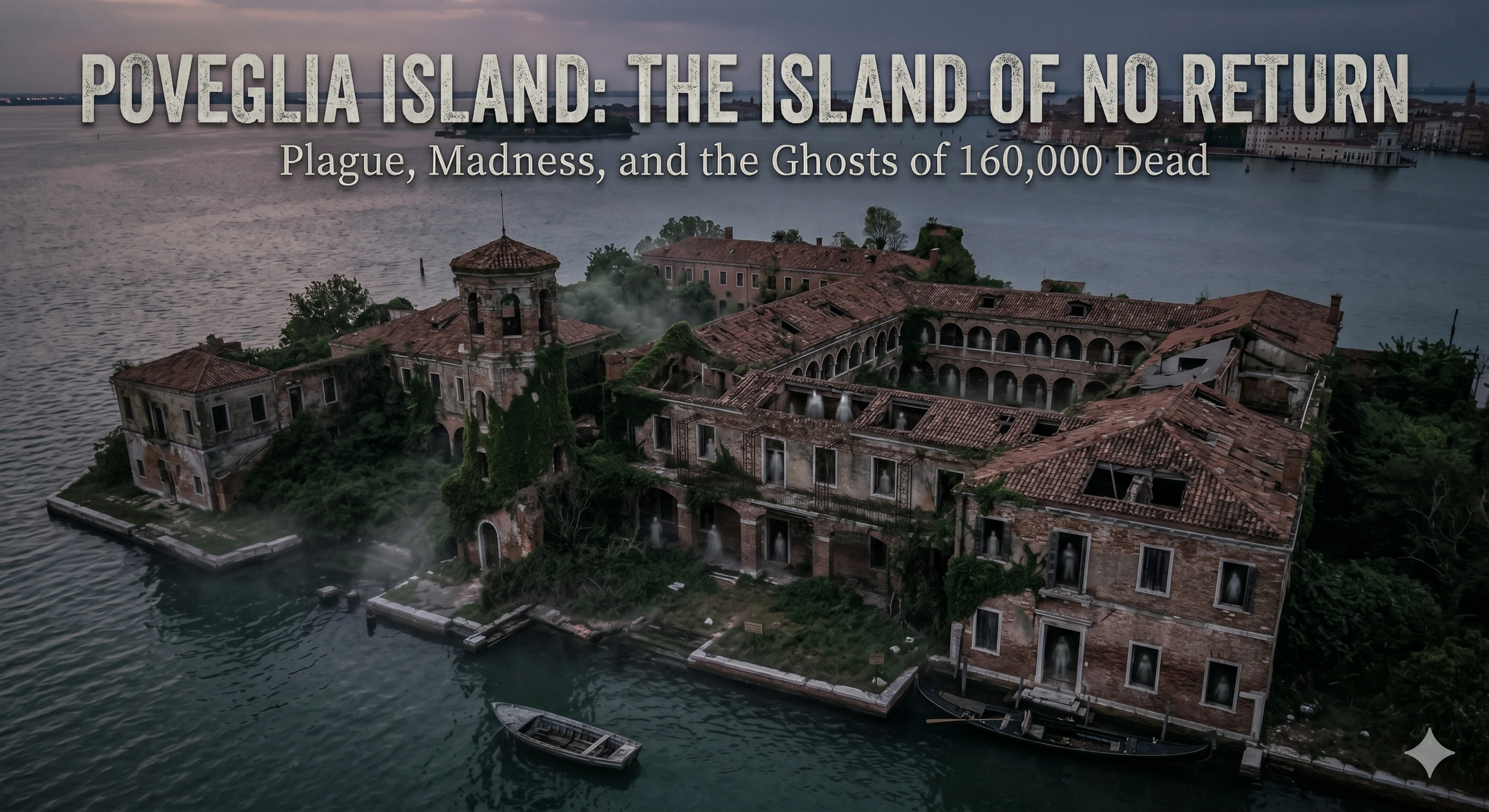
TWO-MINUTE SUMMARY
Plague history, institutional records and folklore surrounding a Venetian lagoon island.
KEY FACTS
- country
- Italy
- type
- Paranormal / Plague History / Abandoned Asylum / Island of the Dead
- year
- 421 AD
WHAT THE RECORD ACTUALLY SAYS
Poveglia is not merely a haunted island. It is an island made of death—literally, if the local claim about soil composition is even partly true. The concentration of human suffering and mortality on this tiny patch of the Venetian Lagoon is extraordinary by any measure: over a hundred thousand plague victims in an area barely large enough for a neighborhood, their bodies burned into the earth over centuries of epidemic. Add to this the documented use as a psychiatric facility—with all the suffering that early 20th-century mental health “care” entailed—and the island becomes a palimpsest of pain, layer upon layer, century upon century. What distinguishes Poveglia from other paranormal sites is the totality of its abandonment. Unlike the Paris Catacombs (which are actively managed) or the Tower of London (which is a functioning tourist attraction), Poveglia has been left almost entirely alone since 1968. Nature has reclaimed the buildings. The forest has grown through the floors of the asylum. The bell tower stands above the tree line like a sentinel guarding something that no one wants to claim. The paranormal reports are consistent with the site’s history but lack independent verification. No controlled scientific investigation has been conducted. The island’s restricted status means that most reports come from unauthorized visitors—urban explorers and paranormal enthusiasts—whose objectivity and methodology vary wildly. And yet. The fishermen avoid the island. The construction crews left. The Italian government cannot give it away. Whatever Poveglia is—a genuinely haunted place or a very effective stage for the human fear of death—it has been resisting human habitation for over six hundred years, and it shows no signs of stopping.
TIMELINE
421 AD
Poveglia first appears in historical records.
5th–9th century
Island populated by settlers fleeing barbarian invasions on the mainland. Community grows, governs itself under a dedicated Podestà, trades with neighboring Pellestrina but avoids the mainland (and its taxes).
1379
War of Chioggia between Genoa and Venice. Poveglia’s population is evacuated to Giudecca. The island is abandoned. It will remain largely uninhabited for four centuries.
14th century (1348 onward)
The Black Death devastates Venice. Poveglia is used as a quarantine/dumping ground for plague victims. Bodies are burned in mass pyres or buried in plague pits. Tens of thousands die.
1630
A second major plague outbreak strikes Venice. Poveglia again receives the dead and dying. The island’s reputation as a place of death solidifies.
1700s
Multiple additional plague outbreaks use the island as an isolation site.
1776
Poveglia comes under the jurisdiction of Venice’s Public Health Office. Used initially for customs control, then as a quarantine station for incoming ships and cargo.
1793–1814
Formal operation as lazaretto (quarantine station).
1806
Napoleon orders demolition of the church of San Vitale. The 12th-century bell tower is retained and converted to a lighthouse. Napoleonic troops store munitions on the island.
1922
The island is converted into a psychiatric asylum. Almost immediately, patients reportedly begin seeing and hearing the ghosts of plague victims. According to legend, a doctor performs cruel experiments on patients.
c. 1930s–1940s
The asylum continues to operate. Legend holds that the doctor, driven mad by the spirits, leaps from the bell tower. Some versions say he survived the fall but died in a “mysterious fog”; others say he was strangled by the bell rope. No documentary evidence confirms the identity or death of such a doctor.
1968
The geriatric hospital (asylum’s final form) closes. The island is abandoned. It has not been permanently inhabited since.
Post-1968
Decay accelerates. Buildings crumble. Forest grows through structures. The island becomes legendary among paranormal enthusiasts. Fishermen avoid the area.
2009
Ghost Adventures (Zak Bagans) films on Poveglia. The episode becomes one of the show’s most famous, bringing the island to international attention.
2014
Italian government auctions 99-year lease. Luigi Brugnaro bids €513,000. Project rejected. Citizens’ association “Poveglia per Tutti” raises €460,000 from 4,500+ donors for alternative community plan.
August 2025
Poveglia per Tutti receives a 6-year concession for the northern part of the island to develop a public lagoon park. First sanctioned civilian presence in over 50 years.
SELECTED EVIDENCE
Historical: Island’s use as plague lazaretto across 14th–18th centuries is documented in Venetian state archives. Asylum/hospital operation 1922–1968 is confirmed. Bell tower dates to 12th century. Napoleonic-era demolition of church is recorded. Physical: Surviving structures: church ruins, hospital/asylum buildings, bell tower, staff housing, cavana, octagonal fort. Plague pits confirmed to exist on the island. Soil composition claims (50% human ash) not scientifically verified. Paranormal Reports: Bell tolling from empty tower (multiple independent witnesses across decades); shadowy figures; disembodied screams and voices; cold spots; physical contact (touching/scratching); wheelchair sounds in asylum; plague-mask apparitions. No controlled scientific investigation conducted. Media Documentation: Ghost Adventures Season 3 (2009): EVP readings, electromagnetic anomalies, claimed physical interactions. Multiple YouTube documentaries. Numerous urban explorer accounts. Absence of Evidence: No documentary confirmation of the “mad doctor” legend. No patient records publicly available. No scientific soil analysis confirming human ash content. No controlled acoustic study of bell tower phenomenon.
WHAT REMAINS UNCERTAIN
Poveglia’s case rests on three pillars: documented historical suffering of extraordinary scale (the plague dead), unverified but persistent legend (the mad doctor), and consistent paranormal reports from unauthorized visitors (the bell, the voices, the touches). The first pillar is solid. The second is shaky. The third is abundant but scientifically uncontrolled. The island’s most compelling feature is not any individual paranormal report but the pattern of institutional failure to reclaim it. Venice transforms every available property into economic use. It has done so for a thousand years. Poveglia is the exception—the one island in the lagoon that has resisted every attempt at redevelopment for over half a century. Whether this resistance has a supernatural explanation, a bureaucratic one, or simply reflects the economic reality of renovating severely decayed structures on an island with no infrastructure, the pattern is real and notable. The 2025 concession to Poveglia per Tutti represents the first test of whether the island will accept reintegration into the living world. If the park project proceeds successfully, it will be the strongest evidence yet that Poveglia’s resistance to habitation is practical rather than supernatural. If it fails—as every previous attempt has failed—the island’s reputation will be reinforced by yet another data point in a pattern that now stretches back more than fifty years. The soil of Poveglia contains the remains of the dead. That is not legend; it is geology. Whether it also contains their presence is the question the island has been asking for six hundred years—and that no one has yet been brave enough, or foolish enough, to answer definitively.
SELECTED SOURCES
Selected source notes are being prepared. The public record will be expanded as material is reviewed.
Continue research