TUI CASE RECORD
GROOTE SCHUUR HOSPITAL
- Location
- South Africa
- Date
- 1938
- Case type
- Paranormal & Hauntings
- File status
- Open
TWO-MINUTE SUMMARY
Medical history, staff folklore and reported experiences at a landmark Cape Town hospital.
WHAT THE RECORD ACTUALLY SAYS
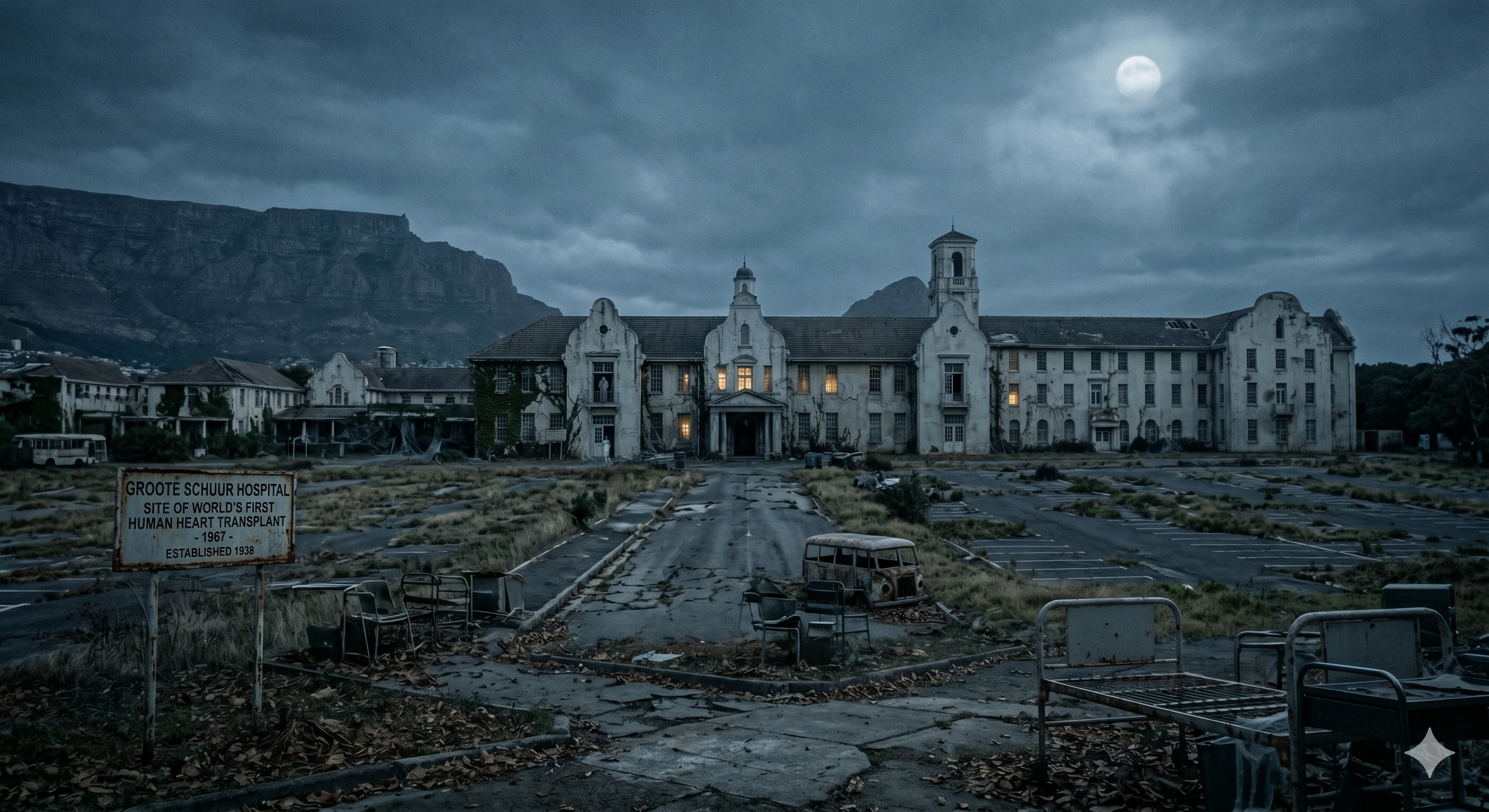
Groote Schuur Hospital — Dutch for 'Great Barn' — is a 975-bed public teaching hospital on the slopes of Devil's Peak in Observatory, Cape Town, South Africa. Founded in 1938, it gained global fame when surgeon Christiaan Barnard performed the world's first successful human-to-human heart transplant on 3 December 1967. But the hospital's corridors carry more than surgical triumph. Staff and patients report persistent paranormal phenomena: Sister Fatima, a benevolent deceased nurse who appears on night shifts to help with patient care before vanishing through walls; a young nurse who committed suicide; a male patient who fell to his death escaping; and the 'White-Eyed Sister' with haunting pale eyes. The hospital operates on two planes — a world-class medical institution and a place where some who lived, worked, and died within its walls appear never to have left.
TIMELINE
1600s
The land is a Dutch settler farm called Groote Schuur (Great Barn), part of the Cape Colony agricultural landscape on the slopes of Devil Peak.
1927
Construction of new hospital commences. Site leveled using convict labor, causing public outcry in the Cape Colony press.
1931-1932
Foundations dug. Architect F.D. Strong designs neo-classical structure with Corinthian columns, Grecian urns, large windows. Foundation stones laid by the Governor General.
31 January 1938
Groote Schuur Hospital officially opened by Sir Patrick Duncan. 850 beds equipped, only 450 staffed. The Cape Argus: so delightfully arranged that it was almost an incentive to be ill.
1940s
Hospital fully functional after WWII outbreak brings increased demand. All 850 beds operational.
1958
Dr. Christiaan Barnard returns from 3 years training at University of Minnesota with heart-lung machine donated by American government. First successful open heart surgery series begins.
1962
Barnard appointed Head of new Department of Thoracic Surgery. Cardiac program grows rapidly.
3 December 1967
Worlds first human-to-human heart transplant. 1:00 AM, Charles Saint Theatre, team of 30 led by Prof. Barnard (45). Heart of Denise Darvall (25, car accident) transplanted into Louis Washkansky (53, terminal heart disease). Nine-hour operation succeeds. Washkansky survives 18 days.
1974
First heterotopic (piggy-back) heart transplant at Groote Schuur - another world first.
1983
Prof. Barnard retires from surgery.
1984
Major expansion - two new wings added. Original 1938 building preserved for academic departments.
4 October 1996
Original 1938 building designated Western Cape Provincial Heritage Site.
2005
Hospital surpasses 500 heart transplants.
3 December 2007
Heart of Cape Town Museum opens in original operating theatres on 40th anniversary.
Mid-20th century - present
Paranormal reports accumulate from nurses, doctors, patients across decades. Named apparitions: Sister Fatima (benevolent helping ghost), suicide nurse, fallen patient, White-Eyed Sister. Phenomena: footsteps, unmanned lifts, temperature drops, being watched. No formal investigation.
Present day
Hospital fully operational: 975 beds, 3,400+ staff, 50,000 inpatients and 350,000 outpatients annually. New paranormal reports continue from night-shift staff.
SELECTED EVIDENCE
Historical: Hospital founded 1938, confirmed. First heart transplant 3 December 1967, confirmed. Provincial Heritage Site 1996, confirmed. 975 beds, 3,400+ staff, confirmed. Paranormal Reports: Multiple independent accounts from nurses, doctors, patients, and visitors spanning decades. Published in Cape Town Tourism, Bona Magazine, Secret Cape Town, Swift Momentum, Time Out Cape Town, and paranormal communities. Absence of Evidence: No formal paranormal investigation. No scientific measurements. No photographic or audio evidence publicly available. No official hospital acknowledgment. Skeptical Explanations: Old building acoustics amplify sounds. Night-shift fatigue and suggestion. Emotional priming in a death-saturated environment. Institutional folklore reinforced by repetition.
WHAT REMAINS UNCERTAIN
The Groote Schuur ghost case is distinguished by its institutional context. This is not an abandoned building explored by thrill-seekers but a functioning hospital where trained medical professionals — people whose careers depend on empirical observation and rational analysis — report experiences they cannot explain. The consistency of the reports across decades, the specificity of the named apparitions, and the fact that the accounts come from a professional population that has no incentive to fabricate supernatural claims give the case a weight that purely anecdotal haunting reports typically lack. The Sister Fatima narrative is particularly compelling because it inverts the typical ghost story. Most haunting accounts describe spirits that frighten, disturb, or obstruct. Sister Fatima helps. She does her job. This detail is both the most interesting feature of the case and the most difficult to explain within conventional frameworks — whether paranormal or psychological. A helpful ghost is harder to dismiss as simple fear-based hallucination than a frightening one, because the emotional logic of hallucination typically produces threatening figures, not benevolent ones. The absence of formal investigation is the cases greatest limitation. No controlled measurements, no thermal imaging, no audio recording, no systematic documentation of reports has been conducted. The evidence is entirely testimonial. In a hospital environment — where the emotional weight of daily exposure to suffering and death is enormous, where night shifts alter perception, and where institutional folklore creates powerful suggestion — testimonial evidence is insufficient to establish the reality of paranormal phenomena. What can be established is that the belief is real, persistent, and culturally significant. Groote Schuur ghosts are part of Cape Towns cultural landscape, connecting the hospital to a broader tradition of South African ghost folklore spanning the Castle of Good Hope, the Green Point Lighthouse, the Tokai Manor, and dozens of other historic sites. Whether the ghosts are real or not, their stories are — and those stories tell us something about how a community processes the reality of death in a place dedicated to preventing it.
SELECTED SOURCES
Selected source notes are being prepared. The public record will be expanded as material is reviewed.
Continue research