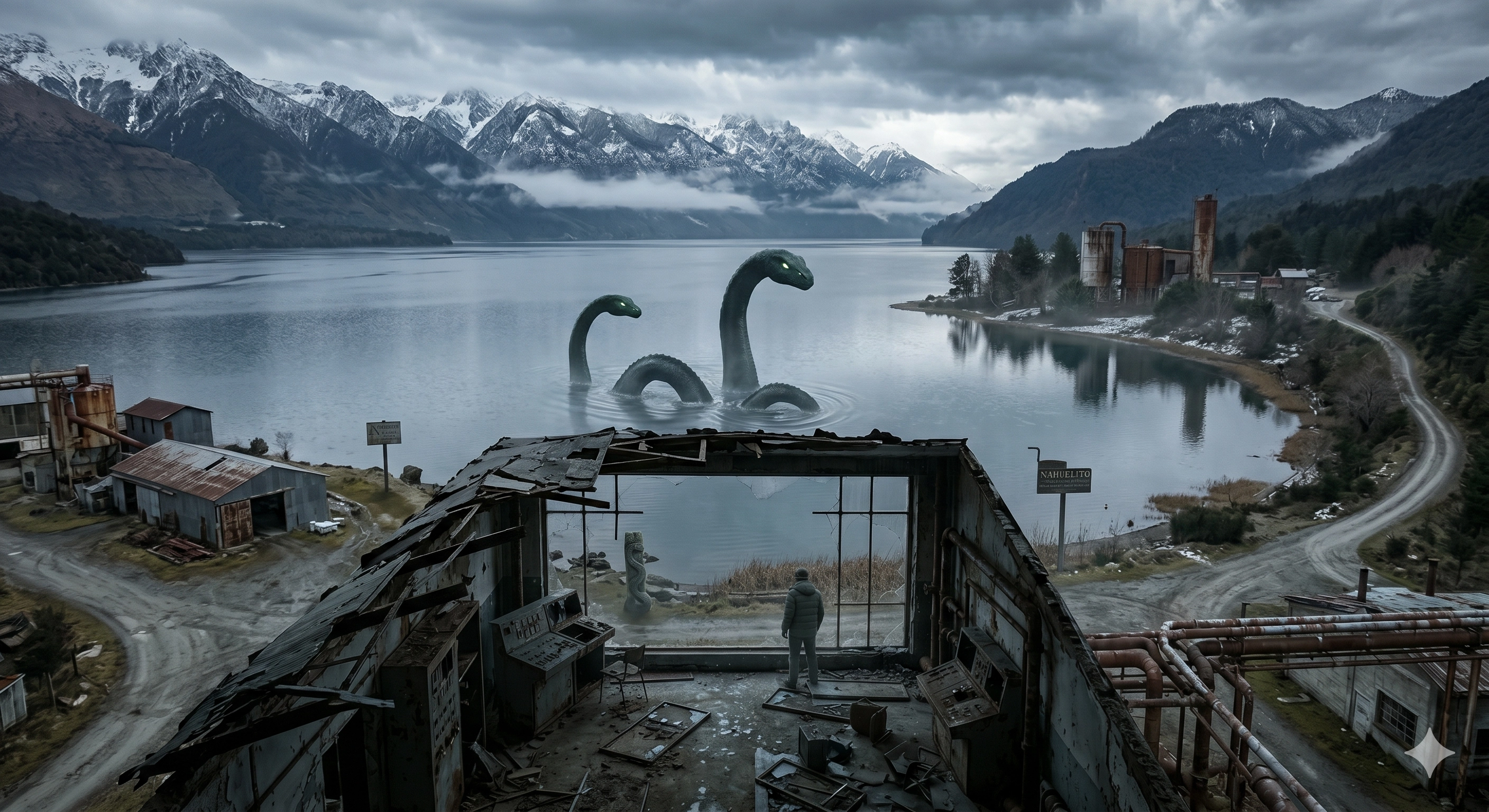
TWO-MINUTE SUMMARY
Patagonian lake-monster reports, local folklore and the history of the Nahuelito legend.
KEY FACTS
- country
- Floating logs; accumulated decomposing organic matter; gas bubbles; sheep herds swimming across shallow sections (appearing as single large creature from distance); waves and wind effects; confirmed hoaxes (2006 photographs)
- type
- Lake Cryptozoology / Indigenous Legend / Cultural Phenomenon
- year
- 1910
WHAT THE RECORD ACTUALLY SAYS
Nahuelito belongs to a global family of lake monsters—a category of cryptid reported from deep, cold, glacial lakes on every inhabited continent. Loch Ness in Scotland, Lake Champlain in Vermont, Lake Okanagan in British Columbia, Lake Storsjö in Sweden, and Nahuel Huapi in Argentina all share common features: glacial origin, great depth, cold and often opaque water, surrounding wilderness, indigenous traditions of water creatures, and a steady stream of modern sightings that have never produced conclusive evidence. What distinguishes Nahuelito is context. Nahuel Huapi Lake is not an ordinary body of water. It is the centerpiece of Argentina’s first national park (established 1934). It is surrounded by one of the country’s premier tourist destinations. Its shores hosted a colony of German and Austrian emigres after World War II, some of whom were rumored to have included high-ranking Nazis. One of its islands was the site of the most spectacular scientific fraud of the 20th century—a fake nuclear fusion reactor built with Perón’s money. And its indigenous name carries overtones of sorcery and transformation. Nahuelito is not just a monster. It is a symbol—of the lake’s mystery, of Patagonia’s wildness, of the human desire to believe that the depths of the earth still hold secrets that science has not reached.
TIMELINE
Pre-colonial era
Mapuche and Tehuelche peoples describe El Cuero and other aquatic creatures in Nahuel Huapi and surrounding lakes. The Mapuche word Nahuel itself carries associations with transformation and sorcery.
16th century
Early Portuguese sailors report monsters among Patagonia’s forests and waterways.
1880
American gold miner Martin Sheffield settles in Patagonia (having followed the trail of Butch Cassidy and the Sundance Kid). He will later report a “long-neck, swan-headed creature” in a lagoon near Epuyén, ~90 miles south of Bariloche.
1910
George Garrett, managing a company on Nahuel Huapi Lake, observes a large creature approximately 400 meters away. Visible portion: 5–7 meters long, ~2 meters above the waterline. Visible for 15 minutes. Local people confirm similar stories from indigenous tradition.
1912
Arthur Conan Doyle publishes “The Lost World,” popularizing the idea of surviving prehistoric creatures in remote South America.
1922
Garrett’s 1910 sighting is published in the Toronto Globe. Clemente Onelli, director of Buenos Aires Zoo, organizes the first scientific expedition to Patagonian lakes. Martin Sheffield provides additional testimony. Major Argentine newspapers (La Nación, La Razón, La Prensa, Caras y Caretas) give the creature plesiosaur form in illustrations. Expedition finds no evidence. The lake where the presence was most claimed is named Laguna del Plesiosaurio.
1934
Nahuel Huapi National Park is established—Argentina’s first national park.
1949–1952
Proyecto Huemul: Perón’s secret nuclear fusion laboratory is built on Huemul Island in Nahuel Huapi Lake by Austrian scientist Ronald Richter. The project costs over 300 million 2022 USD equivalent. A 12-meter concrete bunker houses the “thermotron.” Massive electrical discharges rattle windows in Bariloche. In 1951, Perón announces Argentina has achieved controlled fusion—the claim is false. Physicist José Antonio Balseiro debunks the project in 1952. Richter is jailed. The equipment is repurposed for legitimate science (Instituto Balseiro, still operating in Bariloche).
1960s
Tourists and fishermen report sightings of a large humpbacked creature. The Argentine Navy reportedly pursues an “unknown submarine” in the lake. The mystery submarine theory becomes an alternative explanation for Nahuelito sightings.
1988
Anonymous photographs of a long-necked object near the coast of Bariloche are published in a Río Negro newspaper magazine supplement. Accompanied by a note: “It is not a log of whimsical shapes. It is not a wave. Nahuelito showed his face.” The images are inconclusive.
2006
Anonymous photographer delivers two photographs to El Cordillerano newspaper with a note: “It is not a twisted tree trunk. It is not a wave. Nahuelito has shown his face.” Both photographs are subsequently determined to be a hoax.
2000s–2020s
Sightings continue sporadically. Sci Fi Channel’s “Destination Truth” investigates (Season 1). Filmmaker Miguel Ángel Rossi produces documentary “Bajo Superficie.” Bariloche tourism industry incorporates Nahuelito imagery. Plesiosaur logo appears on souvenirs, signage, and promotional material.
SELECTED EVIDENCE
Testimonial Evidence: Indigenous oral traditions (Mapuche El Cuero, Tehuelche accounts) predating European contact; George Garrett (1910); Martin Sheffield (1920s); multiple tourist and fisherman accounts (1960s–present). Photographic Evidence: 1988 anonymous photographs (inconclusive); 2006 anonymous photographs (confirmed hoax). No verified photographic evidence. Physical Evidence: None. No specimens, tissue, bones, sonar returns of a living creature, or DNA evidence. Scientific Expeditions: 1922 Buenos Aires Zoo expedition (no evidence found); Sci Fi Channel “Destination Truth” investigation (inconclusive). Environmental Context: Glacial lake of great depth and cold; extremely clear water; capable of supporting large aquatic life; no evidence of any species matching the described creature. Nuclear Context: Proyecto Huemul on Huemul Island (1949–1952) produced no radiation or contamination. No scientific basis for the “nuclear mutation” theory.
WHAT REMAINS UNCERTAIN
Nahuelito’s case is distinguished from other lake monsters by the richness of its surrounding context. No other lake monster inhabits a body of water that was simultaneously the site of a fake nuclear reactor, a rumored Nazi hideout, a national park, and a major tourist resort. The layers of history—indigenous legend, golden-age monster hunting, Cold War nuclear fraud, and modern tourism—create an environment in which the creature is less a biological question than a cultural one. The most compelling aspect of the Nahuelito tradition is its indigenous roots. The Mapuche and Tehuelche descriptions of El Cuero predate any European influence and represent an independent cultural response to the experience of living beside a deep, cold, dangerous body of water. Whether El Cuero was based on sightings of a real animal (a large catfish, perhaps, or a freshwater stingray at the extreme limit of its range) or was a purely mythological construct designed to encode warnings about the lake’s dangers is unknown. The nuclear mutation theory, while scientifically baseless, is culturally significant. It demonstrates how genuine historical events (Proyecto Huemul) can be absorbed into pre-existing mythological frameworks (the lake monster) to create hybrid narratives that feel more plausible than either component alone. The monster is ancient; the nuclear laboratory is modern; the combination gives the legend a contemporary relevance it would otherwise lack. From a tourism perspective, Nahuelito functions exactly as Nessie functions for Loch Ness: as a brand. The creature’s plesiosaur form—established by newspaper illustrators in 1922—appears on souvenirs, signage, and promotional materials throughout Bariloche. The economic incentive to maintain the legend is substantial, and it would be naive to ignore its influence on the reporting and perpetuation of sightings.
SELECTED SOURCES
Selected source notes are being prepared. The public record will be expanded as material is reviewed.
Continue research