TWO-MINUTE SUMMARY
Reports of an unusually large Nile crocodile in Burundi and the evidence surrounding them.
KEY FACTS
- country
- Burundi, East Africa — Ruzizi River delta and northern Lake Tanganyika
- type
- Human–Animal Conflict / Serial Predation
- year
- 1987
WHAT THE RECORD ACTUALLY SAYS
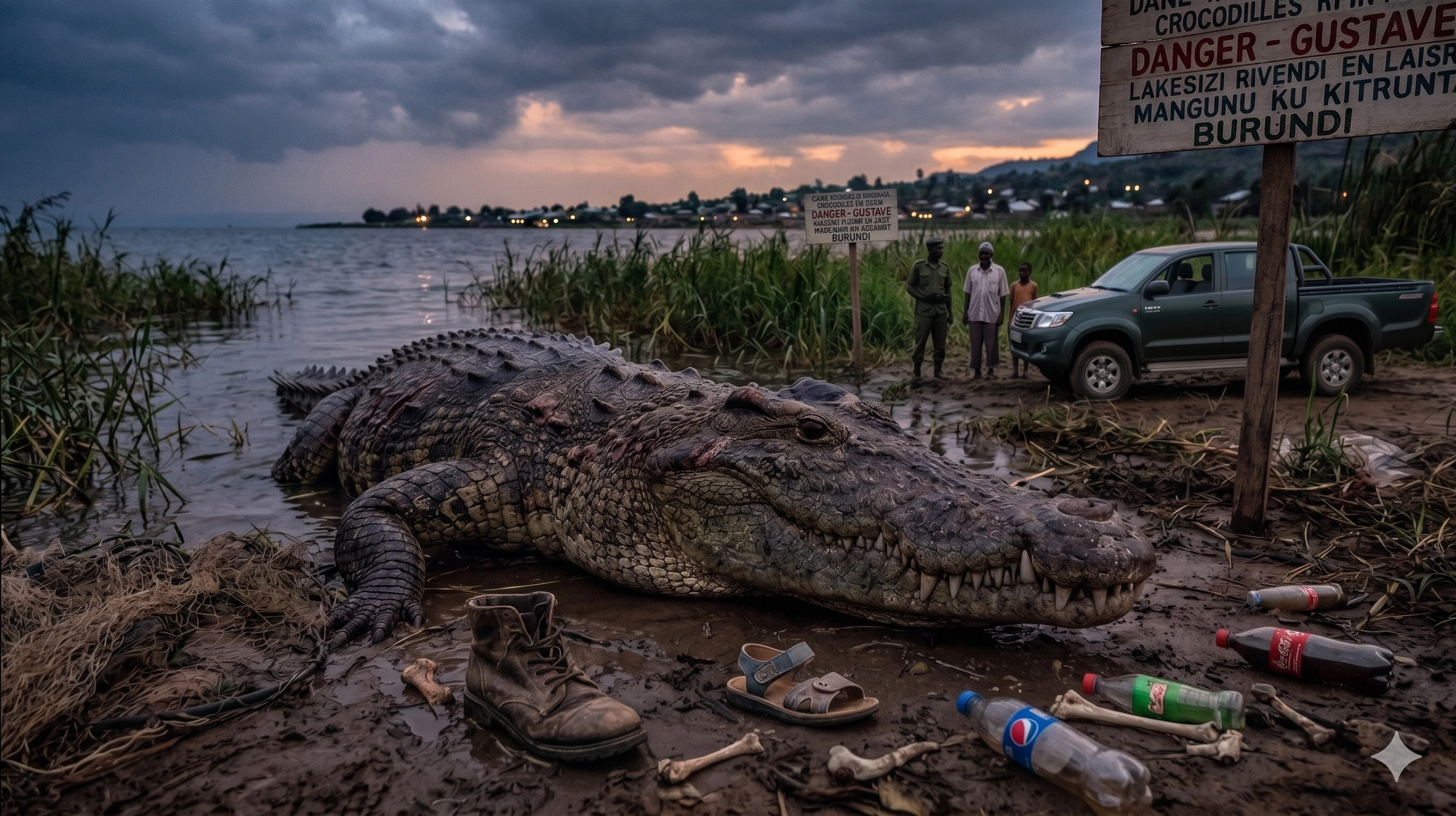
In the hierarchy of man-eating predators, Gustave occupies a category almost entirely his own. He is not a historical figure, like the Tsavo man-eaters of 1898 or the Champawat tigress. He is not a species-level threat, like the oceanic whitetip sharks of the USS Indianapolis disaster. Gustave is something rarer and more unsettling: a single, identifiable, living individual animal that has been killing humans for decades—and that no one has been able to stop. The Nile crocodile is the second-largest living reptile after the saltwater crocodile, with adult males averaging 4 to 4.5 meters and 400–500 kilograms. Gustave dwarfs these averages. He is estimated at nearly six meters in length and close to a metric ton in weight—a size so far beyond the norm that researchers initially believed he must be over 100 years old. However, examination of photographs revealed a complete set of teeth, suggesting an age more likely in the range of 60–70 years. His anomalous size may be the result of exceptional genetics, an unusually rich food supply, or both. Gustave’s territory stretches along the Ruzizi River—which forms the border between Burundi, Rwanda, and the Democratic Republic of the Congo—and into the northern reaches of Lake Tanganyika, the second-deepest lake in the world. This is a region of extraordinary natural beauty and extraordinary human suffering. The Burundian Civil War killed an estimated 300,000 people between 1993 and 2005, and the Ruzizi served as both a dumping ground for bodies and a corridor of displacement for refugees. It is within this context—a landscape where human death was routine and where the waterways themselves became instruments of war—that Gustave became legend. Scientists who have studied Gustave believe that his immense size actually impedes his ability to hunt the agile prey that smaller Nile crocodiles rely on, such as fish, antelope, and zebra. Instead, he is forced to target larger, slower animals: hippopotamuses, water buffalo, and humans. The result is a predator whose size has, paradoxically, made him more dangerous to people rather than less.
TIMELINE
c. 1955
Estimated hatching year, based on size-to-age calculations adjusted for his full dentition.
1987
First documented attacks attributed to an unusually large crocodile in the villages of Magara, Kanyosha, and Minago along the northeastern shores of Lake Tanganyika. National Geographic later confirmed records dating to this year.
1993–2005
Burundian Civil War. Estimated 300,000 dead. Corpses routinely enter the Ruzizi River and Lake Tanganyika. Many disappearances near water may be wrongly attributed to Gustave. Conversely, the chaos may mask genuine crocodile predation.
Late 1990s
French expatriate and self-taught herpetologist Patrice Faye, living in Burundi, hears from fishermen that a colleague was eaten by an enormous crocodile. He begins investigating and discovers a pattern of attacks along the lake dating back a decade.
c. 2001
Faye formally names the crocodile “Gustave” and begins publicizing his existence to international media.
2002
Faye tells the BBC that Gustave is “three times as big as the other crocodiles in Burundi” and cannot hunt normal prey due to his size. Media reports begin citing a kill count of 200–300 humans.
2002–2004
Faye conducts two years of field research, tracking Gustave’s movements and documenting attack patterns. He secures funding for a capture expedition.
2004
PBS documentary “Capturing the Killer Croc” is filmed. A 907 kg, 9-meter trap cage with infrared cameras is deployed. Multiple baits fail. Giant snares catch only smaller crocodiles. A live goat is placed in the cage in the final week; the camera fails during a thunderstorm, and the next morning the goat is gone and the cage is partially submerged. Gustave is not captured. The team is forced to leave as civil conflict intensifies.
2007
The Hollywood film “Primeval” is released, loosely based on the Gustave story.
2009
Gustave is spotted again in the Ruzizi River near Lake Tanganyika after several years of absence.
2010
Gustave is voted the 3rd most famous personality in Burundi in a national poll.
2011
Faye reveals to author Richard Grant that he has documentation for approximately 60 deaths attributed to Gustave—far fewer than the 300 commonly cited in media.
2015
Last confirmed sighting: a local resident reports seeing Gustave dragging an adult buffalo carcass into the river.
2019
A writer for Travel Africa Magazine reports being told that Gustave was killed. No details of how, when, where, or by whom are provided. No photographs or physical evidence surface. The claim remains unverified.
2026
Gustave’s status is officially unknown. If alive, he would be approximately 70–71 years old—well within the lifespan of a large Nile crocodile, which can exceed 100 years.
SELECTED EVIDENCE
Physical Evidence: Three bullet wound scars, deep right shoulder wound, head scarring—all observed and photographed but never examined at close range. No captured specimen. No DNA sample. No measured dimensions. Documentary Evidence: PBS documentary “Capturing the Killer Croc” (2004); National Geographic Adventure article (2005); BBC interviews with Faye (2002); Richard Grant’s book “Crazy River” (2013) documenting Faye’s revised estimate of ~60 verified kills. Testimonial Evidence: Extensive village testimony spanning 1987–2015 from multiple communities. Faye’s firsthand observations over 20+ years. Reports from the Congolese army capture attempt. Photographic/Video Evidence: Footage from the 2004 documentary confirming Gustave’s existence and extraordinary size. Infrared camera footage (limited by equipment failures). No high-resolution measurement photography. Absence of Evidence: No captured specimen. No post-mortem examination. No DNA. No confirmed death. No verified photograph after 2015.
WHAT REMAINS UNCERTAIN
Gustave is unique among documented man-eaters in several respects. Unlike the Tsavo lions or the Champawat tigress, which were killed relatively quickly once they attracted attention, Gustave has evaded every attempt at capture or elimination for over three decades. Unlike the sharks of the USS Indianapolis, which attacked opportunistically in a singular crisis event, Gustave represents sustained, deliberate, repeat predation by a single identified individual over a vast timespan. From a zoological perspective, Gustave’s case raises important questions about the upper limits of Nile crocodile size, the behavioral adaptations of exceptionally large individuals, and the relationship between predator size and prey selection. His apparent preference for large prey—including hippopotami and buffalo, both of which are formidable and dangerous—suggests an animal operating at the absolute apex of its ecological niche. From a cultural perspective, Gustave illuminates the process by which a real animal becomes a legend. The inflation of his kill count from Faye’s documented ~60 to the media’s “300” follows a well-established pattern in man-eater narratives: the story is always larger than the animal. This is not dishonesty—it is the natural function of fear, oral tradition, and the human need to narrativize danger. From a historical perspective, Gustave cannot be separated from the Burundian Civil War. He is, in a very real sense, a product of that conflict—not because the war created him, but because the war created the conditions in which his legend could grow. In a country where 300,000 people died violently, a crocodile that killed 60 or even 300 is a footnote. But a footnote with teeth.
SELECTED SOURCES
Selected source notes are being prepared. The public record will be expanded as material is reviewed.
Continue research