View Case File
PLAUSIBLE
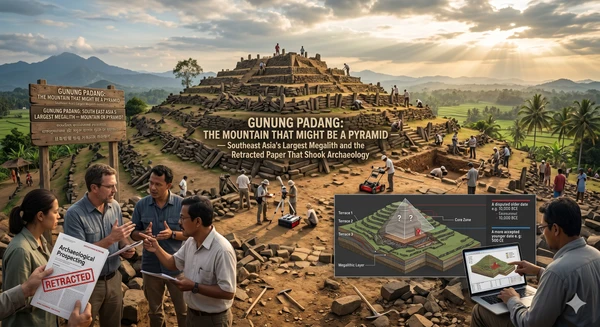
GUNUNG PADANG: The Mountain That Might Be a Pyramid — Southeast Asia's Largest Megalith and the Retracted Paper That Shook Archaeology
Megalith / Volcanic Geology / Scientific Controversy
Last updated: 18 Apr 2026
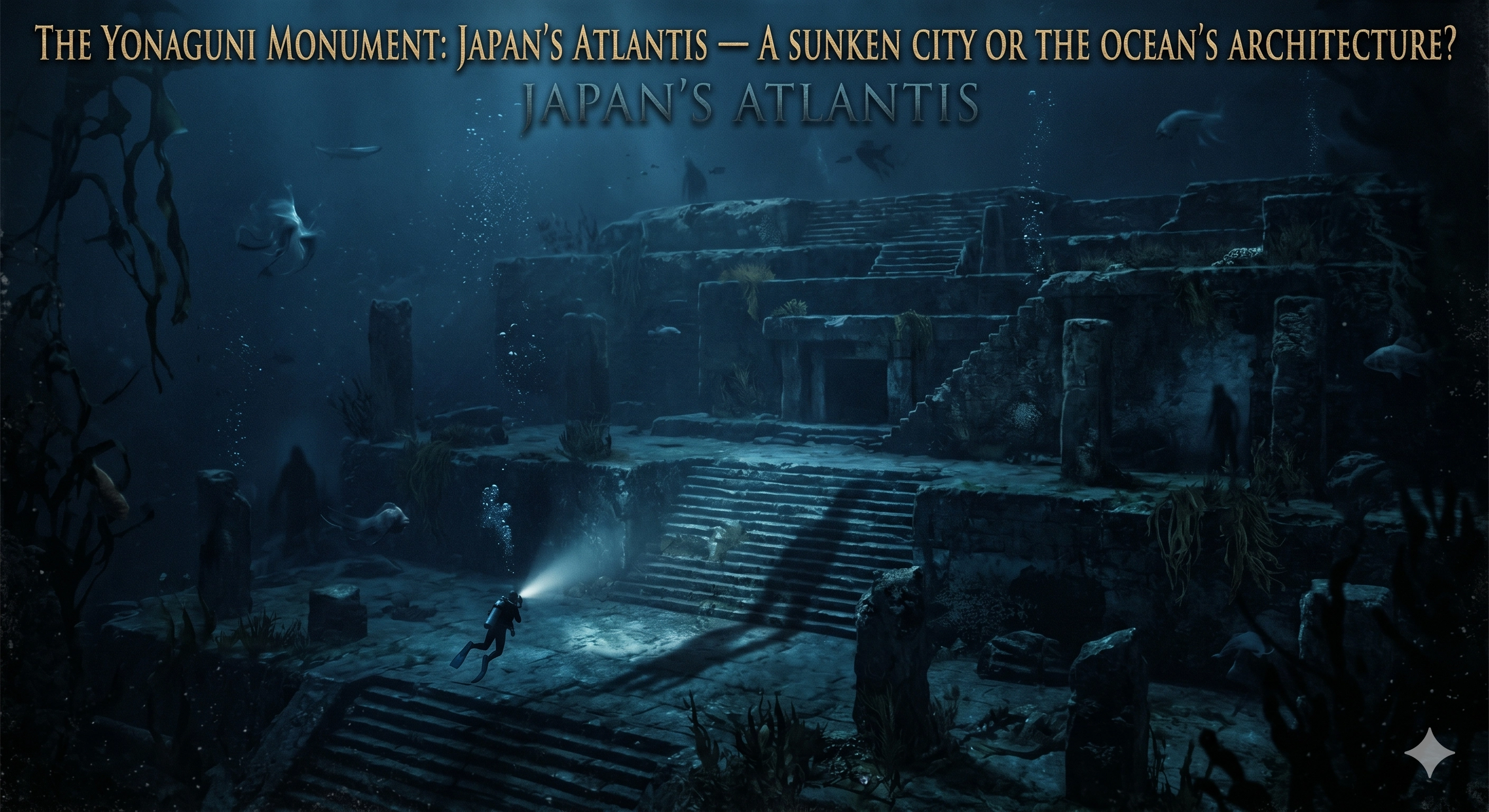
In 1986, a local dive operator named Kihachiro Aratake was searching for new hammerhead shark sites off the southern coast of Yonaguni Island—Japan’s westernmost inhabited island, located approximately 100 kilometers east of Taiwan in the East China Sea—when he discovered something on the ocean floor that should not have been there. Rising 25 meters from the seabed at a depth of roughly 5 to 40 meters, a massive rock formation presented what appeared to be terraced steps, flat platforms, right angles, straight edges, and symmetrical features that looked, to human eyes accustomed to architecture, unmistakably like a building. A stepped pyramid. A monument. A ruin. The Yonaguni Monument, as it came to be known, is approximately 50 meters long, 20 meters wide, and covers around 45,000 square meters including surrounding features. It is composed of fine sandstone and mudstone of the Yaeyama Group, deposited approximately 20 million years ago during the Early Miocene. Most of the rock is connected to the underlying bedrock—it was not assembled from freestanding blocks. Marine geologist Masaaki Kimura of the University of the Ryukyus has spent over 15 years studying the site and believes it is a man-made stepped monolith, possibly dating to 10,000 years ago when sea levels were low enough for the formation to be above water. He identifies quarry marks, carved characters, and animal sculptures in the stone, and connects the site to the mythical lost continent of Mu. Geologist Robert Schoch of Boston University is equally certain the formation is entirely natural: the product of well-defined bedding planes and perpendicular joint sets in sandstone, fractured by earthquakes in one of the most seismically active regions on Earth. He notes that identical formations exist above sea level on Yonaguni’s own coastline. Neither the Japanese Agency for Cultural Affairs nor the government of Okinawa Prefecture recognizes the formation as a cultural artifact. No government research or preservation work has been conducted. The site remains a popular diving destination, where strong currents carry visitors past walls of stone that look—depending on who is describing them—like either the ruins of an impossibly ancient civilization or the masterwork of 20 million years of geology.
Sandstones and mudstones of the Yaeyama Group are deposited in the region that will become Yonaguni Island and its surrounding seabed.
Sea level is ~120–130 m lower than present. The area of the Yonaguni Monument is dry land—a coastal or elevated terrain feature.
The Jōmon culture occupies the Japanese archipelago. They develop the world’s earliest known pottery but have no documented megalithic construction tradition. If the Yonaguni Monument is artificial, the Jōmon are the most likely builders.
Post-glacial sea level rise submerges the formation. If artificial, this is the latest date by which construction could have occurred.
Sea level stabilizes near modern levels. The formation is fully submerged at its current depth of 5–40 m.
Yonaguni Island carries its own folklore: legends of giant serpents, ancient deities, and vanished kingdoms. The island is Japan’s westernmost inhabited land, once considered the border of the known world.
Kihachiro Aratake discovers the formation while diving for hammerhead sharks. He contacts scientists at the University of the Ryukyus. The promontory above the site is unofficially renamed Iseki Hanto (“Ruins Point”).
Masaaki Kimura begins systematic diving, measuring, and mapping. He initially considers the formation might be natural, but changes his mind after his first dive. He identifies quarry marks, carved characters, and animal likenesses.
Major survey expedition. Kimura presents findings at scientific conferences, arguing for artificial origin. He dates the site to ~5,000–10,000 years ago and connects it to the mythical continent of Mu.
German geologist Wolf Wichmann studies the formation during a Spiegel TV expedition. Concludes it is natural.
Wichmann returns by invitation of Graham Hancock. Reaffirms natural-origin conclusion.
Robert Schoch publishes analysis: the formation is natural sandstone fracturing along bedding planes and joint sets. John Anthony West visits and agrees.
Takayuki Ogata et al. publish topographical analysis comparing the submarine formation to above-sea-level formations on Yonaguni Island. Conclusion: the monument is natural, formed by weathering and erosion acting on bedding and linear joints in sandstone. Similar features confirmed at Sanninudai geosite on the south coast.
The site remains a popular diving destination. The debate continues. No government recognition or protection.