No Image
View Case File
UNVERIFIED
FRIENDSHIP ISLAND (Isla Friendship): The Extraterrestrial Congregation at the End of the World
1984|Secret Society & Alien Contact
Last updated: 18 Apr 2026
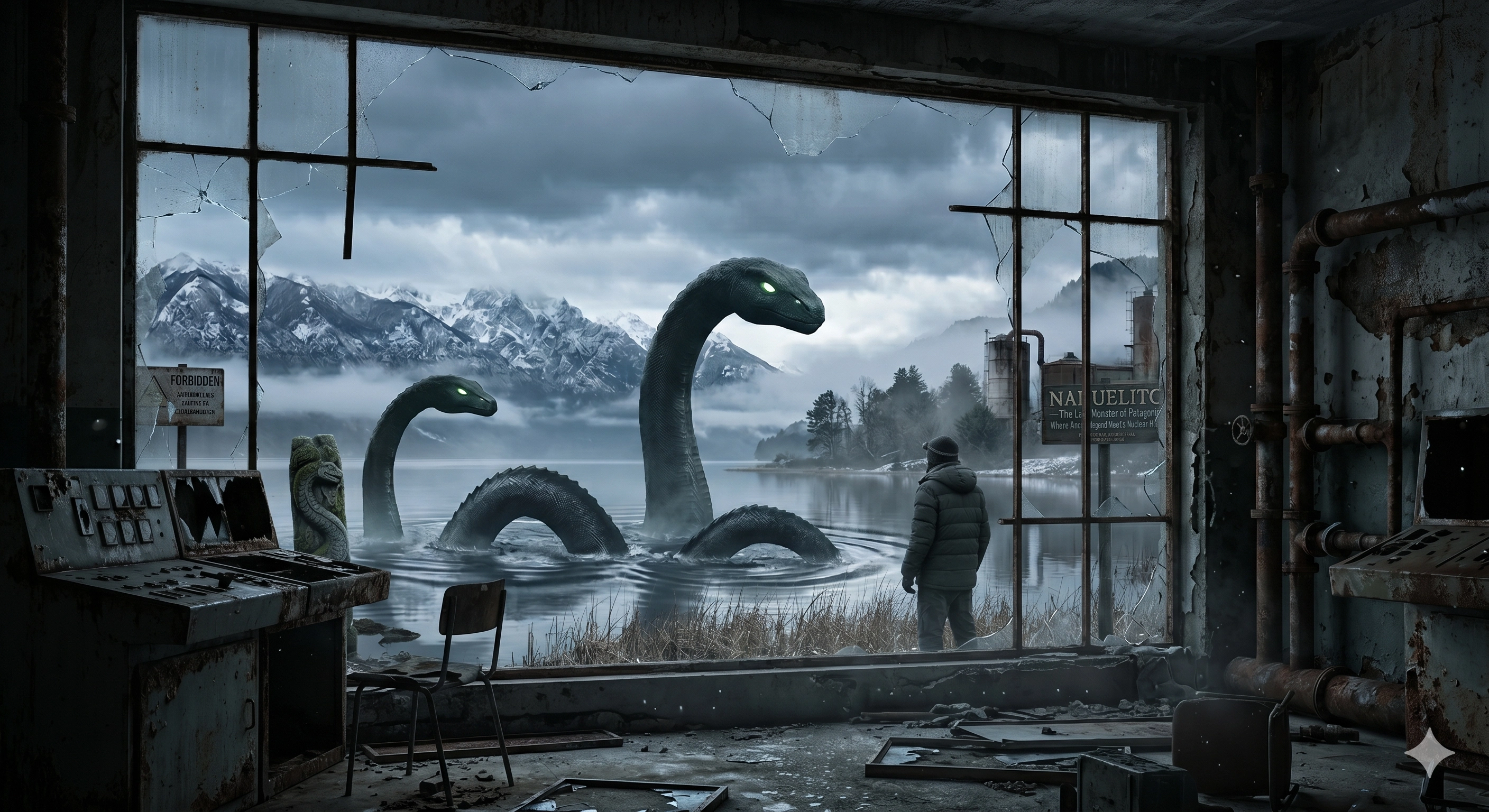
Deep in the Argentine Andes, surrounded by snow-capped mountains and forests of ancient beech and cypress, lies Nahuel Huapi Lake—a glacial body of water covering 530 square kilometers, plunging to depths of 464 meters, and holding one of South America’s most enduring cryptozoological mysteries. Since before European contact, the indigenous Mapuche and Tehuelche peoples told stories of a creature dwelling in the lake’s depths—a being they called El Cuero (“The Leather”), described as a giant stingray-like animal with a sucker mouth that dragged victims beneath the waves. In 1910, a British company manager named George Garrett reported seeing an enormous object, 15 to 20 feet in diameter and six feet above the waterline, in an inlet of the lake. His account, made public in 1922, coincided with a global wave of “living dinosaur” enthusiasm and prompted the Buenos Aires Zoo to mount the first scientific expedition to search for Nahuelito. They found nothing—but the media had already given the creature form: a plesiosaur, a marine reptile from the age of dinosaurs, somehow surviving in the cold depths of a Patagonian lake. What makes Nahuelito unique among lake monsters is the extraordinary layer of real history that surrounds it. On Huemul Island, in the very same lake, the government of Juan Domingo Perón built a secret nuclear fusion laboratory in 1949, run by an Austrian scientist named Ronald Richter who promised to harness the power of the stars. The project was a spectacular fraud—but before it was debunked, its massive electrical discharges made windows rattle in Bariloche, and the secrecy surrounding the island fueled wild speculation. Some theorists have suggested that Nahuelito is the product of a nuclear mutation: a creature born from Richter’s experiments gone wrong. The creature has never been captured, measured, or conclusively photographed. Sightings continue. Bariloche, the resort city on the lake’s southern shore, has embraced the legend commercially, much as Inverness has embraced Nessie. And the lake itself—glacial, cold, deep, and ancient—continues to keep whatever secrets it holds beneath 464 meters of water so clear it appears black.
Mapuche and Tehuelche peoples describe El Cuero and other aquatic creatures in Nahuel Huapi and surrounding lakes. The Mapuche word Nahuel itself carries associations with transformation and sorcery.
Early Portuguese sailors report monsters among Patagonia’s forests and waterways.
American gold miner Martin Sheffield settles in Patagonia (having followed the trail of Butch Cassidy and the Sundance Kid). He will later report a “long-neck, swan-headed creature” in a lagoon near Epuyén, ~90 miles south of Bariloche.
George Garrett, managing a company on Nahuel Huapi Lake, observes a large creature approximately 400 meters away. Visible portion: 5–7 meters long, ~2 meters above the waterline. Visible for 15 minutes. Local people confirm similar stories from indigenous tradition.
Arthur Conan Doyle publishes “The Lost World,” popularizing the idea of surviving prehistoric creatures in remote South America.
Garrett’s 1910 sighting is published in the Toronto Globe. Clemente Onelli, director of Buenos Aires Zoo, organizes the first scientific expedition to Patagonian lakes. Martin Sheffield provides additional testimony. Major Argentine newspapers (La Nación, La Razón, La Prensa, Caras y Caretas) give the creature plesiosaur form in illustrations. Expedition finds no evidence. The lake where the presence was most claimed is named Laguna del Plesiosaurio.
Nahuel Huapi National Park is established—Argentina’s first national park.
Proyecto Huemul: Perón’s secret nuclear fusion laboratory is built on Huemul Island in Nahuel Huapi Lake by Austrian scientist Ronald Richter. The project costs over 300 million 2022 USD equivalent. A 12-meter concrete bunker houses the “thermotron.” Massive electrical discharges rattle windows in Bariloche. In 1951, Perón announces Argentina has achieved controlled fusion—the claim is false. Physicist José Antonio Balseiro debunks the project in 1952. Richter is jailed. The equipment is repurposed for legitimate science (Instituto Balseiro, still operating in Bariloche).
Tourists and fishermen report sightings of a large humpbacked creature. The Argentine Navy reportedly pursues an “unknown submarine” in the lake. The mystery submarine theory becomes an alternative explanation for Nahuelito sightings.
Anonymous photographs of a long-necked object near the coast of Bariloche are published in a Río Negro newspaper magazine supplement. Accompanied by a note: “It is not a log of whimsical shapes. It is not a wave. Nahuelito showed his face.” The images are inconclusive.
Anonymous photographer delivers two photographs to El Cordillerano newspaper with a note: “It is not a twisted tree trunk. It is not a wave. Nahuelito has shown his face.” Both photographs are subsequently determined to be a hoax.
Sightings continue sporadically. Sci Fi Channel’s “Destination Truth” investigates (Season 1). Filmmaker Miguel Ángel Rossi produces documentary “Bajo Superficie.” Bariloche tourism industry incorporates Nahuelito imagery. Plesiosaur logo appears on souvenirs, signage, and promotional material.