0%|~2 min read
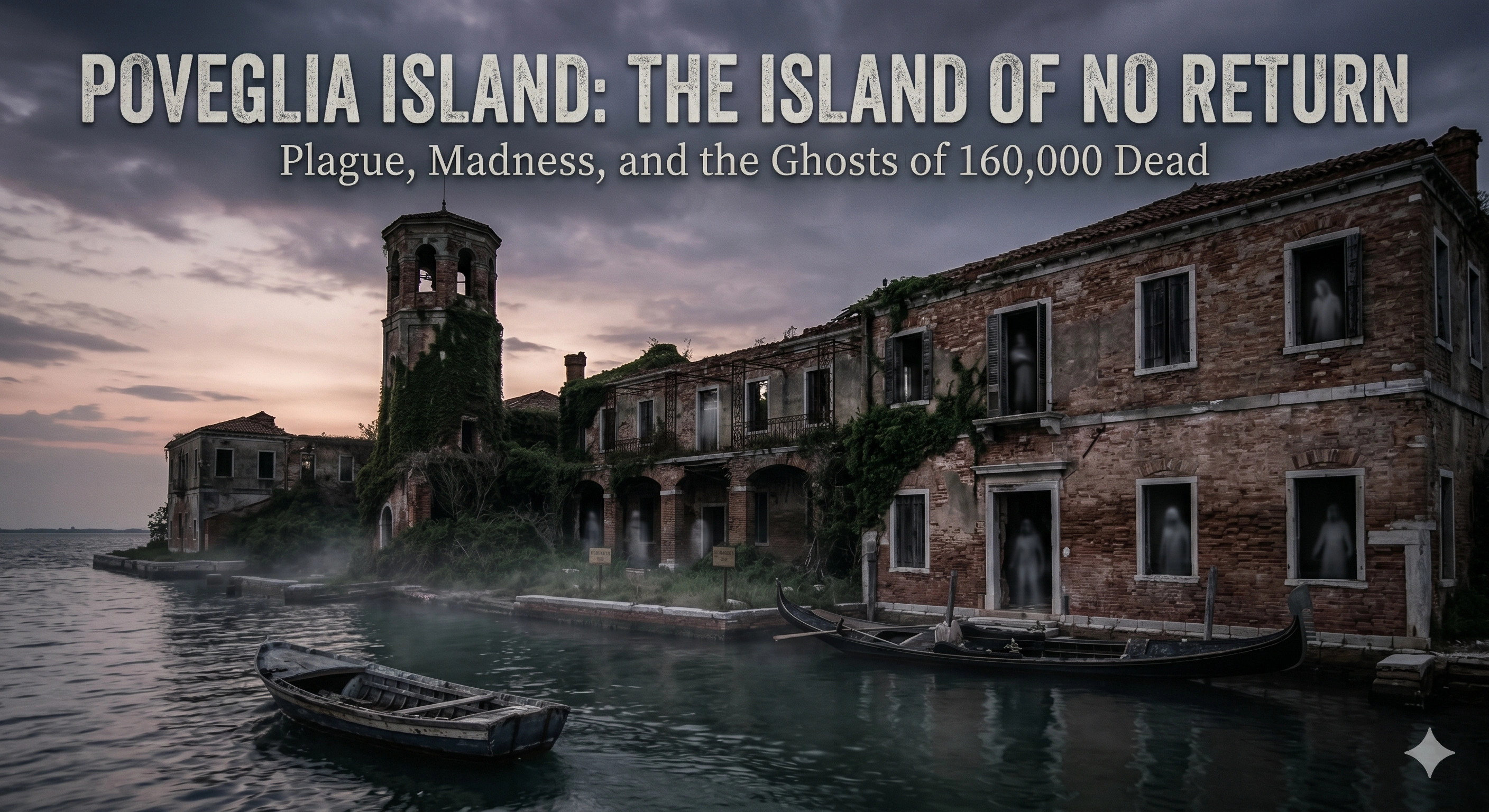
POVEGLIA ISLAND: The Island of No Return — Plague, Madness, and the Ghosts of 160,000 Dead (421) — PLAUSIBLE credibility Paranormal & Hauntings case file
CLASS PLAUSIBLE
1 of 3

POVEGLIA ISLAND: The Island of No Return — Plague, Madness, and the Ghosts of 160,000 Dead

Category|Paranormal & Hauntings
Year|421
Credibility Grade|CLASS PLAUSIBLE

Last updated: 18 Apr 2026


Quick Summary

In the Venetian Lagoon, between Venice and the Lido, lies a small island that the fishermen of the lagoon will not approach. Poveglia—three small islands connected by a bridge and a strip of man-made land—has served, in its sixteen centuries of recorded history, as a community, a fortress, a quarantine station, a plague dumping ground, a Napoleonic weapons depot, and a psychiatric asylum. An estimated 100,000 to 160,000 people died there, most of them plague victims whose bodies were burned in mass pyres or dumped into pits so vast that the island’s soil is said to be 50 percent human ash. The island’s most famous legend concerns a doctor at the psychiatric asylum who, according to local tradition, tortured and lobotomized patients with crude instruments before going mad—driven insane, they say, by the ghosts of the plague dead who whispered to him from the walls—and leaping from the 12th-century bell tower to his death. The bell was removed from the tower decades ago. Locals and visitors report hearing it toll anyway. The geriatric hospital (the asylum’s final incarnation) closed in 1968. Since then, Poveglia has been abandoned, officially off-limits, and increasingly overgrown. Construction crews sent to restore the buildings have reportedly fled. The Italian government attempted to auction a 99-year lease in 2014; the winning bidder’s project was rejected. In August 2025, a citizens’ association called “Poveglia per Tutti” received a 6-year concession for the northern part of the island to create a public park. For the first time in over half a century, part of the island of the dead may return to the living. But the buildings still stand. The bell tower still rises. And the soil beneath them still contains the remains of a hundred thousand people who were sent to this island because the city across the water did not want them anymore.


Key Facts

CountryItaly
Year421 AD
TypeParanormal / Plague History / Abandoned Asylum / Island of the Dead

Overview

Poveglia is not merely a haunted island. It is an island made of death—literally, if the local claim about soil composition is even partly true. The concentration of human suffering and mortality on this tiny patch of the Venetian Lagoon is extraordinary by any measure: over a hundred thousand plague victims in an area barely large enough for a neighborhood, their bodies burned into the earth over centuries of epidemic. Add to this the documented use as a psychiatric facility—with all the suffering that early 20th-century mental health “care” entailed—and the island becomes a palimpsest of pain, layer upon layer, century upon century. What distinguishes Poveglia from other paranormal sites is the totality of its abandonment. Unlike the Paris Catacombs (which are actively managed) or the Tower of London (which is a functioning tourist attraction), Poveglia has been left almost entirely alone since 1968. Nature has reclaimed the buildings. The forest has grown through the floors of the asylum. The bell tower stands above the tree line like a sentinel guarding something that no one wants to claim. The paranormal reports are consistent with the site’s history but lack independent verification. No controlled scientific investigation has been conducted. The island’s restricted status means that most reports come from unauthorized visitors—urban explorers and paranormal enthusiasts—whose objectivity and methodology vary wildly. And yet. The fishermen avoid the island. The construction crews left. The Italian government cannot give it away. Whatever Poveglia is—a genuinely haunted place or a very effective stage for the human fear of death—it has been resisting human habitation for over six hundred years, and it shows no signs of stopping.
Listen to Case File
~12 min

Timeline

421 AD

Poveglia first appears in historical records.

5th–9th century

Island populated by settlers fleeing barbarian invasions on the mainland. Community grows, governs itself under a dedicated Podestà, trades with neighboring Pellestrina but avoids the mainland (and its taxes).

1379

War of Chioggia between Genoa and Venice. Poveglia’s population is evacuated to Giudecca. The island is abandoned. It will remain largely uninhabited for four centuries.

14th century (1348 onward)

The Black Death devastates Venice. Poveglia is used as a quarantine/dumping ground for plague victims. Bodies are burned in mass pyres or buried in plague pits. Tens of thousands die.

1630

A second major plague outbreak strikes Venice. Poveglia again receives the dead and dying. The island’s reputation as a place of death solidifies.

1700s

Multiple additional plague outbreaks use the island as an isolation site.

1776

Poveglia comes under the jurisdiction of Venice’s Public Health Office. Used initially for customs control, then as a quarantine station for incoming ships and cargo.

1793–1814

Formal operation as lazaretto (quarantine station).

1806

Napoleon orders demolition of the church of San Vitale. The 12th-century bell tower is retained and converted to a lighthouse. Napoleonic troops store munitions on the island.

1922

The island is converted into a psychiatric asylum. Almost immediately, patients reportedly begin seeing and hearing the ghosts of plague victims. According to legend, a doctor performs cruel experiments on patients.

c. 1930s–1940s

The asylum continues to operate. Legend holds that the doctor, driven mad by the spirits, leaps from the bell tower. Some versions say he survived the fall but died in a “mysterious fog”; others say he was strangled by the bell rope. No documentary evidence confirms the identity or death of such a doctor.

1968

The geriatric hospital (asylum’s final form) closes. The island is abandoned. It has not been permanently inhabited since.

Post-1968

Decay accelerates. Buildings crumble. Forest grows through structures. The island becomes legendary among paranormal enthusiasts. Fishermen avoid the area.

2009

Ghost Adventures (Zak Bagans) films on Poveglia. The episode becomes one of the show’s most famous, bringing the island to international attention.

2014

Italian government auctions 99-year lease. Luigi Brugnaro bids €513,000. Project rejected. Citizens’ association “Poveglia per Tutti” raises €460,000 from 4,500+ donors for alternative community plan.

August 2025

Poveglia per Tutti receives a 6-year concession for the northern part of the island to develop a public lagoon park. First sanctioned civilian presence in over 50 years.


Witness Accounts

Venetian fishermen have avoided the waters around Poveglia for generations. They report screams audible from across the lagoon, particularly at night. Some claim to have pulled human bones from the seabed near the island. Whether these accounts reflect genuine paranormal phenomena, cultural tradition reinforced through repetition, or practical avoidance of an island whose waters contain actual human remains is unclear. Urban explorers who have illegally accessed Poveglia describe an atmosphere of oppressive dread that intensifies inside the asylum buildings. Reports include: sudden cold spots in rooms with no draft; the sound of footsteps in empty corridors; scratching sounds from inside walls; and the sensation of being physically touched or pushed. One frequently cited account describes hearing the unmistakable sound of a wheelchair rolling across a tiled floor in an empty wing of the asylum. The bell tower generates the most consistent and specific reports. Multiple visitors across different years and from different countries report hearing a bell tolling from the tower—despite the fact that the bell was removed decades ago. The sound is described as deep, resonant, and seemingly directional—appearing to come from the tower itself rather than from the water or the mainland. A construction crew contracted to assess the buildings for potential restoration reportedly abandoned the project and left the island after experiencing what they described as “disturbances” that made continued work impossible. The nature of these disturbances has not been publicly detailed. Ghost Adventures’ 2009 investigation recorded EVP (electronic voice phenomena) readings, electromagnetic anomalies, and what the team interpreted as physical interactions during their overnight stay. The episode remains widely discussed in paranormal circles, though the methodology of reality-TV paranormal investigations is not accepted as scientific evidence.

▶ CINEMATIC SECTIONNarrative Reconstruction

I. The Good Island (421–1379) For nearly a thousand years, Poveglia was a good place to live. The settlers who arrived in the 5th century, fleeing the collapse of the Roman world and the barbarian invasions that followed, found a small island in the sheltered waters of the Venetian Lagoon—close enough to the mainland for trade, far enough for safety. They farmed. They fished. They traded with Pellestrina. They avoided the mainland, and with it, they avoided taxes. A Podestà governed the community. The island prospered. This is the part of Poveglia’s history that no one remembers. When people say the name Poveglia, they do not think of farmers and fishermen and a small, self-governing island community that survived for nine centuries. They think of plague and madness and a bell that should not ring. But for most of its recorded existence, Poveglia was simply a village—a quiet place in a lagoon, surrounded by water and light. In 1379, the War of Chioggia ended it. The Republic of Venice, fighting the Republic of Genoa for control of Mediterranean trade, ordered the evacuation of Poveglia’s residents to the Giudecca. The island was to be used as a defensive position. The people left. They were promised they could return. They never returned. Poveglia’s nine centuries of human habitation ended, and its next four centuries of inhuman use began. II. The Burning Fields (1348–1700s) The Black Death arrived in Venice in 1348. It came by ship, carried in the fleas of rats, and it killed with a speed and thoroughness that the medieval world had no way to comprehend. Within months, the population of Venice had been cut by a third—some estimates say by half. The canals filled with corpses. The hospitals overflowed. The churches ran out of ground to bury the dead. Venice needed somewhere to put its plague victims—the dead and the dying and the suspected. It needed an island. Poveglia, already empty since the evacuation of 1379, was the obvious choice: close enough for transport, isolated enough for containment, small enough to control. The sick were loaded onto boats and ferried across the lagoon to the island. Many were still alive when they arrived. Many would not be for long. The bodies were burned. The Italian quarantine system—lazaretto, from which we get the English word “lazaret”—understood that plague could be transmitted by contact with the dead. Open-air pyres consumed the corpses, day and night, their smoke visible from Venice. Those who could not be burned quickly enough were pushed into mass graves—plague pits—and covered with quickite and earth. The plague returned. It always returned. Venice suffered major outbreaks in 1575–1577 and again in 1630–1631, each one sending fresh waves of the dying across the lagoon to Poveglia. By the time the last major European plague outbreak subsided, an estimated 100,000 to 160,000 people had died on an island smaller than most city parks. Their remains were in the earth, in the pits, in the ash that had settled into the soil until, by some accounts, half the island’s substrate was composed of human remains. The claim about soil composition has never been scientifically verified. But it is not implausible. A hundred thousand bodies, burned and buried on a few hectares of land over three centuries, would leave a measurable residue. The earth of Poveglia is, in a literal sense, made of the dead. III. The Asylum on the Ash (1922–1968) In 1922, after more than a century of use as a quarantine station and customs facility, the buildings on Poveglia were converted into a psychiatric asylum. Italy in the 1920s was not known for progressive mental health care. Asylums across Europe at the time were overcrowded, underfunded, and characterized by treatment methods that ranged from ineffective to brutal: restraints, cold-water immersion, insulin shock, and—beginning in the late 1930s—lobotomy. The legend of the mad doctor is Poveglia’s most famous story, and it is almost certainly embellished. According to local tradition, the asylum’s director was a cruel man who performed unauthorized experiments and lobotomies on patients with crude instruments. Patients reported hearing voices and seeing shadowy figures—the ghosts, they said, of the plague dead who were buried beneath the asylum’s foundations. The doctor, initially dismissive of these reports, eventually began hearing the voices himself. Driven mad by what he heard—or by what he had done—the doctor climbed the 12th-century bell tower, the tallest structure on the island, and threw himself off. Some versions of the story say he survived the fall but was killed by a “mysterious fog” that rose from the ground. Others say he was found tangled in the bell rope. There is no documentary evidence confirming the identity of such a doctor, the specific experiments, or the suicide. The legend appears to have originated in or been amplified by American paranormal television, particularly Ghost Adventures in 2009. What is documented is that the asylum existed

Evidence

Historical: Island’s use as plague lazaretto across 14th–18th centuries is documented in Venetian state archives. Asylum/hospital operation 1922–1968 is confirmed. Bell tower dates to 12th century. Napoleonic-era demolition of church is recorded. Physical: Surviving structures: church ruins, hospital/asylum buildings, bell tower, staff housing, cavana, octagonal fort. Plague pits confirmed to exist on the island. Soil composition claims (50% human ash) not scientifically verified. Paranormal Reports: Bell tolling from empty tower (multiple independent witnesses across decades); shadowy figures; disembodied screams and voices; cold spots; physical contact (touching/scratching); wheelchair sounds in asylum; plague-mask apparitions. No controlled scientific investigation conducted. Media Documentation: Ghost Adventures Season 3 (2009): EVP readings, electromagnetic anomalies, claimed physical interactions. Multiple YouTube documentaries. Numerous urban explorer accounts. Absence of Evidence: No documentary confirmation of the “mad doctor” legend. No patient records publicly available. No scientific soil analysis confirming human ash content. No controlled acoustic study of bell tower phenomenon.

Share This Archive

Community Verdict

Community Verdict