No Image
View Case File
PLAUSIBLE
THE LOCH NESS MONSTER (Nessie): The Most Famous Creature That Probably Doesn’t Exist
565|Lake Cryptozoology
Last updated: 18 Apr 2026
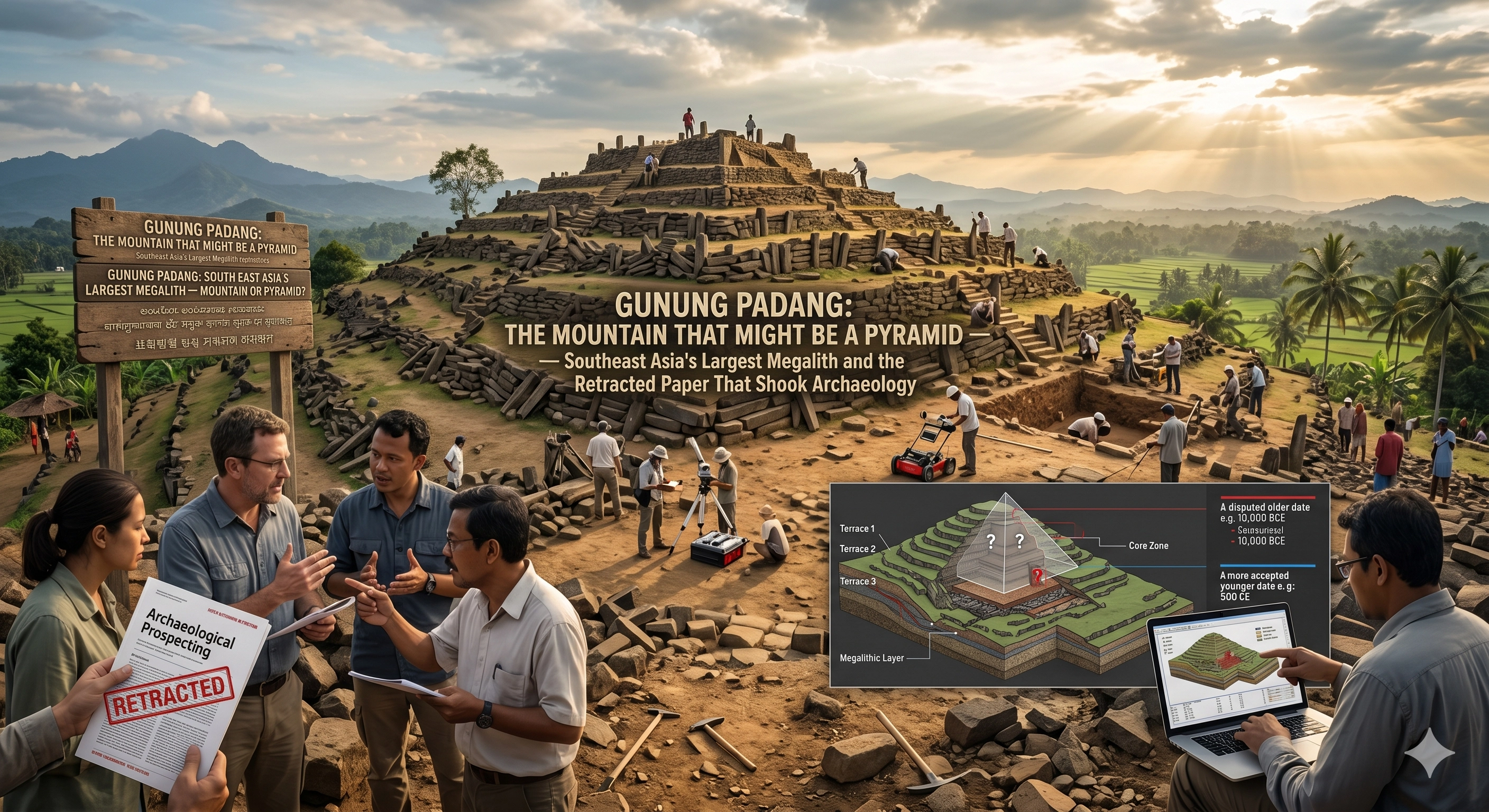
On a volcanic hilltop in West Java, Indonesia, stands the largest megalithic site in Southeast Asia. Gunung Padang consists of five terraced platforms built from massive columnar-jointed andesite and basalt blocks. In October 2023, a team led by geologist Danny Hilman Natawidjaja published a paper claiming the site was a massive buried pyramid with layers dating to 25,000–14,000 BC—the Paleolithic era. The paper was retracted in March 2024 due to methodological flaws in radiocarbon dating. The geophysical anomalies detected underground are real but their interpretation is disputed. The site remains significant as the largest punden berundak in Southeast Asia, conventionally dated to approximately 2,000–5,000 years ago.
Gunung Padang is the most contentious archaeological site in the world right now. It is a case in which a genuine megalithic monument—significant in its own right as the largest punden berundak in Southeast Asia—has been caught in a tug-of-war between mainstream archaeology and alternative history, between peer review and retraction, between national pride and scientific methodology.
The surface site is not in dispute. Gunung Padang is a real, impressive, culturally significant megalithic structure dating to somewhere between 2,000 and 5,000 years ago, built by Austronesian peoples for ancestor veneration.
What is in dispute is everything below the surface. Natawidjaja's team detected underground anomalies they interpreted as buried construction layers and hidden chambers, with radiocarbon dates ranging from 6,000 to 25,000 years. The paper was retracted because soil ages do not necessarily date construction.
The question is whether Gunung Padang is a 2,000-year-old temple built on top of a volcanic hill, or a 25,000-year-old pyramid buried inside one.
The Karyamukti volcano is active. Andesitic-basalt magma cools into columnar joints—naturally rectangular stone blocks.
Austronesian peoples arrange the naturally columnar blocks into a terraced structure: five platforms, ~400 steps. Largest punden berundak in Indonesia.
Dutch colonial report first mentions the site.
Three farmers rediscover the overgrown site. National Archaeology Research Centre notified.
Designated a Provincial-level Cultural Heritage Site.
Danny Hilman Natawidjaja conducts geophysical surveys detecting underground anomalies.
Graham Hancock features Gunung Padang in Netflix series 'Ancient Apocalypse.'
Natawidjaja et al. publish paper claiming multi-layered buried pyramid dating to 25,000 BCE.
Archaeological Prospection retracts the paper. Radiocarbon dating methodology deemed flawed.
Debate continues. Further excavation needed to resolve underground structure questions.
Lutfi Yondri of the University of Padjadjaran, who has excavated at Gunung Padang for over three decades, believes the earliest megalithic structures were built approximately 2,000 years ago—significant, but not civilization-rewriting.
Danny Hilman Natawidjaja described detecting subsurface anomalies that did not match expectations for a natural volcanic hill. Seismic tomography detected what appeared to be hidden cavities deep within the structure.
Flint Dibble of Cardiff University provided the definitive critique: radiocarbon dating soil beneath a structure tells you the age of the soil, not the age of the structure above it.
Vulcanologist Sutikno Bronto stated plainly that the site is the neck of an ancient volcano, and that columnar jointing naturally produces the rectangular stone blocks.
Long before humans existed, a volcano erupted in what is now West Java. Its magma cooled into regular, polygonal columns—prismatic blocks that look engineered but are entirely the product of thermodynamics. Over millions of years, the volcano eroded, leaving behind hills covered in rectangular blocks of columnar-jointed basalt.
The punden berundak tradition is one of the oldest continuous architectural practices in Southeast Asia. When the Austronesian peoples encountered this hill with its ready supply of rectangular, stackable stone blocks, they saw building material. They saw a sacred landscape. They built a temple.
Danny Hilman Natawidjaja used ground-penetrating radar, electrical resistivity tomography, seismic tomography, and core drilling to probe the hill. He identified four construction units, the deepest dating to 25,000–14,000 BCE. If correct, Gunung Padang would be the oldest known monumental construction on Earth.
The central objection was devastating: the radiocarbon dates were obtained from soil samples, not from artifacts. Flint Dibble's analogy: dating soil beneath the Palace of Westminster at 40,000 years does not mean the Palace was built 40,000 years ago.
The geophysical data is real. What the anomalies represent—buried construction, natural volcanic structures, or something in between—has not been determined by independent investigation. The mountain waits.
Physical (Surface): Five terraced platforms of columnar-jointed andesite/basalt blocks, ~400 stone steps, ~3+ hectares. Pottery fragments (45 BCE–22 CE). Confirmed megalithic site.
Geophysical (Subsurface): GPR, ERT, and seismic tomography detected anomalies at 20–30 m depth. Core drilling water loss consistent with underground voids. Data is real; interpretation disputed.
Radiocarbon Dating (Retracted): Soil samples yielded ages of 6,000–25,000+ years. Retracted because samples were not associated with man-made artifacts.
Geological: Columnar jointing produces naturally rectangular blocks. Site sits inside collapsed caldera of Oligocene volcano.
Absence of Evidence: No tools, hearths, burials, or artifacts found in deep layers. No evidence of human settlement during Ice Age.