0%|~2 min read
Groote Schuur Hospital Ghost: Where the First Heart Transplant Met the Dead Who Never Left (1938) — UNVERIFIED credibility Paranormal & Hauntings case file
CLASS UNVERIFIED
1 of 3

Groote Schuur Hospital Ghost: Where the First Heart Transplant Met the Dead Who Never Left

Category|Paranormal & Hauntings
Year|1938
Credibility Grade|CLASS UNVERIFIED

Last updated: 18 Apr 2026


Quick Summary

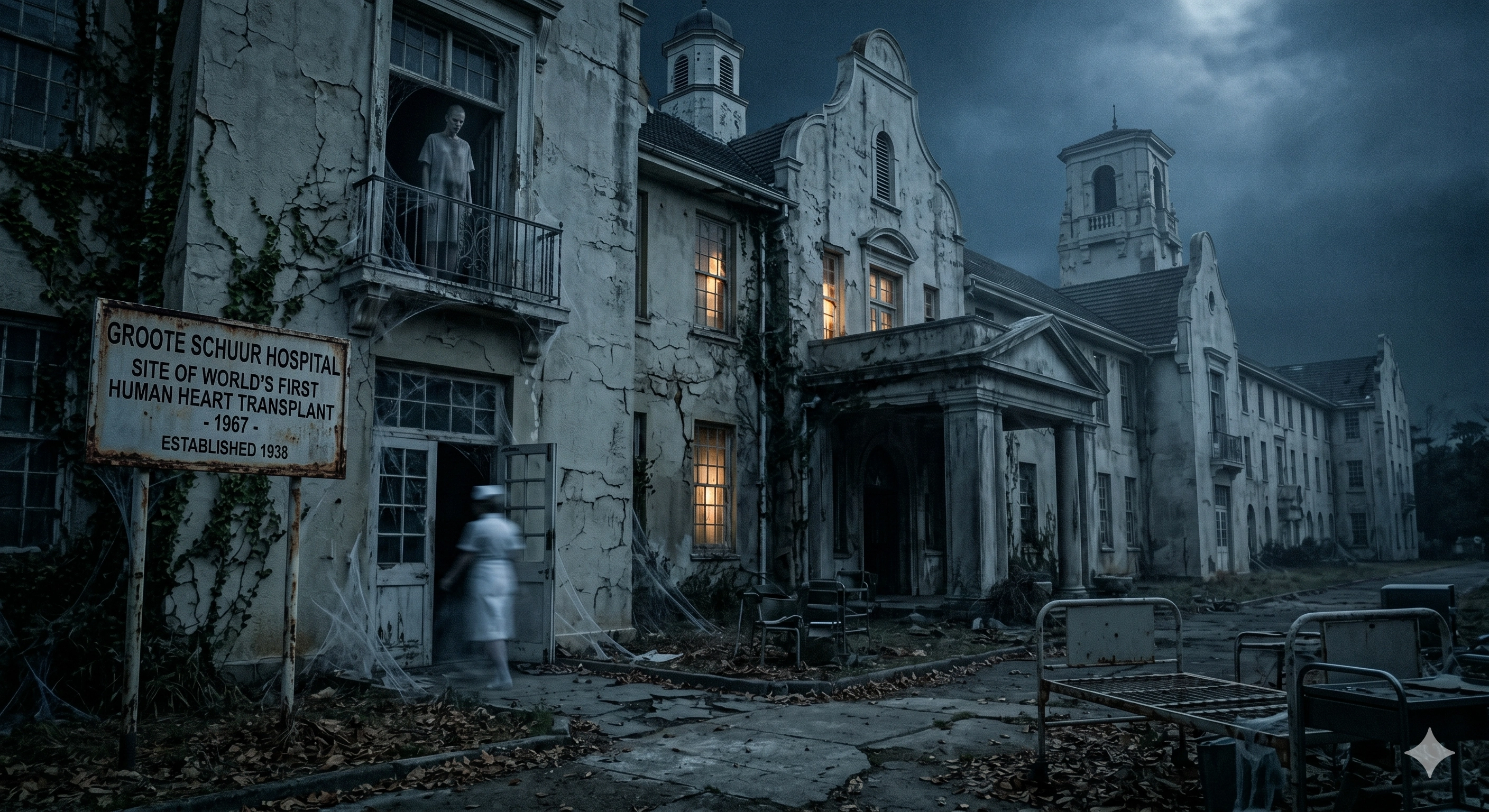
A 975-bed teaching hospital in Cape Town, founded 1938, site of the world's first heart transplant (1967). Staff and patients report seeing Sister Fatima — a deceased nurse still helping on night shifts — along with a suicide nurse, a fallen patient's ghost, and the enigmatic White-Eyed Sister. No formal investigation has been conducted despite decades of consistent reports from medical professionals.


Overview

Groote Schuur Hospital — Dutch for 'Great Barn' — is a 975-bed public teaching hospital on the slopes of Devil's Peak in Observatory, Cape Town, South Africa. Founded in 1938, it gained global fame when surgeon Christiaan Barnard performed the world's first successful human-to-human heart transplant on 3 December 1967. But the hospital's corridors carry more than surgical triumph. Staff and patients report persistent paranormal phenomena: Sister Fatima, a benevolent deceased nurse who appears on night shifts to help with patient care before vanishing through walls; a young nurse who committed suicide; a male patient who fell to his death escaping; and the 'White-Eyed Sister' with haunting pale eyes. The hospital operates on two planes — a world-class medical institution and a place where some who lived, worked, and died within its walls appear never to have left.
Listen to Case File
~10 min

Timeline

1600s

The land is a Dutch settler farm called Groote Schuur (Great Barn), part of the Cape Colony agricultural landscape on the slopes of Devil Peak.

1927

Construction of new hospital commences. Site leveled using convict labor, causing public outcry in the Cape Colony press.

1931-1932

Foundations dug. Architect F.D. Strong designs neo-classical structure with Corinthian columns, Grecian urns, large windows. Foundation stones laid by the Governor General.

31 January 1938

Groote Schuur Hospital officially opened by Sir Patrick Duncan. 850 beds equipped, only 450 staffed. The Cape Argus: so delightfully arranged that it was almost an incentive to be ill.

1940s

Hospital fully functional after WWII outbreak brings increased demand. All 850 beds operational.

1958

Dr. Christiaan Barnard returns from 3 years training at University of Minnesota with heart-lung machine donated by American government. First successful open heart surgery series begins.

1962

Barnard appointed Head of new Department of Thoracic Surgery. Cardiac program grows rapidly.

3 December 1967

Worlds first human-to-human heart transplant. 1:00 AM, Charles Saint Theatre, team of 30 led by Prof. Barnard (45). Heart of Denise Darvall (25, car accident) transplanted into Louis Washkansky (53, terminal heart disease). Nine-hour operation succeeds. Washkansky survives 18 days.

1974

First heterotopic (piggy-back) heart transplant at Groote Schuur - another world first.

1983

Prof. Barnard retires from surgery.

1984

Major expansion - two new wings added. Original 1938 building preserved for academic departments.

4 October 1996

Original 1938 building designated Western Cape Provincial Heritage Site.

2005

Hospital surpasses 500 heart transplants.

3 December 2007

Heart of Cape Town Museum opens in original operating theatres on 40th anniversary.

Mid-20th century - present

Paranormal reports accumulate from nurses, doctors, patients across decades. Named apparitions: Sister Fatima (benevolent helping ghost), suicide nurse, fallen patient, White-Eyed Sister. Phenomena: footsteps, unmanned lifts, temperature drops, being watched. No formal investigation.

Present day

Hospital fully operational: 975 beds, 3,400+ staff, 50,000 inpatients and 350,000 outpatients annually. New paranormal reports continue from night-shift staff.

Witness Accounts

Sister Fatima: Multiple nurses across decades describe encountering an unrecognized colleague during night shifts — a woman in nursing attire who helps with patient care, tends trolleys, assists with rounds, then walks through a wall or vanishes. Staff identify her as a nurse who died years earlier. She is described as friendly and competent. Suicide Nurse: A young nurse who took her own life inside the hospital is seen in corridors and stairwells — a figure of grief rather than menace. Fallen Patient: A man who fell to his death from a window while trying to escape. Footsteps in empty corridors, doors opening and closing, the sense of someone trying to leave. White-Eyed Sister: A woman with haunting pale or white eyes wandering the halls. No narrative accompanies her — she is the ghost without a story. General: Unexplained footsteps at night, lifts moving between floors unmanned, sudden cold spots, sensation of being watched — particularly in the older 1938 building sections.

▶ CINEMATIC SECTIONNarrative Reconstruction

I. THE GREAT BARN ON DEVIL'S PEAK (1938) The slopes of Devil's Peak have always carried a weight that exceeds their geology. The name itself — given by early Dutch settlers who saw fires on the mountain and attributed them to the devil — establishes the landscape as a place where the natural and the supernatural coexist. When Groote Schuur Hospital opened on 31 January 1938, it was built on land that had been a Dutch settler farm for three centuries. Architect F.D. Strong designed a building that was both grand and humane: neo-classical columns and Grecian urns alongside large windows that filled the wards with Cape sunlight. The Cape Argus wrote that the hospital was 'so delightfully arranged that it was almost an incentive to be ill.' It was, from the beginning, a place where people came to be healed — and, inevitably, a place where some of them died. II. THE HEART THAT CHANGED EVERYTHING (3 DECEMBER 1967) At 1:00 AM on 3 December 1967, in the Charles Saint Theatre at Groote Schuur, a team of thirty people led by Christiaan Barnard began transplanting the heart of 25-year-old Denise Darvall into 53-year-old Louis Washkansky. When the new heart began to beat on its own, the world changed. Groote Schuur became the most famous hospital on Earth. It is perhaps not surprising that a hospital where the boundary between life and death was so dramatically redefined should also be a hospital where the dead are reported to remain among the living. III. THE NURSE WHO NEVER STOPPED WORKING Sister Fatima is not a frightening ghost. She is a helpful one. She appears during night shifts, wearing nursing attire, tending to patients, moving trolleys, assisting with rounds — doing in death exactly what she did in life. The nurses who encounter her do not immediately realize anything is wrong. She looks like a colleague. It is only when she walks through a wall or vanishes mid-conversation that the living nurses understand what they have been working alongside. She represents the most poignant possibility of the paranormal: that the dead can continue to care. IV. THE ONES WHO COULD NOT LEAVE Not all of Groote Schuur's ghosts are benevolent. The young nurse who committed suicide carries sorrow through the corridors. The male patient who fell from a window while trying to escape embodies restless torment — footsteps echo, doors open and close, the sense of someone trying to find a way out and failing. The White-Eyed Sister is the most unsettling because she is the least explained — a woman with white eyes, walking the halls, looking at the living with an unreadable expression. She is the ghost without a story, which makes her the ghost that frightens most. V. A HOSPITAL ON TWO PLANES Groote Schuur treats 50,000 inpatients and 350,000 outpatients every year. It is also, by persistent report, a place where nurses who died years ago continue their rounds, where patients who died in anguish remain, and where the boundary between the living and the dead is not a wall but a membrane. No formal investigation has been conducted. The ghosts are an unofficial presence in an official institution — tolerated, whispered about, and never quite confronted. The living and the dead share the corridors. The hospital continues. And Sister Fatima, whether she is a ghost, a memory, or a story nurses tell each other to make the night shifts bearable, is part of Groote Schuur — part of what it is and what it means.

Evidence

Historical: Hospital founded 1938, confirmed. First heart transplant 3 December 1967, confirmed. Provincial Heritage Site 1996, confirmed. 975 beds, 3,400+ staff, confirmed. Paranormal Reports: Multiple independent accounts from nurses, doctors, patients, and visitors spanning decades. Published in Cape Town Tourism, Bona Magazine, Secret Cape Town, Swift Momentum, Time Out Cape Town, and paranormal communities. Absence of Evidence: No formal paranormal investigation. No scientific measurements. No photographic or audio evidence publicly available. No official hospital acknowledgment. Skeptical Explanations: Old building acoustics amplify sounds. Night-shift fatigue and suggestion. Emotional priming in a death-saturated environment. Institutional folklore reinforced by repetition.

Share This Archive

Community Verdict

Community Verdict