Ver Archivo
PLAUSIBLE
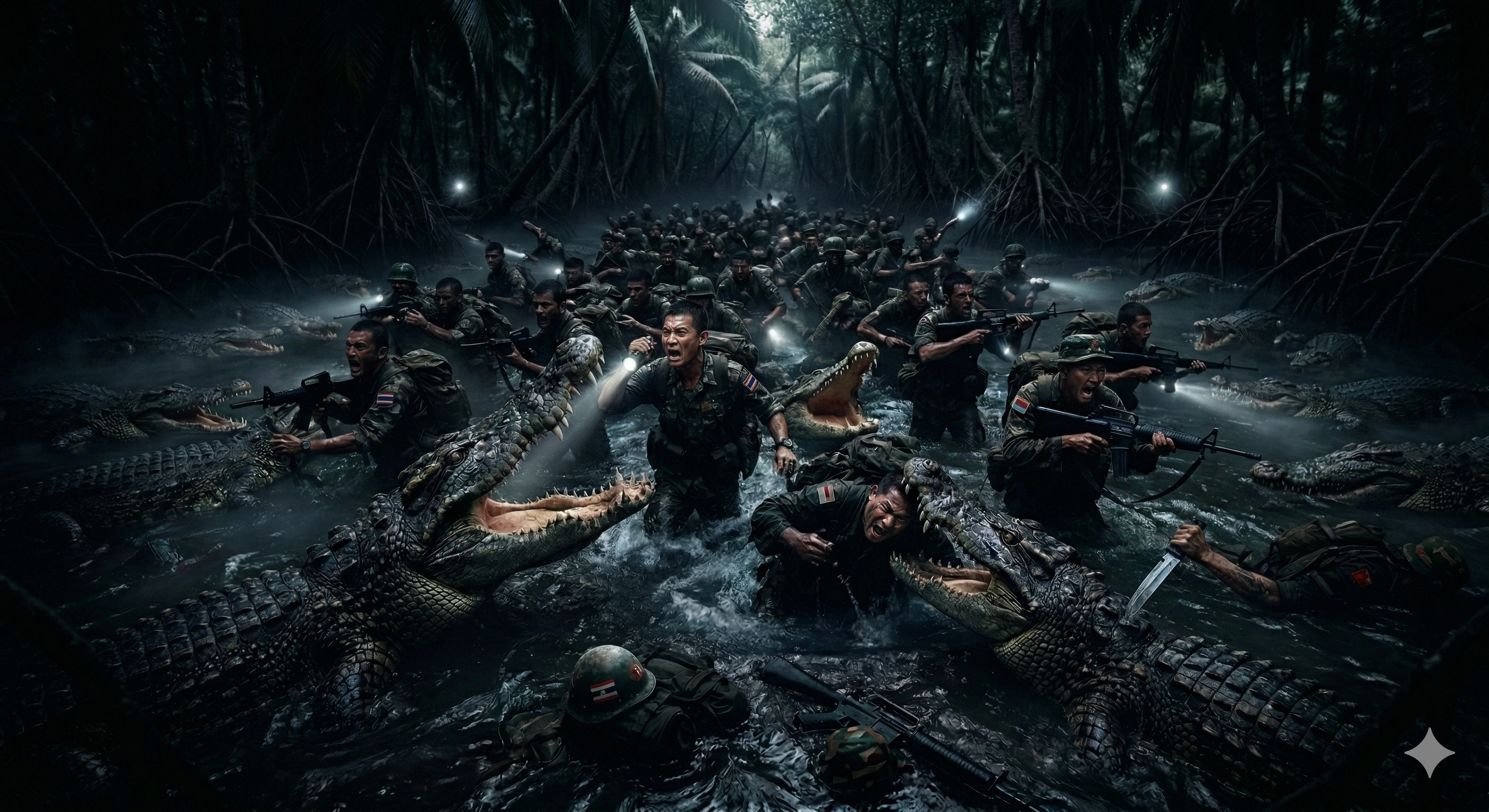
THE RAMREE ISLAND MASSACRE: The Night Crocodiles Devoured an Army
1945
Last updated: 16 Apr 2026
El Monstruo del Lago Ness—afectuosamente conocido como Nessie—es una criatura acuática mítica que, según se dice, habita el Lago Ness, un lago de aguas dulces y profundas en las Tierras Altas de Escocia. Es el criptido más famoso del mundo y ha sido objeto de más de 1,159 avistamientos registrados a lo largo de casi 1,500 años, desde un relato del siglo VI atribuido al monje irlandés San Columba hasta observaciones por webcam en 2025. La leyenda moderna comenzó en 1933, cuando la construcción de una carretera a lo largo de la orilla del lago proporcionó vistas despejadas del agua por primera vez. Una pareja informó haber visto un “dragón o monstruo prehistórico” cruzando la carretera antes de desaparecer en el lago. En pocos meses, Nessie se convirtió en noticia internacional. La fotografía más famosa—la “Fotografía del Cirujano” de 1934, que mostraba una criatura de cuello largo emergiendo del agua—fue desvelada en 1994 como un fraude, elaborada a partir de un submarino de juguete y una cabeza modelada. A pesar de décadas de estudios con sonar, cámaras submarinas y un análisis exhaustivo de ADN ambiental (eDNA) realizado en 2018 que no encontró evidencia alguna de ningún animal grande desconocido (pero sí una cantidad significativa de ADN de anguila), los avistamientos persisten. El consenso científico es que Nessie no existe tal como se describe—que los avistamientos son producto de fraudes, mala identificación y la expectativa psicológica generada por la misma leyenda. La industria turística discrepa: Nessie genera un ingreso estimado de 41 millones de libras anuales para las Tierras Altas de Escocia. La cuestión que plantea Nessie no es si un plesiosaurio habita un lago escocés. La cuestión es por qué, a pesar de la abrumadora evidencia en contra de su existencia, millones de personas continúan creyendo—o desean creer—que sí existe.
Saint Columba reportedly encounters a “water beast” in the River Ness and commands it to retreat. Recorded in Adomnán’s 7th-century hagiography. Skeptics note that water-beast stories are common in medieval hagiographies.
Occasional reports and local folklore, but no sustained monster tradition. Pictish standing stones in the region depict a mysterious creature with flippers, sometimes called the “beastie.” Ronald Binns argues there is no credible monster tradition before 1933.
The A82 road along the northern shore of Loch Ness is completed, providing the first unobstructed public view of the loch. Within weeks, Aldie Mackay reports seeing an enormous creature in the water. The story is published in the Inverness Courier.
George Spicer and his wife report seeing a massive creature with a long neck crossing the road near the loch and disappearing into the water. The Courier publishes the account. Public interest explodes. Letters describing sightings pour in from across Scotland.
The Daily Mail commissions big-game hunter Marmaduke Wetherell to find the monster. He reports large footprints on the shore. Zoologists at the Natural History Museum determine the prints were made with a hippopotamus-foot umbrella stand or ashtray. Wetherell is humiliated.
The “Surgeon’s Photograph” is published, attributed to Dr. Robert Kenneth Wilson. It shows what appears to be a long-necked creature emerging from the loch. It becomes the most famous and most reproduced image of the monster.
Regular sightings continue. Multiple expeditions and amateur investigators visit the loch. The monster becomes a permanent fixture of Scottish culture and British popular imagination.
Tim Dinsdale films a dark hump creating a wake across the loch. JARIC (Joint Air Reconnaissance Intelligence Centre) analyzes the film in 1966 and concludes the object is “probably animate.” The film remains the most significant motion-picture evidence.
The Loch Ness Phenomena Investigation Bureau operates from the shore, conducting systematic visual surveillance with cameras and observers. No conclusive evidence is obtained.
Underwater photographs by Dr. Robert Rines appear to show a flipper-like appendage. The images are later criticized for heavy enhancement and remain disputed.
Operation Deepscan: 24 boats equipped with sonar sweep the entire length of the loch simultaneously. Three sonar contacts are recorded at depth, described as “stronger than a fish but weaker than a whale.” Results are inconclusive.
The Surgeon’s Photograph is revealed as a hoax. Christian Spurling, Wetherell’s stepson, confesses on his deathbed that the image was a toy submarine fitted with a sculpted head, orchestrated by Wetherell as revenge against the Daily Mail for the hippopotamus-foot humiliation.
BBC sponsors a comprehensive sonar survey of the entire loch using 600 separate sonar beams and satellite tracking. Nothing unusual is found. Team leader Ian Florence states: “We went from shoreline to shoreline, top to bottom… and found no trace of any large living animal.”
International eDNA survey (Universities of Otago, Copenhagen, Hull, Highlands and Islands) collects 250 water samples from throughout the loch. Results (published 2019): no DNA of plesiosaurs, sharks, sturgeons, or catfish. No otter or seal DNA. Significant amounts of European eel (Anguilla anguilla) DNA. Prof. Gemmell: possibility of giant eels “cannot be ruled out.”
The largest search since Operation Deepscan marks the 90th anniversary of the 1933 Mackay sighting. Thermal drones, infrared cameras, and hydrophone arrays are deployed. No conclusive evidence is found.
Sightings continue. The Malm family photographs an “unidentified presence” near Urquhart Castle (2024). First sighting of 2025 reported at Dores Beach in March. Webcam observations continue globally. Seal spotted in loch (October 2024).