Last updated: 09 Apr 2026
Quick Summary
In February 1945, during the closing stages of World War II in Burma, approximately 900–1,000 Japanese soldiers retreated into the mangrove swamps of Ramree Island to escape encirclement by British and Indian forces. What followed has been called the deadliest animal attack in recorded history: hundreds of men allegedly killed by saltwater crocodiles over the course of a single night. The incident was later enshrined in the Guinness Book of World Records—yet modern historians and herpetologists have cast serious doubt on the scale of the crocodile predation, suggesting that disease, drowning, gunfire, and starvation accounted for the majority of deaths.
Key Facts
CountryBurma
Year1945
TypeWartime Mystery
Overview
Ramree Island is a flat, muddy landmass of approximately 1,350 square kilometers off the coast of Rakhine State in western Myanmar. During World War II, the island was occupied by Japanese forces and targeted by the British XV Corps in January 1945 as part of Operation Matador, an amphibious assault to secure airfields for the mainland campaign.
After weeks of fierce fighting, British and Indian forces outflanked a Japanese stronghold, splitting the garrison and isolating approximately 900–1,000 soldiers. Rather than surrender, the Japanese chose to cross roughly 16 kilometers of dense mangrove swamp to rejoin a larger force on the far side of the island. The mangrove swamps of Ramree were—and remain—natural habitat for saltwater crocodiles, the world’s largest and most aggressive crocodilian species.
What happened over the following nights has become one of the most debated incidents in both military history and zoological literature. The canonical account claims that hundreds of Japanese soldiers were killed by crocodiles in the swamp, while only approximately 20 survived to be captured by the British. Modern revisionist research suggests the true number of crocodile fatalities may have been as low as 10–15, with the majority of deaths attributable to combat, drowning, disease, and exposure.
Timeline
Early 1942: Japanese forces invade and occupy Ramree Island during the conquest of Burma. 21 January 1945: British XV Corps launches Operation Matador; the 71st Indian Infantry Brigade lands on Ramree under heavy naval bombardment from HMS Queen Elizabeth and supporting vessels. 26 January 1945: Operation Sankey: Royal Marines land on neighboring Cheduba Island, found unoccupied. 1 February 1945: British forces reach the town of Sane; Japanese positions are increasingly encircled. 8–22 February 1945: Operation Block: Royal Navy destroyers blockade sea exits; RAF strafes Japanese boats and positions; ground forces tighten the encirclement. 19 February 1945: Approximately 900–1,000 Japanese soldiers enter the mangrove swamp in an attempt to cross to the mainland. The “massacre night” occurs. 24 February 1945: Reuters correspondents report Japanese soldiers “being forced by hunger out of the mangrove swamps and many have been killed by crocodiles.” Late February 1945: Only approximately 20 Japanese soldiers are captured alive by British forces. The remainder—roughly 480–500 men—are unaccounted for. 1962: Bruce S. Wright publishes his account in “Wildlife Sketches Near and Far,” providing the foundational narrative of the crocodile massacre. 1964: Conservationist Roger Caras amplifies Wright’s account in “Dangerous to Man,” calling it “one of the most deliberate and wholesale attacks on man by large animals.” 1998: Herpetologist Steven Platt visits Ramree Island and interviews wartime survivors, who “unanimously discounted” the mass crocodile attack narrative. 2016: Historian Sam Willis uncovers British military documents suggesting most Japanese casualties resulted from drowning and gunfire, with crocodiles scavenging corpses afterward.
Witness Accounts
The primary account comes from Bruce Stanley Wright, a Royal Canadian Lieutenant Commander and naturalist who served in the Burma campaign. Wright described the night of 19 February 1945 in vivid terms: the sounds of scattered rifle shots in a pitch-black swamp, screams of wounded men, and what he characterized as the unmistakable noise of crocodiles attacking. At dawn, he noted, vultures arrived to feed on what the crocodiles had left behind.
However, Wright was not personally present in the swamp. His account was assembled from reports by British motor launch crews stationed offshore. No Japanese survivor testimony corroborating the mass crocodile attack has ever been located. When the Japanese War Office was asked about the incident in 1974, they could not confirm it had occurred.
Local Burmese villagers interviewed by Steven Platt in 1998—including individuals who had been alive during the war and had been conscripted into forced labor by the Japanese—uniformly rejected the crocodile massacre narrative, attributing the majority of deaths to combat, disease, and drowning.
▶ CINEMATIC SECTIONCinematic Reconstruction
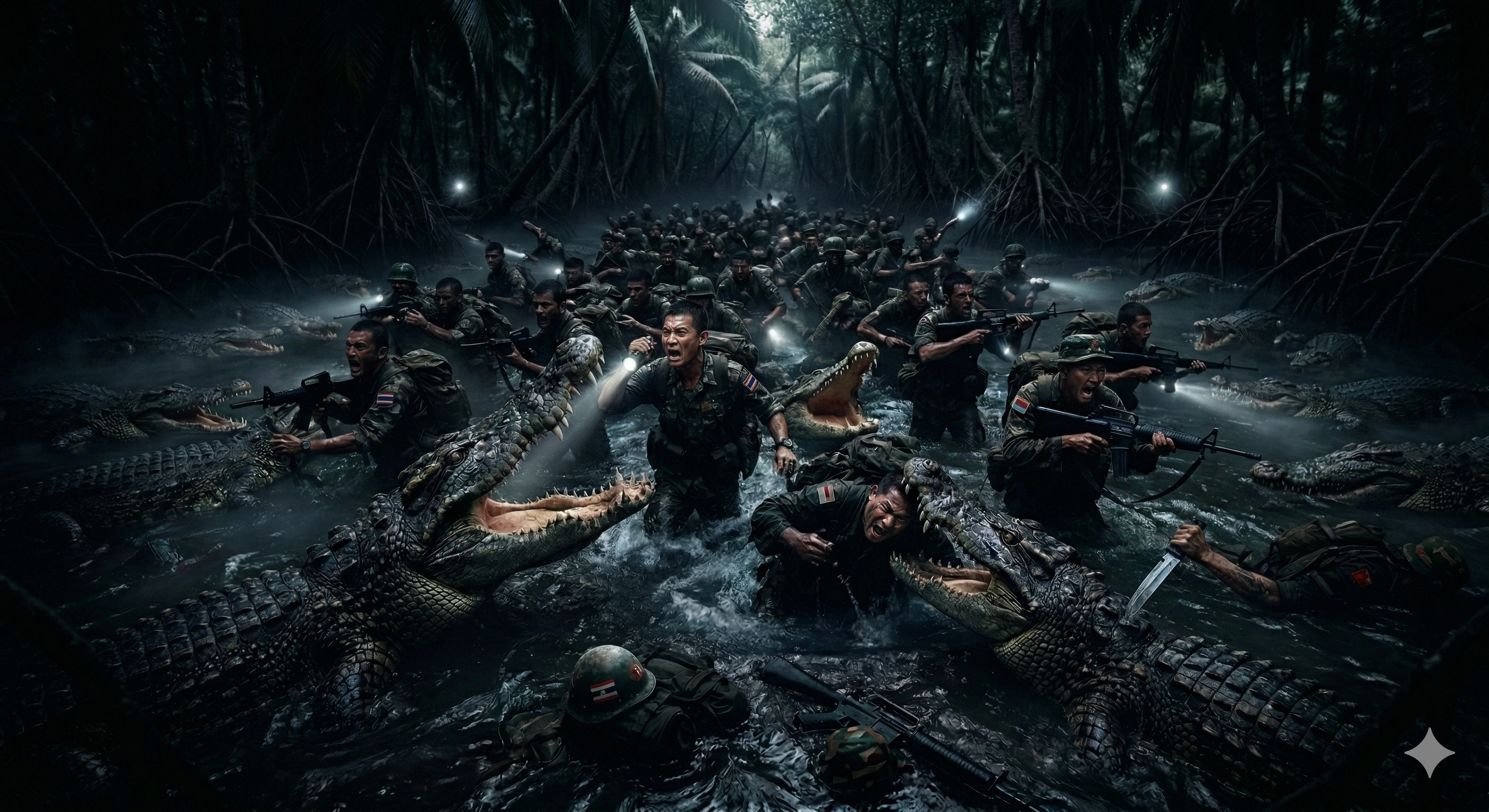
It is the night of 19 February 1945. The air is thick with humidity and the rotten-egg stench of mangrove mud. Nearly a thousand Japanese soldiers—exhausted, wounded, many suffering from tropical diseases—wade into the swamp in near-total darkness. Behind them, British forces have sealed every exit. Ahead lies 16 kilometers of waist-deep water, tangled roots, and sucking mud.
The first hours are a slog of exhaustion. Men stumble and fall. Equipment is lost. Wounds reopen in the brackish water. Then the sounds begin—a splash that is not a footstep, a low hiss from the darkness, the sudden violent thrashing of water as something large strikes. A scream cuts the night, then another. Rifle shots crack randomly into the blackness, hitting nothing or hitting men. The swamp itself seems to devour them. Some drown in mud. Some succumb to infection. Some are pulled beneath the waterline by forces they never see.
By morning, the vultures come. Of the nearly one thousand men who entered the swamp, only twenty will emerge alive on the British side of the perimeter. The rest vanish into the mangrove—consumed by war, by nature, or by something in between.
To this day, no one knows the exact proportion.
Evidence
No systematic forensic recovery of remains was conducted. The swamp terrain made body retrieval impossible for most casualties. No crocodile stomach contents were examined.
Documentary Evidence: Reuters dispatch of 24 February 1945 references crocodile killings. Bruce Wright’s 1962 account provides the canonical narrative. British military operational reports (Operation Block) document the Japanese retreat into the swamp but do not specifically attribute casualties to crocodiles.
Testimonial Evidence: Wright’s account is secondhand (assembled from motor launch crew reports). No Japanese survivor testimony corroborates mass crocodile predation. Local Burmese villagers (Platt, 1998) rejected the narrative. Japanese War Office (1974) could not confirm.
Scientific Evidence: Platt (1998) argued the mangrove ecosystem could not support the thousands of crocodiles implied by the massacre narrative. Historian Frank McLynn raised the same ecological objection. Saltwater crocodiles were subsequently eradicated from Ramree Island by the late 20th century.
Guinness Record: Listed as “Most Number of Fatalities in a Crocodile Attack” in some editions, though the record’s accuracy has been questioned. Guinness partnered with National Geographic Channel to reinvestigate in 2016.
Theories
Theory 1: Mass Crocodile Predation (The Wright Narrative)
Hundreds of Japanese soldiers were killed by saltwater crocodiles in a feeding event of unprecedented scale. The swamp’s dense crocodile population attacked the soldiers en masse during the night. Proponents cite Wright’s eyewitness-adjacent account, the Reuters dispatch, and the Guinness record. Critics note Wright was not present, no Japanese testimony exists, and the ecosystem could not support the implied crocodile numbers.
Theory 2: Multi-Cause Mortality (Revised Consensus)
The vast majority of the approximately 500 deaths resulted from a combination of British gunfire (especially the attempted channel crossing discovered on 18 February), drowning in deep mud and tidal channels, tropical disease, dehydration, starvation, and suicide. Crocodiles were present and almost certainly killed some soldiers—perhaps 10–15—but were a contributing hazard, not the primary cause. Crocodiles likely also scavenged corpses, which may have inflated the perception of predation. This is the current position of most modern historians and herpetologists.
Theory 3: Deliberate British Propaganda
The crocodile narrative was exaggerated or fabricated as wartime propaganda to demoralize Japanese forces and justify the British strategy of containment rather than direct assault. The story served British interests by framing nature itself as an ally. No definitive evidence of deliberate fabrication has been found, but the absence of the narrative from official military reports is notable.
Theory 4: Ecological Memory
While the 1945 incident may be exaggerated, Ramree Island’s mangrove swamps historically supported a significant saltwater crocodile population that posed genuine danger to human life. The “massacre” narrative may be a compression of decades of human–crocodile conflict into a single dramatic event. Saltwater crocodiles were eventually eradicated from the island by the 1960s.
Theory 5: Post-Hoc Mythologization
A genuine but modest number of crocodile fatalities (perhaps 10–50) was inflated through successive retellings—Wright’s 1962 account, Caras’s 1964 amplification, Guinness’s institutional endorsement—into a legend that took on a life of its own. The story’s irresistible dramatic quality (soldiers devoured by prehistoric predators) ensured its survival in popular culture regardless of its accuracy.
Analysis
From a cultural perspective, the Ramree Island massacre sits at the intersection of wartime myth-making and humanity’s primal fear of predation. The image of soldiers—armed, trained, and organized—being helpless before natural predators inverts the usual narrative of human dominance over nature and creates a story of almost mythological power.
Psychologically, the narrative taps into thalassophobia (fear of deep water), nyctophobia (fear of darkness), and a deep evolutionary dread of reptilian predators. The story persists not because it is well-documented, but because it is terrifying in a way that resonates at the most fundamental level of human anxiety.
Historically, the Ramree incident serves as a case study in how a single unreliable account—elevated by institutional endorsement (Guinness) and successive amplification (Caras)—can become an accepted “fact” that resists correction for decades. The 1998 Platt investigation and the 2016 Willis/National Geographic reinvestigation represent important correctives, but the myth remains far better known than the debunking.
Scientifically, the case raises important questions about saltwater crocodile behavior. While individual predation on humans is well-documented (approximately 1,000 fatalities annually worldwide), no verified instance of coordinated mass predation of the scale claimed at Ramree has ever been confirmed.
Conclusion
Case Status: Open — Disputed
Something terrible happened in the mangrove swamps of Ramree Island in February 1945. Approximately 500 Japanese soldiers died during a desperate retreat through one of the most hostile environments on Earth. That crocodiles were present and killed some of these men is almost certain. That crocodiles killed hundreds in a single night of unprecedented mass predation is almost certainly false.
The case remains formally open within this dossier because: (a) no systematic forensic investigation was ever conducted; (b) the true number of crocodile fatalities remains unknown; (c) the ecological conditions of 1945 Ramree—including the actual size of the crocodile population—can never be fully reconstructed; and (d) the absence of Japanese survivor testimony leaves a critical gap in the historical record.
Unanswered Questions: What exactly did the British motor launch crews hear that night? How large was the saltwater crocodile population of Ramree in 1945? Why does the incident appear in no official military reports despite its extraordinary nature? Could a combination of individual predation and post-mortem scavenging account for the physical evidence that Wright’s informants observed?
Education & Sources
Wright, B.S. (1962). Wildlife Sketches Near and Far. Fredericton: Brunswick Press.
Caras, R. (1964). Dangerous to Man: The Definitive Story of Wildlife’s Reputed Dangers. New York: Holt, Rinehart and Winston.
Platt, S.G. et al. (1998). “Man-Eating by Estuarine Crocodiles: The Ramree Island Massacre Revisited.” Herpetological Bulletin, No. 63.
McLynn, F. (2011). The Burma Campaign: Disaster into Triumph, 1942–1945. London: Vintage.
Willis, S. (2016). National Geographic Channel Investigation: Ramree Island. Unpublished research documents and British military records.
Allen, L. (1984). Burma: The Longest War 1941–1945. London: Dent.
Tags
##ramree-island##crocodile-massacre##wwii##saltwater-crocodile##burma##myanmar##wartime-mystery##animal-attack##disputed-history##mangrove-swamp##bruce-wright##guinness-record##human-predation##1945##operation-block