Category|Deep Sea & Underwater
Subcategory|Sea Creatures
Credibility Grade|CLASS PLAUSIBLE
Last updated: 08 Apr 2026
Quick Summary
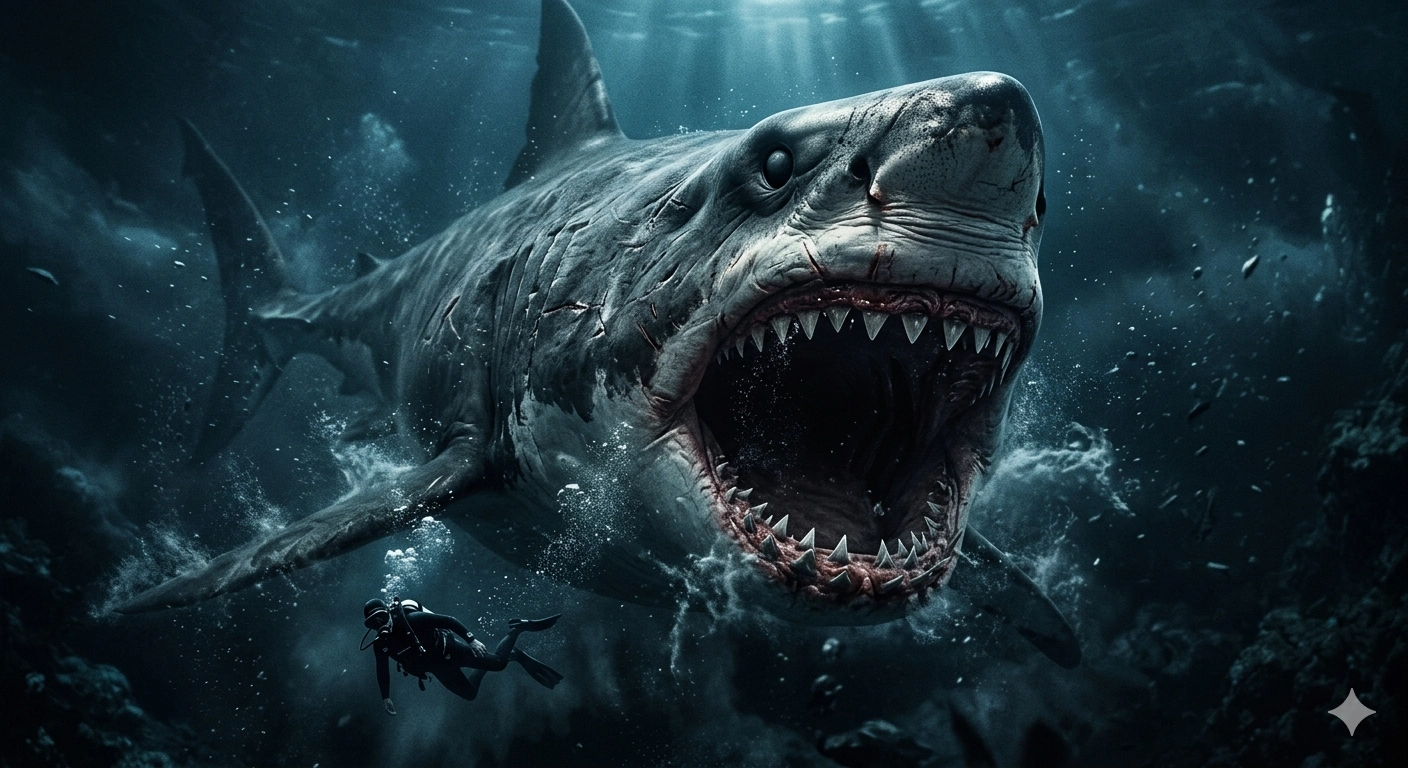
Otodus megalodon, the largest shark to ever roam Earth’s oceans, is widely believed to have gone extinct approximately 3.6 million years ago. Yet persistent eyewitness reports, anomalous deep-sea sonar readings, and the ocean’s vast unexplored depths continue to fuel speculation that a surviving population may lurk in the abyss.
Key Facts
CountryGlobal
Year1918-Present
TypeCryptozoology / Paleontology / Marine Mystery
Overview
Otodus megalodon dominated the world’s oceans for roughly 20 million years, growing to estimated lengths of 15–18 meters with jaws capable of producing bite forces exceeding 180,000 newtons. Its fossilized teeth—some exceeding 17 centimeters—have been found on every continent.
The mainstream scientific consensus holds that megalodon went extinct during the Pliocene epoch, driven by cooling ocean temperatures, shifting prey migration patterns, and competition from early great white sharks. However, the discovery of relatively “fresh” megalodon teeth dredged from the Pacific seafloor in the late 19th century (initially dated to only 10,000–15,000 years ago, though later re-dated) ignited a debate that has never fully subsided.
The central question persists: could a population of apex predators of this scale remain undetected in an ocean that is 95% unexplored below 1,000 meters?
Timeline
23 MYA: Earliest megalodon ancestors appear in the fossil record. 3.6 MYA: Accepted extinction date based on the most recent verified fossil evidence. 1875: HMS Challenger expedition dredges megalodon teeth from the Pacific seafloor; manganese dating initially suggests ages of 10,000–15,000 years. 1918: Australian naturalist David Stead documents fishermen’s accounts of an enormous shark “well over 100 feet” in waters off Broughton Island, NSW. 1960s–1980s: Sporadic reports of abnormally large sharks from South African and Polynesian waters. 2013: Discovery Channel airs “Megalodon: The Monster Shark Lives,” a widely criticized mockumentary that reignites public interest. 2019–present: Advances in deep-sea autonomous vehicle technology reveal previously unknown ecosystems below 4,000 meters, renewing scientific interest in deep-ocean megafauna.
Witness Accounts
The most cited account comes from David Stead’s 1963 book “Sharks and Rays of Australian Seas.” Stead interviewed crayfish divers from Nelson Bay who refused to return to the water after encountering an impossibly large shark. The fishermen described a creature that dwarfed their boats and had a head “at least as long as the wharf.”
Additional unverified accounts include: a 1960s South African naval report describing sonar contact with an object “the size of a whale but moving like a fish” at 900 meters depth; and multiple Polynesian oral traditions referencing a “devil shark” that surfaces only during deep-water upwelling events.
▶ CINEMATIC SECTIONCinematic Reconstruction
t is 1918. The Tasman Sea churns under a grey sky. A fleet of small crayfish boats sits anchored off Broughton Island, nets heavy with the morning’s haul. Then the water changes. The surface flattens unnaturally, as if pressed from below. A shadow rises—longer than the boats, wider than anything the fishermen have seen in lifetimes on the sea. The creature moves slowly, deliberately, its dorsal fin cutting the water like a blade the height of a man. Nets, pots, and crayfish vanish into its wake. No one speaks. No one moves.
They never return to that site.
Decades later, the question remains: what did they see?
Evidence
Physical Evidence: Fossilized teeth found globally; Challenger expedition specimens with contested dating; no verified modern physical remains.
Sonar/Acoustic: Unverified sonar anomalies in deep-sea trenches reported by military and research vessels.
Photographic/Video: No verified imagery. All circulated photographs have been debunked or traced to known species.
Biological: Bite marks on whale carcasses occasionally attributed to megalodon, though most are consistent with known large shark species.
Theories
Theory 1: Deep-Ocean Refugium
A remnant population survives in deep-ocean trenches (below 4,000 m), feeding on deep-sea whale species and giant squid. Proponents argue the ocean’s unexplored volume provides sufficient habitat. Critics note megalodon’s known physiology was adapted for warm, shallow coastal waters.
Theory 2: Standard Extinction
Megalodon went extinct 3.6 MYA due to ocean cooling, prey base collapse, and competition. The Challenger teeth were contaminated by manganese accretion that produced misleading dates. This is the consensus scientific position supported by the fossil record.
Theory 3: Recent Extinction
Megalodon survived significantly longer than the accepted date—possibly into the Pleistocene or even the Holocene—but is now fully extinct. The Challenger specimens and indigenous oral traditions may preserve memory of a more recent overlap with human history.
Theory 4: Misidentification
All modern sightings are misidentifications of known species: whale sharks, basking sharks, or unusually large great whites. The psychological impact of encountering large marine animals in open water produces exaggerated size estimates.
Theory 5: Convergent Evolution
A separate, unrelated species of giant shark has evolved to fill a similar ecological niche in the deep ocean. This would explain sightings without requiring megalodon survival.
Analysis
From a cultural perspective, the megalodon occupies a unique position at the intersection of paleontology and cryptozoology. Unlike most cryptids, megalodon’s existence is not in question—only its continued survival. This lends the case a legitimacy that purely mythological creatures lack.
Psychologically, the megalodon represents humanity’s deep-seated fear of the ocean’s unknown depths—thalassophobia given teeth. The creature’s persistence in popular culture (films, documentaries, video games) reflects an almost archetypal anxiety about what lies beneath.
Scientifically, the case serves as a valuable lens for examining the limits of negative evidence. The absence of modern megalodon remains is strong evidence of extinction, but it is not proof—and the ocean’s sheer volume makes definitive claims of absence extraordinarily difficult.
Conclusion
Case Status: Open — Under Review
The scientific consensus overwhelmingly supports megalodon’s extinction 3.6 million years ago. However, the case remains formally open within this dossier due to: (a) the ocean’s vast unexplored volume; (b) the ongoing discovery of “living fossils” in deep-sea environments; and (c) unresolved questions surrounding the Challenger teeth dating.
Unanswered Questions: Could a cold-adapted megalodon variant have survived in deep water? What explains recurring large-shark sightings in the South Pacific that do not match known species profiles? Will autonomous deep-sea exploration vehicles eventually provide definitive evidence?
Education & Sources
Pimiento, C. & Clements, C.F. (2014). “When Did Carcharocles megalodon Become Extinct?” PLOS ONE, 9(10). DOI: 10.1371/journal.pone.0111086
Stead, D.G. (1963). Sharks and Rays of Australian Seas. Angus & Robertson, Sydney.
Shimada, K. et al. (2023). “Megalodon Body Size and Feeding Ecology.” Historical Biology, 35(8).
Collareta, A. et al. (2021). “Bite Marks on Fossil Whale Bones.” Palaeogeography, Palaeoclimatology, Palaeoecology.
Kent, B.W. (2018). The Cartilaginous Fishes of Calvert Cliffs. Smithsonian Contributions to Paleobiology.
Tags
##megalodon #cryptozoology #marine-mystery #deep-ocean #paleontology #giant-shark #living-fossil #unexplored-ocean #sonar-anomaly #apex-predator