TWO-MINUTE SUMMARY
A centuries-long treasure claim, excavation history and unresolved questions on Oak Island.
KEY FACTS
- type
- Archaeological Mystery / Treasure Legend / Engineering Anomaly
- year
- Summer 1795
WHAT THE RECORD ACTUALLY SAYS
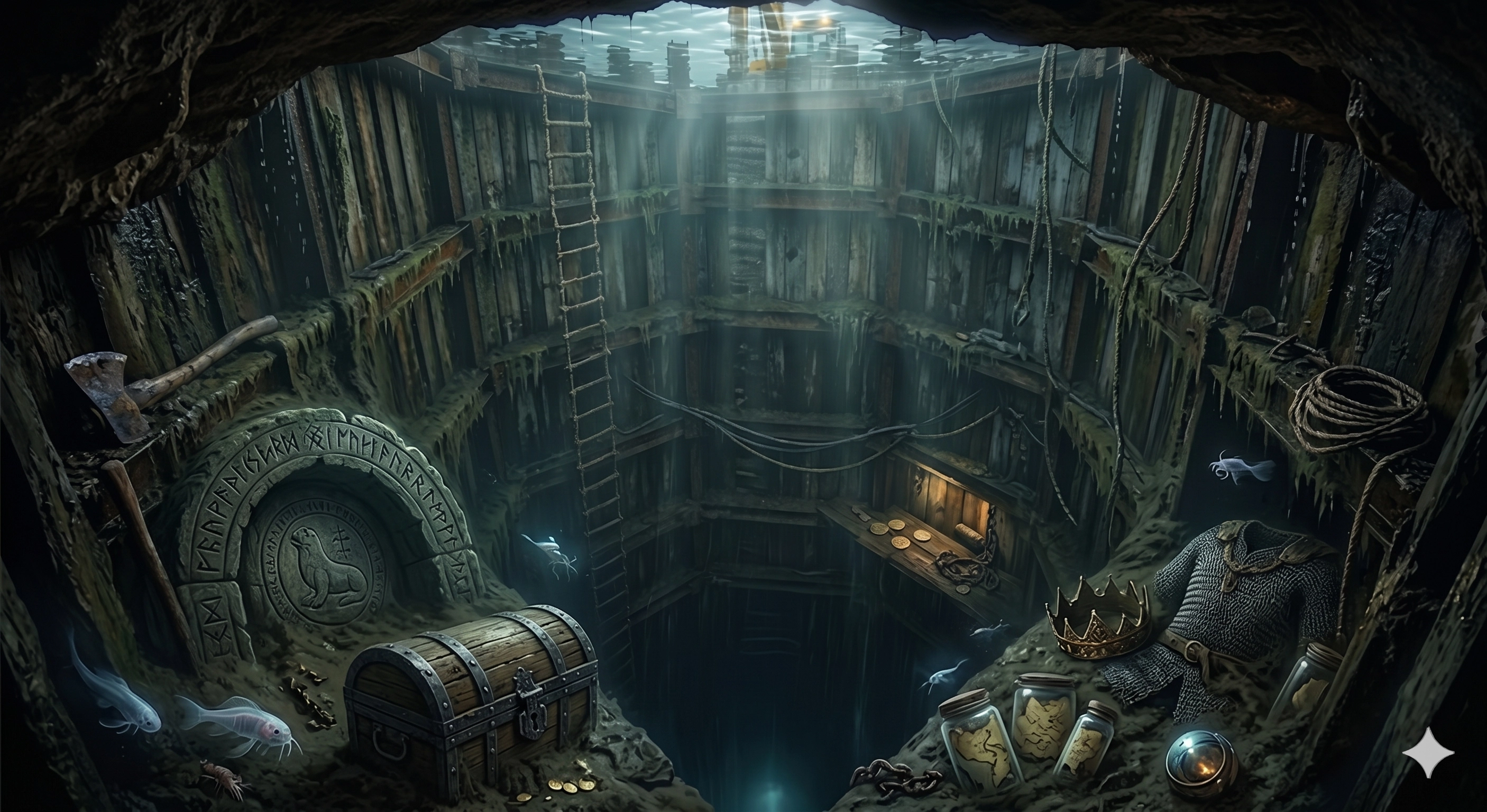
Oak Island is a 140-acre island in Mahone Bay, one of approximately 360 islands scattered along the Atlantic coast of Nova Scotia. It is low, wooded, and unremarkable in every way except one: for 230 years, people have believed that something is buried beneath it, and they have been willing to die trying to find out what. The story begins in 1795, when three teenage boys discovered a circular depression in the ground beneath an old oak tree. Above the depression, a branch appeared to have been used as a crude derrick, with marks suggesting a block-and-tackle had once hung from it. The boys began to dig. At two feet, they found a layer of flagstones not native to the island. At ten feet, they hit a platform of oak logs fitted tightly into the walls of the shaft. At twenty feet, another platform. At thirty feet, another. They stopped. They could go no deeper alone. But the regularity of what they had found— engineered platforms at precise intervals, in a shaft that had clearly been dug and backfilled by human hands—convinced them that something had been deliberately buried at great depth, with extraordinary effort. They were right about the effort. Whether they were right about the treasure remains, 230 years later, an open question. What followed was one of the longest, most expensive, and most deadly treasure hunts in human history. Expedition after expedition dug deeper into the pit, only to be defeated by flooding that seemed to come from nowhere. Engineers eventually determined that at least one tunnel had been dug from nearby Smith’s Cove to the pit, designed to flood the shaft with seawater as soon as diggers reached a certain depth—an apparent booby trap of remarkable sophistication. Whoever built the pit, the reasoning went, had gone to extraordinary lengths to protect whatever lay at the bottom. Or had they? Skeptics have argued since at least 1911 that the pit is a natural sinkhole—a geological feature created by the dissolution of underlying limestone and gypsum, into which trees and debris naturally fall, creating the appearance of engineered platforms. The “flood tunnels,” they suggest, are natural fissures connecting the island’s underground water table to the sea. The “coconut fiber” may be the remains of a colonial-era tar kiln. And the “treasure” may be nothing more than 230 years of accumulated hope.
TIMELINE
1795
Daniel McGinnis, John Smith, and Anthony Vaughan discover the pit. They dig to ~30 feet, finding flagstones and oak platforms every 10 feet.
1803
The Onslow Company organizes the first formal excavation. Diggers reach ~90 feet, finding more platforms, layers of charcoal, putty, and coconut fiber (the latter not native to Nova Scotia). At ~90 feet, a flat stone with encoded symbols is reportedly found. At 93 feet, water begins seeping in. At 98 feet, a crowbar strikes something hard—some say wood, others a chest. The men leave for the night. By morning, the pit is flooded to within 33 feet of the surface. All pumping efforts fail.
1804–1805
The Onslow Company digs a parallel shaft to 110 feet and attempts to tunnel laterally to the pit. Water floods the new shaft as well. The company abandons the effort.
1849
The Truro Company resumes excavation. A pod auger is drilled through the flooded pit. At ~98 feet, it passes through a spruce platform, then 12 inches of what the drill team calls “metal in pieces,” then oak, then more “metal in pieces,” then another spruce platform. Fragments of chain links and what appear to be parchment are brought to the surface. This is interpreted as having drilled through two chests or casks.
1850
The Truro Company discovers the flood tunnel from Smith’s Cove. An artificial beach of coconut fiber and eel grass is found, apparently designed as a filtration system feeding seawater into the tunnel. The tunnel is estimated at ~150 meters long.
1861
The Oak Island Association re-excavates to 88 feet. The bottom collapses into a presumed void below, dropping the contents an estimated 15 feet. Water fills the shaft.
1893
The Oak Island Treasure Company drills additional boreholes. Claims of finding cement, iron, wood, and parchment at various depths. A small piece of parchment with apparent writing is the most significant find.
1909
A young Franklin D. Roosevelt invests in an Oak Island expedition through the Old Gold Salvage group. He maintains interest in the mystery for the rest of his life.
1936–1938
Gilbert Hedden excavates and claims to identify correspondences between Oak Island and a map allegedly drawn by Captain Kidd.
1959–1965
Robert Restall and his family move to Oak Island to search full-time. On August 17, 1965, Restall, his son Robert Jr., Karl Graeser, and Cyril Hiltz die after being overcome by fumes (likely hydrogen sulfide or carbon monoxide) in a shaft. A fifth man nearly dies attempting rescue.
1960s–2000s
Dan Blankenship and David Tobias conduct extensive excavations including the drilling of Borehole 10-X, a 235-foot steel-cased shaft. Underwater cameras lowered into a cavern at the bottom capture ambiguous images—some claim to see a chest, a hand, and a body. None are confirmed.
2005–present
Marty and Rick Lagina acquire controlling interest in Oak Island Tours Inc. Their excavation is documented in “The Curse of Oak Island” on History Channel (premiered 2014, Season 13 in 2025). Discoveries include a lead cross with possible Templar connections, a gemstone-set brooch, 14th-century pottery, wood carbon-dated to the 1400s–1700s, and refined gold particles in soil samples.
SELECTED EVIDENCE
Physical Evidence: Oak log platforms at 10-foot intervals (confirmed by multiple expeditions); coconut fiber layers (not native to Nova Scotia, confirmed by botanical analysis); putty and charcoal seals; parchment fragment (recovered by Truro Company auger); inscribed stone (descriptions survive; stone lost c. 1900s); lead cross (found by Laginas, pending further analysis); gemstone brooch; 14th-century pottery fragments; wood dated 1400s–1700s by radiocarbon; refined gold particles in Money Pit soil; bone fragments. Structural Evidence: Flood tunnel(s) connecting to Smith’s Cove (confirmed by multiple investigators); artificial beach construction at Smith’s Cove with coconut fiber filtration; apparent engineered shaft with regular platform spacing. Geological Counter-Evidence: Island sits on glacial deposits over limestone and gypsum bedrock prone to dissolution and sinkhole formation; natural caverns and underground water channels exist on nearby mainland; tidal water infiltration occurs naturally at depth on coastal islands. Absence of Evidence: No treasure recovered. No intact chamber reached. Original shaft location lost. Inscribed stone missing. No definitive identification of builders. No confirmed treasure item.
WHAT REMAINS UNCERTAIN
The Oak Island Money Pit is perhaps the purest example in existence of what might be called a self-sustaining mystery. Unlike most unsolved cases, which grow cold over time, Oak Island becomes more compelling with each failure. Every flooded shaft is interpreted as evidence of engineering sophistication. Every collapsed tunnel is proof that the builders were smarter than the seekers. Every piece of ambiguous debris is a “clue.” The mystery feeds on its own resistance to solution. From an archaeological perspective, the Lagina brothers’ discoveries are the most significant development in the pit’s history. Items carbon-dated to the 14th–17th centuries suggest that someone was on Oak Island long before the 1795 discovery. Whether that “someone” was a pirate, a Templar, a colonial officer, or an indigenous person remains unknown. From a psychological perspective, Oak Island is a study in the sunk-cost fallacy—the cognitive bias that causes people to continue investing in a losing proposition because they have already invested so much. Two centuries of digging, six deaths, and millions of dollars create an almost irresistible pressure to continue. To stop is to admit that all of it was for nothing. The pit demands one more try. From an engineering perspective, the flood tunnel—if man-made—represents a remarkable feat. Constructing a 150-meter tunnel below the water table, connecting it to an artificial filtration beach, and designing it to activate at a specific depth would have required significant labor, expertise, and planning. This is either evidence of a sophisticated builder with access to considerable resources, or it is evidence of the human tendency to see design in natural phenomena. The truth of Oak Island may ultimately be simpler and more disappointing than any theory suggests. Or it may be stranger and more significant than anyone imagines. The pit keeps its counsel. The water keeps rising. And the digging goes on.
SELECTED SOURCES
Selected source notes are being prepared. The public record will be expanded as material is reviewed.