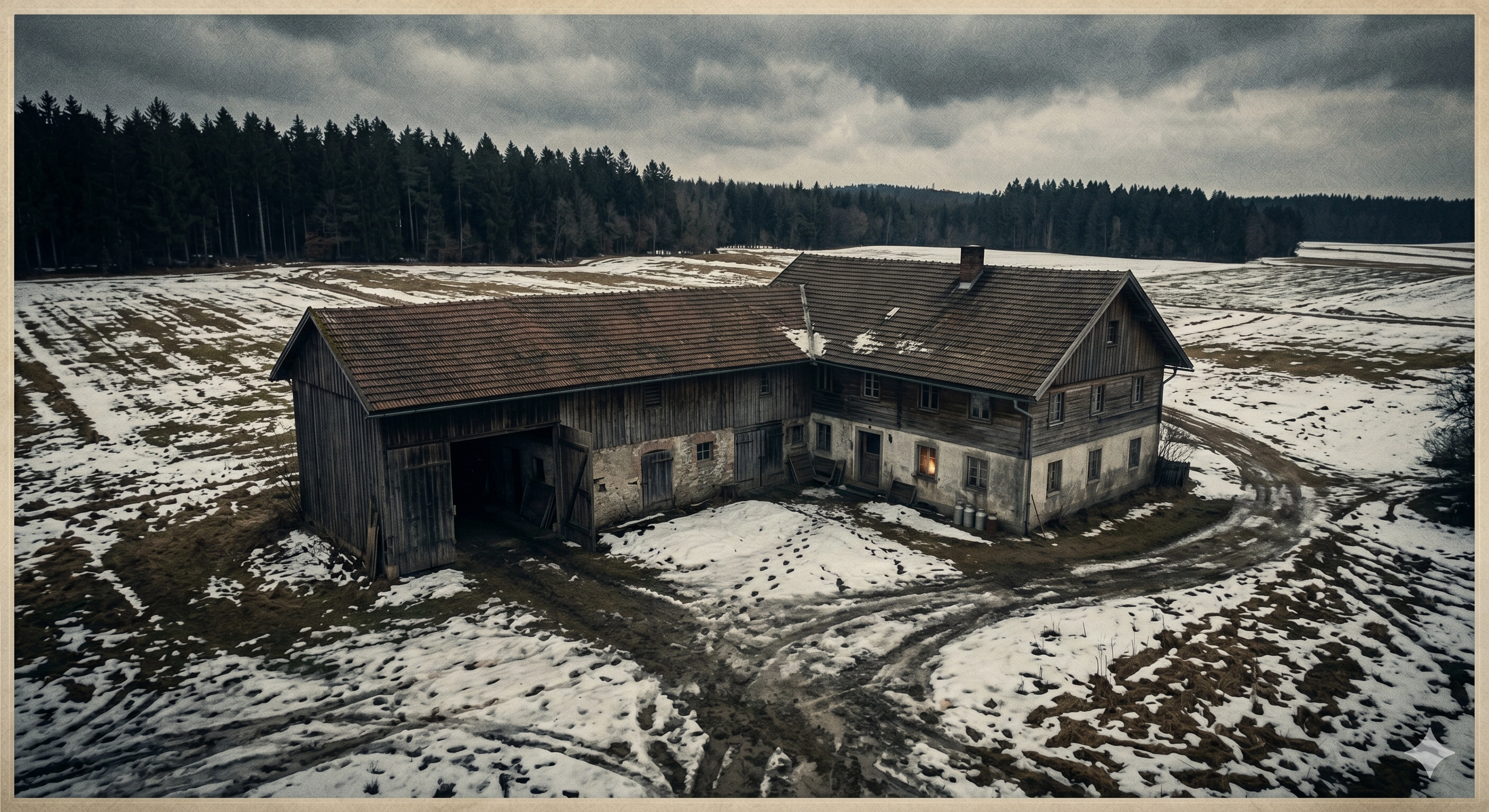
TWO-MINUTE SUMMARY
The 1922 Hinterkaifeck killings, the investigation and unanswered questions.
KEY FACTS
- country
- Germany
- type
- Unsolved True Crime / Mass Murder / Rural Horror / Weimar-Era Germany
- year
- 1922
WHAT THE RECORD ACTUALLY SAYS
The Hinterkaifeck murders are Germany’s most famous unsolved crime—and arguably the most disturbing unsolved mass murder in European history. What makes the case unforgettable is not the killing itself, which was brutal but straightforward (six people, one weapon, one night), but what happened before and after. Before: someone was watching. The footprints in the snow—leading in but not out—suggest that an intruder approached the farm from the forest and did not leave. The noises in the attic, the missing key, the mysterious newspaper—all point to someone who had infiltrated the property and was living inside it, unseen, while the family went about their daily lives. The previous maid quit because she believed the house was haunted. It was not haunted. It was occupied. After: someone stayed. For three to four days after killing six people, the murderer remained on the farm. They fed the animals. They ate the family’s food. They turned the page on the calendar. They lived, quietly and methodically, in a house with six corpses. This behavior—neither flight nor panic but calm, domestic routine—is what has haunted investigators and true-crime researchers for over a century. It suggests a killer who felt entitled to be there. Who was comfortable. Who was in no hurry. The case sits at the intersection of multiple dark currents in early Weimar Germany: rural isolation, family scandal (the incest conviction), the rise of far-right paramilitary organizations (Freikorps Oberland), and a police system that was 45 miles away and arrived at a crime scene already trampled by dozens of neighbors. The farm was demolished a year later. The evidence is gone. The suspects are dead. And the question—who stayed in that house for four days after killing everyone in it?—has no answer.
TIMELINE
c. 1863
Hinterkaifeck farmstead built. Owned by the Gruber family.
1912–1914
Andreas Gruber and his daughter Viktoria are accused of incest via anonymous report. Both are tried and convicted. Andreas serves one year in prison; Viktoria serves a shorter sentence. The scandal is known throughout the local community.
1914
Viktoria’s husband Karl Gabriel leaves for World War I. He is killed in action in 1914 (officially declared dead in 1917). Viktoria returns to live at Hinterkaifeck with her parents and children.
1920
Josef Gabriel is born. Paternity is uncertain; Lorenz Schlittenbauer, a neighboring farmer, acknowledges paternity. The local community widely suspects that Andreas is the actual father.
Late 1921 / Early 1922
The family’s maid quits, reportedly telling people that the farmhouse is “haunted” after hearing unexplained footsteps in the attic.
March 1922 (weeks before)
Andreas finds a strange Munich newspaper on the property that no one purchased. No one in the area subscribes to this newspaper. He initially blames the postman (who denies it).
Late March 1922 (days before)
Andreas discovers fresh footprints in the snow leading from the forest to the farm. The tracks lead only one direction—toward the farm. There are no return tracks. He tells neighbors but does not report it to police. That same night, the family hears footsteps in the attic. Andreas searches and finds no one. A house key goes missing. A lock on the machine room door is found broken.
30 March 1922
According to a school friend of Cäzilia Gabriel (age 7), young Cäzilia reported that her mother Viktoria fled the farmstead the previous night after a violent argument with Andreas, and was found in the forest hours later.
31 March 1922 (afternoon)
New maid Maria Baumgartner arrives at Hinterkaifeck, escorted by her sister. The sister leaves after a short stay—likely the last person to see the household alive.
31 March 1922 (late evening)
The murders. Andreas, Cäzilia Sr., Viktoria, and young Cäzilia are lured one by one to the barn through the stable and killed with a mattock. Bodies are stacked and covered with hay. The killer enters the house and murders baby Josef in his crib and Maria Baumgartner in her bed.
1–3 April 1922
The killer remains on the farm. Livestock are fed. Food is consumed. The calendar is turned from March 31 to April 1. Smoke is seen from the chimney. Mail accumulates at the post office.
1 April
Coffee sellers Hans and Eduard Schirovsky arrive to take an order but cannot gain entry.
3 April
Seven-year-old Cäzilia has now missed three days of school. Neighbors grow alarmed.
4 April 1922
A group including Lorenz Schlittenbauer enters the farm. They discover the four bodies in the barn (covered with hay) and the two bodies in the house. Police in Munich are notified.
5 April 1922
Dr. Johann Baptist Aumüller performs autopsies inside the barn. Cause of death: blunt force trauma to the head. Weapon: mattock.
April–May 1922
Lead investigator Georg Reingruber from Munich conducts investigation. Crime scene has been extensively contaminated by neighbors. Over 100 suspects are identified and interviewed. No charges are filed.
1923
Farm is demolished. During demolition, a blood-stained mattock is found hidden in the attic and a penknife is found in the barn hay. These are the last pieces of physical evidence.
1925
Schlittenbauer is discovered visiting the demolished farm site. When asked why, he states that the killer’s attempt to bury the bodies in the barn was “hindered by frozen ground”—a detail that implies intimate knowledge of the conditions at the time of the murders.
1941
Schlittenbauer dies without ever being charged. He had won several slander lawsuits against people who called him the murderer.
2007
German police re-examine the case using modern forensic techniques. No definitive conclusion is reached.
Present
The case remains officially unsolved. The site where the farm stood has become a pilgrimage site for true-crime enthusiasts.
SELECTED EVIDENCE
Physical: Mattock (found in attic during 1923 demolition, blood-stained); penknife (found in barn hay); bodies with documented injuries (autopsy reports by Dr. Aumüller, 5 April 1922); footprints in snow (observed by Andreas, not preserved); mysterious newspaper; broken lock on machine room. Crime Scene: Extensively contaminated before police arrival. Bodies in barn (covered with hay), baby in crib, maid in bed. Calendar turned to 1 April. Kitchen showed evidence of meal preparation. Livestock had been fed. Testimonial: Neighbors’ accounts of Andreas’s reports (footprints, attic sounds, newspaper); previous maid’s account of “haunted” house; Cäzilia Gabriel’s school friend (Viktoria’s flight to forest); Schlittenbauer’s 1925 comment about frozen ground. Circumstantial: Incest conviction (1914); paternity dispute over Josef; Schlittenbauer’s behavior; Gump’s Freikorps connection; dark-coated figure observed near farm. Forensic (2007): Cold-case re-examination using modern techniques. Results not fully published. No charges filed.
WHAT REMAINS UNCERTAIN
The Hinterkaifeck case is distinguished by two features that no other unsolved murder case possesses in combination: the pre-crime evidence of an intruder already living inside the home, and the post-crime evidence of the killer remaining for days in a house full of corpses. Together, these features create a psychological profile that is more disturbing than the killing itself: a person who was patient enough to wait, methodical enough to kill six people one by one, and comfortable enough to stay. The crime scene contamination is the case’s greatest forensic tragedy. In 1922, there was no concept of crime-scene preservation in rural Bavaria. By the time professional investigators arrived, the evidence was irretrievably compromised. The 2007 re-examination attempted to recover what could be recovered, but a century of degradation—and the demolition of the farm itself in 1923—had eliminated most physical evidence. The incest dimension adds a layer of complexity that the original investigation struggled to address. In 1920s rural Bavaria, the social taboo around incest was so severe that investigators may have been reluctant to pursue lines of inquiry that would expose the family’s shame posthumously. Dr. Christian Hardinghaus has argued that the “social taboos of the time” shaped and constrained the investigation in ways that would not apply today. The case’s enduring power lies in its details. Not the murder itself—which, while terrible, is the kind of crime that occurs throughout human history—but the specifics: the one-way footprints, the attic sounds, the maid who lasted one day, the child alive in the barn, the calendar turned to a new day by hands that had just killed six people. These details refuse to become abstract. They remain vivid, specific, and horrifying after more than a hundred years.
SELECTED SOURCES
Selected source notes are being prepared. The public record will be expanded as material is reviewed.