
View Case File
PLAUSIBLE
THE VARGINHA UFO INCIDENT: Brazil’s Roswell — Crash, Creatures, and Cover-Up
1996
Last updated: 18 Apr 2026
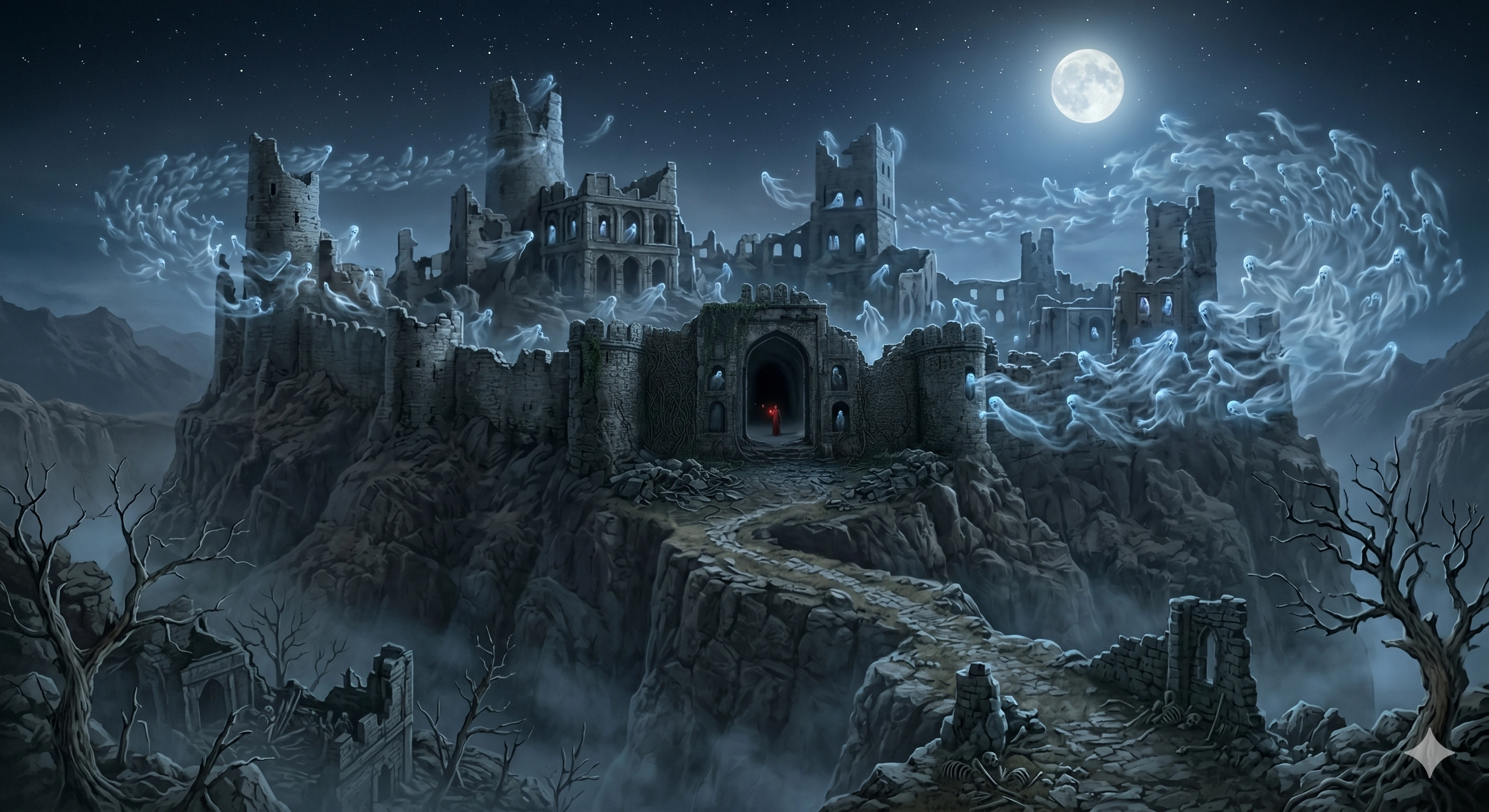
Bhangarh Fort in the Aravalli Hills of Rajasthan, approximately 83 kilometers from Jaipur, is officially designated as India's most haunted location. Built in 1573 by Raja Madho Singh I, the sprawling complex of palaces, temples, marketplaces, and grand havelis once housed over 10,000 people. It was completely abandoned by the early 19th century. The Archaeological Survey of India prohibits entry between sunset and sunrise. Two curse legends explain the abandonment: (1) an ascetic named Baba Balu Nath cursed the city when its shadow fell upon his dwelling, and (2) a tantrik sorcerer named Singhia cursed the entire city after Princess Ratnavati discovered and turned his love potion against him. Over 200,000 visitors annually report shadowy figures, a woman in a black sari, disembodied voices, sudden temperature drops, and electronic equipment failures.
Bhangarh is not merely a haunted building. It is a haunted city—an entire urban settlement, complete with streets, markets, temples, palaces, and residential quarters, all abandoned, all decaying, all standing empty in the Aravalli Hills as if the population simply walked out one day and never came back. The scale is what distinguishes Bhangarh from other haunted sites: this is not a single room or a lone tower but a complete human settlement, with all the infrastructure of daily life, from which daily life has been completely and permanently removed.
The fort sits in a landscape of extraordinary beauty. The Aravallis—one of the oldest mountain ranges on Earth—roll away in every direction, covered in scrub forest and punctuated by rocky outcrops. Sariska Tiger Reserve lies nearby. The air is dry and hot for most of the year, cooling only in the brief Rajasthani winter. The ruins are overgrown with vegetation that has been slowly reclaiming the sandstone for two centuries, giving the site an atmosphere that oscillates between romantic decay and genuine menace depending on the light, the time of day, and the state of the visitor's nerves.
The combination of documented history (Rajput kingdom, Mughal-era construction, verifiable decline), rich folklore (two competing curse legends with named characters), official government restriction (the ASI sunset prohibition), and persistent contemporary paranormal reports creates a case that operates on multiple levels simultaneously. Bhangarh is history, legend, tourism, and mystery all at once—and the boundaries between these categories are as weathered as the fort's walls.
Raja Madho Singh I founds the city of Bhangarh and begins construction of the fort and palace complex in the Aravalli Hills.
Bhangarh flourishes as a prosperous Rajput settlement. Over 9,000 houses constructed. Markets, temples, havelis, and royal quarters built within three concentric fortification walls.
According to legend, ascetic Baba Balu Nath grants permission for construction on condition no shadow fall on his dwelling. Princess Ratnavati attracts attention of tantrik sorcerer Singhia.
King Ajab Singh raises fortifications, violating the ascetic's condition. In the Ratnavati legend, the princess destroys Singhia; his dying curse condemns the city. Bhangarh is attacked within a year.
Population begins to decline. Causes debated: famine, water scarcity, economic decline, or the psychological power of the curse legends.
Bhangarh is completely abandoned. No permanent inhabitants remain.
Archaeological Survey of India designates Bhangarh Fort as a protected monument. Sunset-to-sunrise entry prohibition established.
Bhangarh becomes a major paranormal tourism destination. Over 200,000 visitors annually. Featured in Bollywood films, TV shows, and paranormal investigation documentaries.
Visitors consistently report a pervasive feeling of being watched or followed while walking through the ruins, particularly in the area of the royal palace and the Jauhari Bazaar. This sensation intensifies in the late afternoon as the light changes and shadows lengthen across the stone corridors.
The most frequently reported apparition is a woman in a black sari, seen moving through the ruins or standing motionless in doorways. Some identify her as Princess Ratnavati; others as a dancer from the royal court. The figure is described as translucent or shadow-like and disappears when approached.
Electronic equipment failures are among the most commonly cited phenomena. Visitors report fully charged camera batteries draining instantly upon entering certain areas of the fort, phones losing signal or shutting down, and recording equipment malfunctioning.
Local villagers treat the legends with reverence rather than skepticism. They refer to the fort as "bhoot bangla" (haunted house) and share accounts of screams, footsteps, and lights seen in the fort after dark. Some report that no structure built within the fort's precincts can survive: roofs collapse, walls crumble, and any attempt at restoration fails.
Several widely circulated accounts describe individuals or groups who attempted to stay overnight in the fort and suffered misfortune—car accidents on the return journey, unexplained injuries, or never being seen again. These accounts are part of oral tradition and have not been independently verified.
The Aravallis are among the oldest mountains on Earth—a range so ancient that it was already worn smooth when the Himalayas were still being born. Raja Madho Singh I chose this landscape for his city. He was the younger brother of Man Singh I of Amber—one of the most powerful Mughal generals of his era. Bhangarh rose from the red sandstone of the Aravallis between 1573 and the early 1600s. Three concentric walls of fortification enclosed a settlement of over 9,000 houses. Five massive gates controlled access. At its peak, Bhangarh was home to more than 10,000 people.
Before Madho Singh laid the first stone, the land belonged to Baba Balu Nath—a sadhu who had renounced the world to meditate in solitude. He gave his permission with one condition: no structure should ever grow so tall that its shadow fell upon his dwelling. For generations, the condition was honored. Then Ajab Singh raised the fortifications. The shadow crept across the valley floor and fell upon the dwelling of Baba Balu Nath. The curse was self-executing. The city's fate was sealed.
Princess Ratnavati was said to be the most beautiful woman in all of Rajasthan. Among those who desired her was Singhia, a tantrik sorcerer. He replaced her perfumed oil with a love potion. But Ratnavati discovered the substitution and threw the potion onto a boulder. The boulder rolled and struck Singhia with the full force of his own magic. Before he died, Singhia spoke his curse: the city of Bhangarh would be destroyed. No one would ever live in peace within its walls again. Within a year, Bhangarh was sacked. Ratnavati was killed. The city was abandoned forever.
What makes Bhangarh's abandonment remarkable is not that it happened but that it stuck. Cities are abandoned and resettled constantly throughout Indian history. But Bhangarh was never resettled. A city with walls, streets, temples, and houses was left empty. The surrounding villagers stayed away. They still stay away.
India's Archaeological Survey does not believe in ghosts. And yet the ASI has placed a signboard at the entrance prohibiting entry between sunset and sunrise. The restriction has become, in the public imagination, an official acknowledgment that the Indian government considers Bhangarh too dangerous after dark.
The paranormal reports are numerous, consistent, and span at least the last century. They include shadowy figures, a woman in a dark sari, disembodied voices, footsteps, temperature drops, and electronic equipment failures. The villagers do not dismiss the legends. They treat them as fact: the fort is cursed, the dead are present, and no good comes to those who stay after dark.
Historical: Fort construction confirmed: 1573, Raja Madho Singh I. Rajput-Mughal architectural fusion documented. Population of 9,000+ houses documented. Gradual decline from ~1720; complete abandonment by early 19th century. Protected by ASI as monument of national importance.
Physical: Extensive ruins: royal palace, temples (Gopinath, Someshwar, Mangla Devi, Hanuman), marketplace (Jauhari Bazaar), havelis, dancing hall (Naach Ghar), three fortification walls, five gates. Red sandstone construction.
Paranormal Reports: Shadowy figures; woman in black sari; disembodied voices/screams/whispers; footsteps; temperature drops; electronic failures; feeling of being watched; alleged disappearances of overnight visitors (unverified).
Government Action: ASI signboard prohibiting entry between sunset and sunrise. Officially for safety; culturally interpreted as acknowledgment of supernatural danger.
Absence of Evidence: No controlled paranormal investigation conducted. No scientific study of reported phenomena. No verified disappearances documented. No physical evidence of supernatural activity.