0%|~2 min read
THE YONAGUNI MONUMENT: Japan’s Atlantis — A Sunken City or the Ocean’s Architecture? (1986) — PLAUSIBLE credibility Lost Civilizations case file
CLASS PLAUSIBLE
1 of 3

THE YONAGUNI MONUMENT: Japan’s Atlantis — A Sunken City or the Ocean’s Architecture?

Category|Lost Civilizations
Year|1986
Credibility Grade|CLASS PLAUSIBLE

Last updated: 18 Apr 2026


Quick Summary

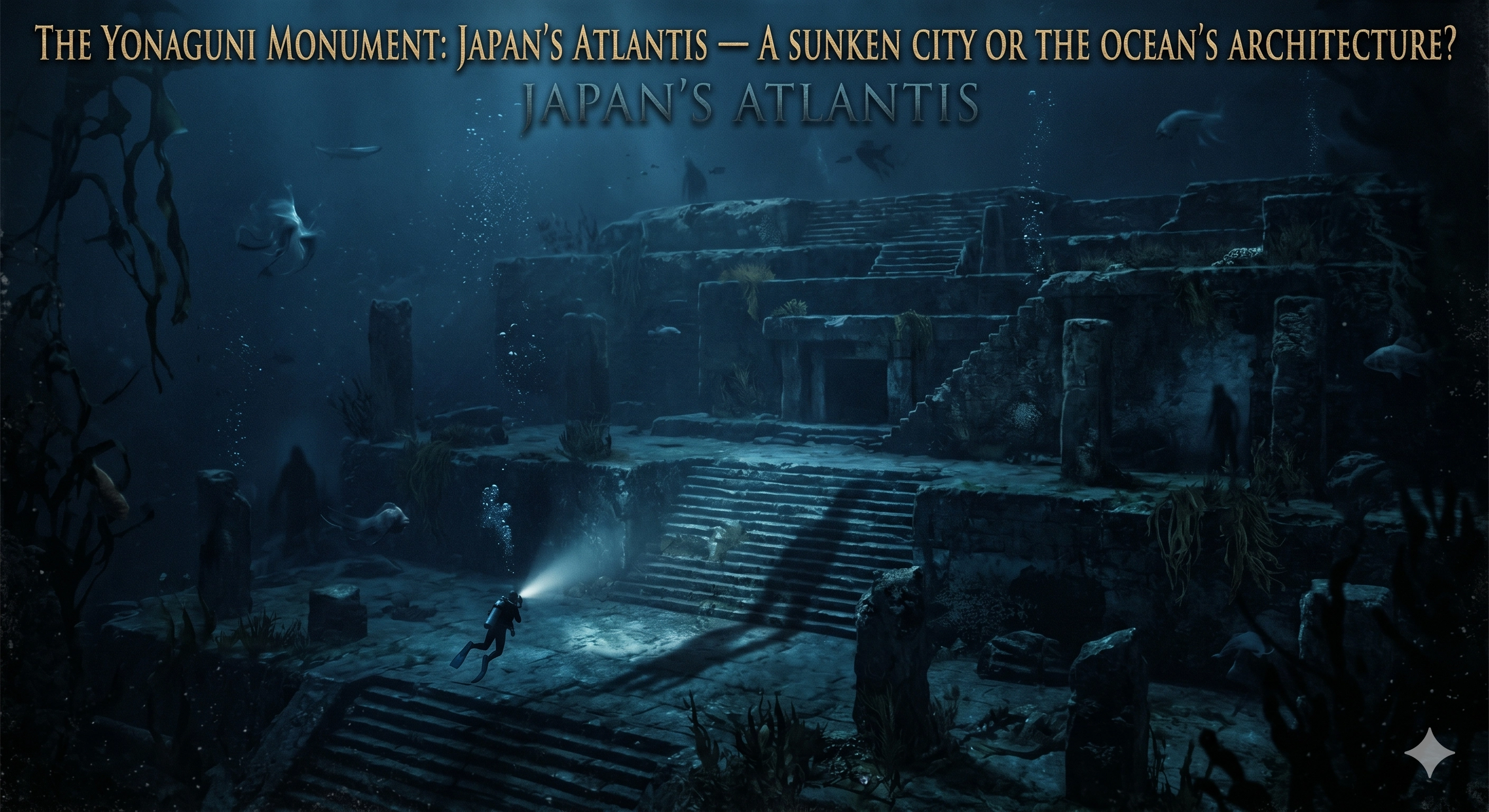
In 1986, a local dive operator named Kihachiro Aratake was searching for new hammerhead shark sites off the southern coast of Yonaguni Island—Japan’s westernmost inhabited island, located approximately 100 kilometers east of Taiwan in the East China Sea—when he discovered something on the ocean floor that should not have been there. Rising 25 meters from the seabed at a depth of roughly 5 to 40 meters, a massive rock formation presented what appeared to be terraced steps, flat platforms, right angles, straight edges, and symmetrical features that looked, to human eyes accustomed to architecture, unmistakably like a building. A stepped pyramid. A monument. A ruin. The Yonaguni Monument, as it came to be known, is approximately 50 meters long, 20 meters wide, and covers around 45,000 square meters including surrounding features. It is composed of fine sandstone and mudstone of the Yaeyama Group, deposited approximately 20 million years ago during the Early Miocene. Most of the rock is connected to the underlying bedrock—it was not assembled from freestanding blocks. Marine geologist Masaaki Kimura of the University of the Ryukyus has spent over 15 years studying the site and believes it is a man-made stepped monolith, possibly dating to 10,000 years ago when sea levels were low enough for the formation to be above water. He identifies quarry marks, carved characters, and animal sculptures in the stone, and connects the site to the mythical lost continent of Mu. Geologist Robert Schoch of Boston University is equally certain the formation is entirely natural: the product of well-defined bedding planes and perpendicular joint sets in sandstone, fractured by earthquakes in one of the most seismically active regions on Earth. He notes that identical formations exist above sea level on Yonaguni’s own coastline. Neither the Japanese Agency for Cultural Affairs nor the government of Okinawa Prefecture recognizes the formation as a cultural artifact. No government research or preservation work has been conducted. The site remains a popular diving destination, where strong currents carry visitors past walls of stone that look—depending on who is describing them—like either the ruins of an impossibly ancient civilization or the masterwork of 20 million years of geology.


Key Facts

CountryJapan
Year1986
TypeUnderwater Anomaly / Disputed Archaeological Site / Geological Formation

Overview

The Yonaguni Monument is the Rorschach test of underwater archaeology. Show someone a photograph of the formation and they will see either a building or a rock—and their answer will tell you more about their relationship with mystery than about the formation itself. The case is genuinely difficult. The features of the Yonaguni formation are, individually, explicable by natural processes: bedding planes create flat surfaces; perpendicular joints create right angles; earthquake fracturing creates steps; erosion smooths and sharpens. Every single feature has a geological explanation. And yet, viewed as a whole, the formation possesses a cumulative geometry that the eye reads as architecture. Steps too regular. Angles too clean. Platforms too flat. The concentration of so many “architectural” features in a single small area is, as Graham Hancock has argued, highly unusual even for sandstone formations. The question is not whether nature can create right angles—it can. The question is whether nature created these specific right angles, in this specific concentration, in this specific arrangement, with this specific appearance of intentional design. And the answer depends on what you consider more extraordinary: that a pre-Jōmon civilization built a monument that predates every known megalithic structure on Earth by thousands of years, or that 20 million years of geology and 20,000 years of sea-level change produced a formation that looks, from certain angles, like a pyramid.
Listen to Case File
~16 min

Timeline

~20 million years ago (Early Miocene)

Sandstones and mudstones of the Yaeyama Group are deposited in the region that will become Yonaguni Island and its surrounding seabed.

~20,000 years ago (Last Glacial Maximum)

Sea level is ~120–130 m lower than present. The area of the Yonaguni Monument is dry land—a coastal or elevated terrain feature.

~14,000–300 BC

The Jōmon culture occupies the Japanese archipelago. They develop the world’s earliest known pottery but have no documented megalithic construction tradition. If the Yonaguni Monument is artificial, the Jōmon are the most likely builders.

~10,000–8,000 years ago

Post-glacial sea level rise submerges the formation. If artificial, this is the latest date by which construction could have occurred.

~3,000–2,000 years ago

Sea level stabilizes near modern levels. The formation is fully submerged at its current depth of 5–40 m.

Pre-1986

Yonaguni Island carries its own folklore: legends of giant serpents, ancient deities, and vanished kingdoms. The island is Japan’s westernmost inhabited land, once considered the border of the known world.

1986

Kihachiro Aratake discovers the formation while diving for hammerhead sharks. He contacts scientists at the University of the Ryukyus. The promontory above the site is unofficially renamed Iseki Hanto (“Ruins Point”).

1986–1990s

Masaaki Kimura begins systematic diving, measuring, and mapping. He initially considers the formation might be natural, but changes his mind after his first dive. He identifies quarry marks, carved characters, and animal likenesses.

1997

Major survey expedition. Kimura presents findings at scientific conferences, arguing for artificial origin. He dates the site to ~5,000–10,000 years ago and connects it to the mythical continent of Mu.

1999

German geologist Wolf Wichmann studies the formation during a Spiegel TV expedition. Concludes it is natural.

2001

Wichmann returns by invitation of Graham Hancock. Reaffirms natural-origin conclusion.

2003

Robert Schoch publishes analysis: the formation is natural sandstone fracturing along bedding planes and joint sets. John Anthony West visits and agrees.

2019

Takayuki Ogata et al. publish topographical analysis comparing the submarine formation to above-sea-level formations on Yonaguni Island. Conclusion: the monument is natural, formed by weathering and erosion acting on bedding and linear joints in sandstone. Similar features confirmed at Sanninudai geosite on the south coast.

Present

The site remains a popular diving destination. The debate continues. No government recognition or protection.
Witness Accounts

Kihachiro Aratake, the diver who discovered the formation, was convinced from the beginning that it was not entirely natural. He believed that if the sea gods themselves had not carved it, then humans must have. His initial impression—of something too ordered, too geometric, too purposeful to be random geology—has been shared by thousands of divers since. Masaaki Kimura has spent more time underwater at the site than any other scientist. He describes returning from each dive more convinced than before that the formation is artificial. He has identified what he interprets as quarry marks—tool scars in the stone—as well as rudimentary characters etched onto flat surfaces and rocks sculpted into animal likenesses. He states: “I think it’s very difficult to explain away their origin as being purely natural, because of the vast amount of evidence of man’s influence on the structures.” Robert Schoch describes an opposite experience: “The first time I dived there, I knew it was not artificial. It’s not as regular as many people claim, and the right angles and symmetry don’t add up in many places.” He notes that photographs tend to present the most regular views, making the formation appear more geometric than it is in person. He interprets Kimura’s “quarry marks” as natural scratches, the “carvings” as pareidolia, and the “walls” as natural platforms that fell vertical when underlying rock eroded. Divers consistently describe an uncanny sense of hovering beside something that feels constructed—colossal walls dropping away into the deep blue, terraces rising in steps, channels that resemble corridors. The experience of being underwater beside the formation is, by all accounts, profoundly affecting regardless of one’s interpretation of its origin.

▶ CINEMATIC SECTIONNarrative Reconstruction

Note: The following presents both interpretations—natural and artificial—based on published research. All claims are sourced from Section 12. I. The Edge of the Known World Yonaguni is the last island. West of it, there is nothing but 100 kilometers of open ocean and then Taiwan. East of it, the chain of the Ryukyu Islands arcs back toward mainland Japan, 1,500 kilometers to the northeast. It is Japan’s westernmost inhabited land—the place where the archipelago ends and the sea begins. The island is small—28.9 square kilometers—and beautiful in the way that remote Pacific islands are beautiful: steep cliffs, dense vegetation, coral reefs, and water that shifts from turquoise to cobalt depending on depth and weather. The human population is roughly 1,700. The hammerhead shark population, in winter, is considerably larger. The Ryukyu Islands sit atop the Ryukyu Arc, a volcanic island chain formed by the subduction of the Philippine Sea Plate beneath the Eurasian Plate. The region is one of the most seismically active on Earth. Earthquakes are frequent and sometimes catastrophic. The underlying geology—layers of sandstone and mudstone deposited 20 million years ago, then uplifted, fractured, and eroded by millennia of tectonic violence and ocean current—is a geology that produces geometry. Flat surfaces. Right angles. Steps. Terraces. The rock breaks along bedding planes (horizontal) and joint sets (vertical), creating blocks that can look, from certain angles, astonishingly like architecture. This is the geological context that skeptics insist must be understood before any claims of artificial origin are entertained. The Yonaguni formation is made of a rock type, in a tectonic environment, that naturally produces the very features that proponents interpret as evidence of human construction. II. The Diver and the Monument (1986) Kihachiro Aratake was not looking for ruins. He was looking for sharks. Yonaguni’s waters are famous among divers for the schools of scalloped hammerhead sharks that gather in winter, and Aratake, a local dive operator, was scouting new sites to bring his clients. What he found, in the shallow waters off the island’s southern tip, was something that did not look like a reef, did not look like a natural rock formation, and did not look like anything he had encountered in decades of diving in the Ryukyu Islands. It looked like a building. A massive, stepped structure rising from the seabed—terraces, platforms, edges, angles—submerged in water so clear that the geometry was visible from the surface on calm days. Aratake contacted scientists. Masaaki Kimura, a marine geologist at the University of the Ryukyus, was among the first to dive the site. His initial reaction was cautious: it might be natural. But the more he saw, the less natural it appeared. The steps were too regular. The platforms too flat. The angles too clean. Over the next fifteen years, Kimura would make hundreds of dives, map every feature, and become the world’s most vocal advocate for the artificial origin of the Yonaguni Monument. III. The Case for Civilization Kimura’s argument rests on several pillars. First, the concentration of geometric features: while individual right angles and flat surfaces occur naturally in sandstone, Kimura argues that the density of such features at Yonaguni—steps, platforms, channels, walls, and apparent carvings packed into a single formation—exceeds what natural processes would produce. Second, the absence of loose debris: if the steps and platforms were created by natural fracturing and erosion, Kimura argues, the surrounding seabed should be littered with broken blocks and rubble. Instead, the flat areas are relatively clean. Third, specific features that Kimura interprets as tool marks, carved characters, and animal figures—a turtle, a bird, a face—sculpted into the rock. Fourth, the existence of what appears to be a road: a long, straight channel flanked by vertical walls that resembles a processional pathway. If the monument is artificial, it must have been built before the sea level rose to submerge it—approximately 10,000 to 8,000 years ago. The only culture present in the Japanese archipelago during this period was the Jōmon, the pre-agricultural hunter-gatherers who are credited with producing the world’s earliest known pottery (dating to approximately 14,000 BC). The Jōmon left no evidence of megalithic construction—no known stone structures, no quarrying tools, no architectural tradition. If they built the Yonaguni Monument, it would predate every known megalithic structure on Earth by thousands of years, including Göbekli Tepe (c. 9500 BC), which is currently considered the oldest known monumental construction. Graham Hancock, who has featured the Yonaguni Monument prominently in his books and media appearances, argues that this is precisely the point: the existence of the monument is evidence for a lost civilization that predates the known archaeological record. “It was the submerged structures of Japan that first awakened me to the possibility that an underworld in history, unrecognized by archaeologists, could lie concealed and forgotten beneath the sea.” IV. The Case for Geology Robert Schoch’s counter-argument is equally systematic. The sandstone of which the monument is composed is riddled with parallel bedding planes and vertical joints. This is a known geological feature of sandstone in seismically active regions. Earthquakes fracture the rock along these planes, creating the stepped, terraced appearance. The flat surfaces are bedding planes. The right angles are joints. The channels are erosion features. The absence of debris is explained by the strong currents that sweep the site. In short, every feature that Kimura interprets as artificial, Schoch interprets as natural. He points to identical formations above sea level on Yonaguni Island as proof that these are natural geological structures. V. The Intermediate Hypothesis There is a third possibility: that the formation is natural, but was modified by humans. Schoch himself allows for this. Perhaps the Jōmon people, or some earlier culture, discovered this unusual natural formation and used it, enhanced it, or minimally modified it for their own purposes. They might have smoothed some of the steps, carved some of the symbols Kimura claims to have found, or used the flat platforms for rituals. This would explain the architectural appearance without requiring a lost civilization with advanced construction capabilities. The problem with this hypothesis is that it is nearly impossible to prove. The subtle marks of human modification would be nearly impossible to distinguish from natural processes after 10,000 years of submersion, erosion, and biological activity. This intermediate position is perhaps the most intellectually honest—and the least satisfying to either side of the debate. Believers want a lost civilization. Skeptics want unambiguous geology. The formation offers neither certainty, only the enduring discomfort of a rock that looks too much like a building and a building that cannot be proven to exist. VI. The Ocean’s Architecture To dive at the Yonaguni Monument is, by every account, to experience something that transcends the geological-versus-artificial debate. The formation is enormous. The water is clear. The currents are strong. You hover beside walls that drop 25 meters into blue shadow. You swim along terraces that stretch to the limits of visibility. You turn a corner and find a flat platform that looks like a plaza, a channel that looks like a corridor, a triangular formation that looks like a ceremonial stage. The experience is not neutral. The human brain is an architecture-detecting machine. We see buildings everywhere: in clouds, in rock formations, in the arrangement of trees. The Yonaguni formation triggers this detection system with extraordinary force. Whether the detection is accurate—whether the brain is correctly identifying something built by humans—or whether it is a false positive, triggered by a geological formation that happens to match the patterns the brain associates with construction, is the question that 38 years of investigation have not resolved. The ocean does not care about the debate. It shaped this stone—or it preserved what humans shaped—with the same indifference. Twenty million years of deposition, twenty thousand years of exposure, ten thousand years of submersion. The currents continue to move across the surface. The hammerhead sharks continue to gather in winter. And the monument—natural or artificial, ruin or rock, architecture or geology—continues to wait, 25 meters below the surface of the East China Sea, for someone to prove what it is. No one has. Perhaps no one can. And perhaps that is the monument’s deepest lesson: that the line between nature and design is not as clear as we would like, and that the ocean, which has been building things for longer than any civilization, does not owe us the courtesy of making its work look different from ours.

Evidence

Physical: Submerged rock formation confirmed by multiple diving expeditions and surveys. Composed of Yaeyama Group sandstone/mudstone (~20 million years old). Connected to underlying bedrock (not assembled). Features: stepped terraces, flat platforms, right angles, channels, triangular forms. Geological: Identical formations exist above sea level on Yonaguni Island (Sanninudai, Tindabana, Kube Ryofurishi). 2019 Ogata et al. study confirms natural origin via bedding planes and joint sets. Region is seismically active (Ryukyu Arc subduction zone). Artificial-Origin Claims: Kimura: quarry marks, carved characters, animal sculptures, absence of loose debris, concentration of geometric features. None independently verified. Described as pseudoarchaeological by mainstream geologists. Archaeological Context: No Jōmon megalithic tradition documented. No quarrying tools, no stone construction, no architectural tradition in the period when the formation would have been above water. Would predate Göbekli Tepe by millennia. Government Position: Neither Japanese Agency for Cultural Affairs nor Okinawa Prefecture recognizes the site as cultural artifact. No government research or preservation.

Share This Archive

Community Verdict

Community Verdict